While the regulatory spotlight remains on the United States, Ripple has decided to win the battle on the international stage. It's not just about physical expansion; it's about market capture, which is already reflected in increasing buying pressure.
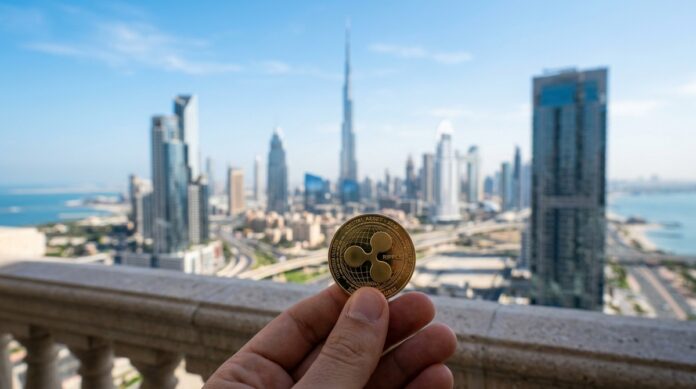
Ripple is strengthening its international presence. It recently opened a new regional headquarters in the Dubai International Financial Centre (DIFC)consolidating its presence in the Middle East and Africa, a region where interest in blockchain-based payment and custody solutions continues to grow.
This expansion represents a further step in the legal legitimization process that the company began in March 2025, when it became the first payment service provider with a full license granted by the Dubai Financial Services Authority (DFSA).
Operating within a strict yet clear regulatory framework, Ripple's infrastructure is positioned as the preferred technical option for entities such as Zand Bank, Garanti BBVA, and Absa Bank. This new office allows for doubling the local operations team, facilitating the management of institutional demand seeking to move away from the regulatory opacity of other jurisdictions.
Dubai catapults Ripple's stablecoin into the financial center
In Dubai, Ripple found the environment it needed to move forward steadily. The approval granted by the DFSA within the DIFC not only validates its technology but also opens the door for its stablecoin. RLUSD operates as a recognized asset within a regulated framework.
This development positions Ripple strategically within one of the world's most active financial centers. Regulatory validation allows RLUSD to operate with legal backing, essential for financial institutions to integrate blockchain-based solutions without compromising their internal standards. In this context, the stablecoin transcends being a mere digital tool and becomes a reliable channel for facilitating liquidity across different jurisdictions.
The DIFC offers an environment where financial operations can be conducted securely and predictably. Therefore, banks and other institutions find it possible to manage international payments and custody services more efficiently, reducing operational frictions that often hinder the adoption of new technologies. This type of infrastructure fosters an orderly transition to more agile systems, where innovation aligns with regulatory requirements.
Thus, while barriers still persist in other markets, Dubai has allowed Ripple to consolidate a comprehensive offering that encompasses from custody to near-instant settlement using its native assets RLUSD and XRPThis is a complete integration that makes it easier for financial institutions to operate within an environment that prioritizes transparency and regulatory compliance.
As part of this expansion, the company stressed that the opening of his new office will allow him “To double the size of existing operations and thus meet growing regional demand.”
Japan promotes the actual use of XRP
While Dubai secures the institutional front, Japan has become the laboratory for mass adoption by end users. Through the integration with Rakuten Wallet—announced a few days ago—approximately 44 million users now have the ability to convert their loyalty points into XRP for use at 5 million retail locations. This technical move shifts the asset's value from candlestick charts and into everyday consumption.
According to analyst Daniel Markson, social sentiment towards Ripple's native token has reached its peak. highest point in 2 yearsnot through a speculative narrative, but through a tangible utility that the average citizen can experience when making a purchaseThis bridge with the Japanese fintech ecosystem generates constant usage pressure that stabilizes the perception of the asset as a tool for exchanging value.
However, despite this solid progress in the fundamentals of the Ripple ecosystem, the behavior of the XRP price continues to reflect a phase of technical compression that suggests an imminent resolution.

XRP in a key zone: the market awaits its next big move
Earlier this month, cryptocurrency analyst Ali Martinez noted that XRP's daily charts show the formation of a symmetrical triangle patternThis structure often precedes high-volatility movements. The expert's analysis suggests that the area between $1,35 and $1,45 is currently acting as a neutral zone where the risk of false breakouts is high.
According to Martinez, a daily close above the resistance at $1,45 This could project the cryptocurrency's price to higher levels, such as $1,82 per unit, representing a 26% increase. Conversely, the loss of Support at $1,35 This would invalidate the bullish structure of XRP, with a corrective target close to dollar parity.
This convergence between real utility in Asia and institutional strength in the Middle East places Ripple in an unprecedented position. Although technical analysis of XRP suggests caution in the short term, the bridges built with the banking and retail sectors provide a base of adoption that, sooner or later, will put pressure on the asset's supply in global markets.