Circle, the company that issued USDC, is taking a strategic step with the launch of Arc, a blockchain designed specifically for payments, tokenized assets, and institutional finance. This move aims to solidify its position in an ecosystem where financial giants are showing increasing interest in crypto technology.
The Arc ecosystem and its institutional approach
The evolution of the crypto ecosystem is moving decisively towards integration with traditional finance. In this context, Circle introduces the Arc blockchainA technological infrastructure aimed at optimizing global payments and the management of tokenized assets. According to the company's CEO, Jeremy Allaire, this development could have an even greater long-term impact than its own stablecoin, providing the foundation for a new generation of financial applications designed to operate on a global scale.
Unlike general-purpose networks, specialized blockchains or app-chains They allow adjusting consensus parameters and fees to meet very specific use cases. In the case of Arc, the goal is to offer an environment where institutions can settle transactions in real time, reducing the friction that typically characterizes cross-border banking systems.
Beyond $74.000 billion
To date, the company's success has been primarily built on USDC, a digital asset that has reached a market capitalization of $74.000 billion (approximately €68.500 billion). This enormous liquidity has positioned the company as a key player in the sector. However, the creation of its own network indicates a clear strategy to capture the value of the underlying transactions and offer an environment tailored to the stringent requirements of banks and large corporations.
Having such a large user base and liquidity provides a significant competitive advantage when it comes to driving the adoption of a new network. If you want to delve deeper into the technical workings of distributed networks and how they manage value, you can explore the free educational resources at Academy.
Tokenization and the future of payments
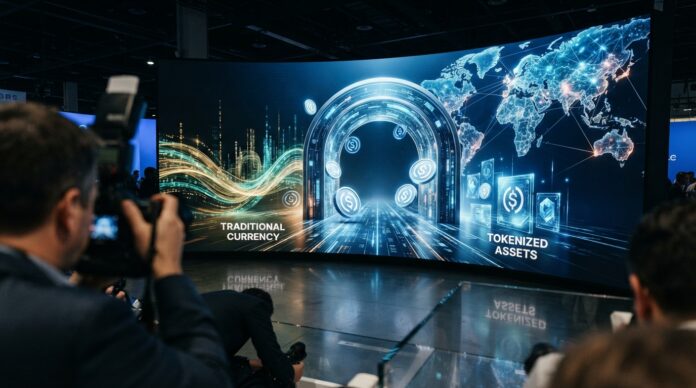
Real-world asset tokenization (RWA) is one of the most compelling narratives today. Arc was created to facilitate the issuance and exchange of these assets in a transparent and compliant environment. From government bonds to money market funds, the ability to represent traditional value on a blockchain opens the door to more efficient and accessible markets.
In regions like the European Union, the MiCA Regulation provides the necessary legal clarity for these types of technological innovations to develop with known and managed risk. This regulatory framework is essential for attracting institutional players who require high standards of compliance, auditing, and transparency before integrating crypto technology into their daily operations.
Competition in the institutional sector
The interest of traditional financial institutions in blockchain technology is undeniable, and the stablecoin market has become the main bridge between these two worlds. The arrival of specialized networks like Arc responds to the need for scalable infrastructures that can support high volumes of transactions without compromising security or decentralization.
For users looking to understand how to build their portfolio for the long term, understanding the evolution of these networks and the role of issuing companies is crucial. The ecosystem is rapidly moving towards more sophisticated solutions, and you can follow the latest industry developments at news.bit2me.com to keep you up to date on technological and regulatory developments.
FAQ
What is the Arc blockchain?
Arc is a blockchain network developed by Circle, specifically designed to facilitate global payments, institutional finance, and the issuance of tokenized assets in an environment optimized for large transaction volumes.
What is Arc's relationship with USDC?
Both were created by the same company. While USDC is a stablecoin used as a medium of exchange and store of value, Arc is the network infrastructure upon which financial applications can be built and payments processed natively.
Why is tokenization important in this context?
Tokenization allows real-world assets to be represented on a blockchain, facilitating their transfer and reducing operating costs. Networks like Arc aim to provide the necessary technological support for institutions to adopt this innovation efficiently and in a regulated manner.
The development of proprietary infrastructure by established companies in the crypto sector marks a turning point in institutional adoption. The investment in specialized networks demonstrates that blockchain technology continues to mature, meeting the scalability and compliance demands of the global financial system.
As the regulatory framework consolidates in different jurisdictions, the integration of advanced technological solutions could redefine the standards of efficiency and transparency in international payments and digital asset management in the coming years.
Investing in cryptoassets is not fully regulated, may not be suitable for retail investors due to high volatility and there is a risk of losing all invested amounts.
Generative artificial intelligence tools were used to create this article.