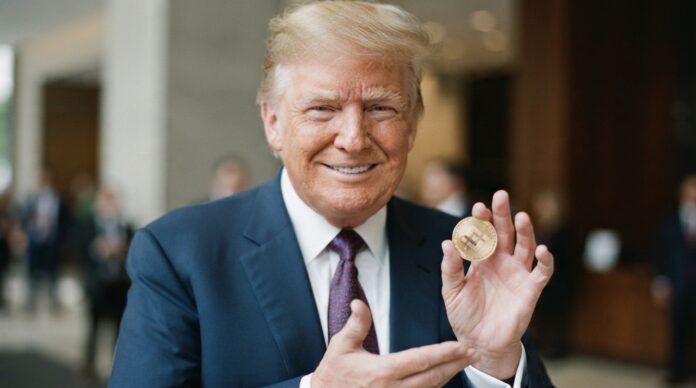
The Donald Trump-linked WLFI token allocation, valued at approximately $800 million, has entered a consolidation agreement. This on-chain transaction establishes a formal timeline that blocks any potential sale of these crypto assets until May 2028, following a mandatory 10% token burn for participants in the plan.
The new consolidation schedule for WLFI tokens
The crypto ecosystem is based on blockchain transparency, and the recent movements of wallets linked to World Liberty Financial (WLFI) are a clear example of this. According to the recorded data, the allocation of WLFI tokens by the founders entered into a consolidation contract in May, establishing for the first time a defined timeline for these assets to become liquid.
One of the main wallets, which matches the disclosed allocation for President Donald Trump, holds approximately 14.175 billion WLFI tokens after complying with the rules of the new contract. At the current price of the asset, this amount represents a value of close to $800 million. While this figure is striking, the design of the smart contract prevents these funds from being transferred or liquidated immediately, thus providing predictability to the token's circulating supply.
Contract mechanics: Two-year cliff and 10% burn
To understand how this lock works, it's crucial to analyze the technical conditions that the project community approved in early May. The proposal, supported by 11.537 wallets, offered founder token holders the option to exchange an indefinite lock for a structured schedule. Those who chose not to participate keep their tokens locked without a release date.
For those who accepted the new model, the contract stipulated one non-negotiable condition: the immediate destruction of 10% of their tokens upon entering the program. In the case of the main wallet, 15.750 billion WLFI were initially transferred, leaving the aforementioned 14.175 billion after the burn. This supply reduction mechanism is a common practice that you can study in depth at [link to relevant documentation]. Bit2Me Academy, as it is often used to align the creators' incentives with the long-term health of the protocol.
In addition to the burning, the contract imposes a cliff (grace period) of two years. This means that the first token release will not occur until May 2028. After that date, the assets will not be released all at once, but will continue to be released gradually over the following three years. This structure mitigates the risk of a sudden sell-off flooding the market.
Political and regulatory context: The Clarity Act
The establishment of this timeline coincides with a period of intense regulatory debate in the United States. The latest version of the Clarity Act includes stricter ethics rules that would require senior government officials with significant holdings in crypto assets to divest those holdings or place them in a qualified blind trust.
Although Trump reportedly accepted this new provision to facilitate the bill's passage through the Senate, on-chain data suggests that WLFI's consolidation contract was executed months before the final text of the Clarity Act emerged. In Europe, the regulatory approach has taken a different but equally transparent path through the MiCA Regulation, which aims to standardize rules for token issuers and service providers, ensuring that users operate in an environment with known and managed risk.
Impact on founders' portfolios and the market
Managing large treasuries and founder allocations is one of the most scrutinized aspects of any crypto project. Records show that six internal wallets moved 30 trillion WLFI tokens into the new consolidation contract. Two of these wallets transferred 3.750 billion tokens each, while the other three contributed 2.250 billion each.
Until the implementation of this agreement, Trump's founder tokens had no set timeline for becoming liquid. While they held significant face value, there was no date set for their conversion into cash. It's worth noting that, according to previous financial disclosures, Trump's cryptocurrency-related revenue already included approximately $515 million derived from the sale of WLFI tokens issued by the company to third parties.
The use of smart contracts to automate and enforce these rules demonstrates the technological maturity of the sector. By using a Wallet Secure and interacting with audited contracts, projects can ensure that issuance and locking rules are met transparently and without manual intervention, a standard increasingly demanded by market participants.
FAQ
What is a vesting or consolidation agreement?
It's a smart contract that locks up a specific amount of cryptocurrency and releases it gradually according to a predetermined schedule. Its purpose is to prevent founders or early investors from selling all their tokens at once, thus protecting the project's long-term stability.
How many WLFI tokens does the main wallet linked to Trump hold?
After accepting the terms of the new contract and implementing the mandatory burn, the main wallet holds 14.175 billion WLFI tokens. This amount matches the publicly disclosed founder's allocation for the US president.
What does the grace period or cliff until 2028 mean?
The cliff is an initial period during which no tokens are released. In this case, the contract establishes a total two-year lock-up, meaning that holders will not be able to move or liquidate their assets until May 2028, at which point a three-year phased release will begin.
Why was a 10% token burn required?
Token burning involves sending crypto assets to an inaccessible address, permanently removing them from the circulating supply. In this project, it was the requirement approved by community governance to allow the founders to replace their indefinite lock-up with a schedule of specific release dates.
The implementation of strict consolidation schedules reflects a growing trend toward accountability and long-term planning in tokenomics design. By setting 2028 as the earliest possible timeframe for releasing these assets, the community and market are provided with a clear and verifiable roadmap directly on the blockchain.
As global regulation evolves and demands greater clarity, on-chain tools like vesting agreements are becoming essential mechanisms. These systems not only automate compliance with agreements but also build a more structured ecosystem where the rules are public, immutable, and equally applicable to all participants.
Investing in cryptoassets is not fully regulated, may not be suitable for retail investors due to high volatility and there is a risk of losing all invested amounts.
Generative artificial intelligence tools were used to create this article.