

MATIC, the token of Ethereum’s layer-two solution Polygon, has seen its value grow by 80% in the past week, driven by mass adoption from users and other projects.
The MATIC token, from the project Matic Network, began to experience significant growth in its value after the protocol announced its change to Polygon, to present itself as a second layer protocol to boost the scalability of the blockchain de Ethereum.
According to CoinGecko data, this token has grown by more than 80% in value over the past week, going from being worth $0,31 per unit to over $0,57 at the time of writing. MATIC hit a new all-time high on Tuesday, worth $XNUMX per unit. $0,59.
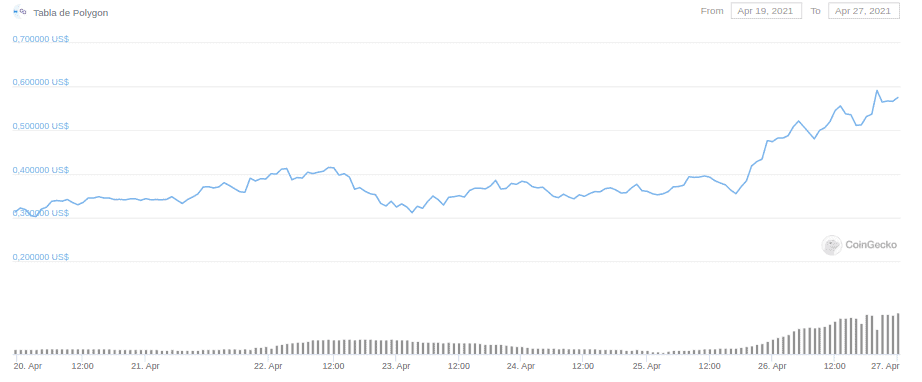
Source: CoinGecko.
Over the past year, MATIC has seen growth of over 3.500%. The value of this token is growing as more users, investors, and projects explore the layer 2 scalability solutions it offers for the Ethereum network, keeping it competitive against the many options on the market. MATIC is the only native token on the network, and plays a critical role in the operation and security of the network.
This protocol makes Ethereum a more interoperable and scalable blockchain for the development of innovative projects, minimizing the gas problems that the main network currently suffers from, which make it inaccessible to users and investors with small wallets. The development and evolution that this protocol has had since its creation as Matic Network, until its change of focus as Polygon, led it to be considered today as “The Ethereum Internet of Blockchains”.
Since its shift in focus, Polygon’s ecosystem has grown significantly in just a few weeks.
It may interest you: The Berlin update goes live on the Ethereum blockchain
Boosting the DeFi ecosystem
So far, the most well-known and important protocols of DeFias the Aave, pooltogether, Sushiwap, OpenSea, CurveFinance y Decentraland, have integrated Polygon.
This protocol offers an effective solution to Ethereum's gas and scalability problems, which are becoming more pronounced as decentralized finance ecosystems continue to grow in adoption and liquidity. The large number of users and investors currently demanding the Ethereum network to operate in DeFi causes it to become congested and, therefore, commission fees to increase.
Polygon’s integration with several of the industry’s most popular DeFi protocols, which are built on the Ethereum blockchain, allows them to remain attractive to investors and users in general.
Polygon is capable of processing between 7.000 and 10.000 transactions per second (TPS), thanks to Plasma, a scalability solution that allows for the creation of secondary chains that periodically send snapshots of their states to the Ethereum main chain. In addition to Plasma, Polygon is also developing other second-layer blockchains for Ethereum, which use the potential of zk-Rollups and Optimistic Rollup to become even more scalable.
Interoperability between blockchains
In addition to improving the scalability of the network, Polygon wants to make Ethereum a highly interoperable network with other blockchains, considering that the future of this technology lies in the possibility that users and projects can interact with various networks that coexist at the same time.
Polygon offers state-of-the-art cross-chain communication and data availability solutions to enable this interoperability between Ethereum and other blockchain networks, transforming the network into a complete multi-chain system, on par with third-generation blockchains such as Polkadot and Cosmos.
Continue reading: Decentraland allows value to be moved with its $MANA token between Ethereum and Polygon