
Discover how the record number of digital transactions in Latin America is redefining commerce. We analyze the trends that will dominate the region's payments ecosystem in 2026.
The figure is as compelling as it is revealing. The record of nearly $1,5 trillion in digital asset transactions in Latin America is not just a market statistic, but a symptom of a structural transformation in how the continent interacts with money.
Chainalysis, one of the leading blockchain analytics firms in the market, cites in its report “Latin America Emerges as a Crypto Powerhouse Amid Volatile Growth” that, what began as a refuge from monetary instability In specific corners of the region, it has now consolidated itself as a robust ecosystem that challenges the boundaries of the traditional financial system and sets the roadmap for what we will see for the rest of 2026.
According to their analysts, this massive volume of capital allows us to glimpse a reality where blockchain infrastructure functions as the backbone of cross-border paymentsThe maturity of the Latin American market is manifested through a fascinating duality: while nations like Brazil are leading the way in institutional integration with established banks, other markets are using stablecoins as an essential defense mechanism against the loss of purchasing power. This diversification of digital asset usage suggests that, by the end of this year, adoption will be measured by the efficiency of the networks in instantly liquidating value.
Looking to the immediate future, the lessons learned from this data point to a invisibility of technologyThe average user in 2026 will no longer be concerned with understanding the technicalities of distributed ledgers, but rather with the convenience of a remittance that arrives in seconds or savings that don't evaporate with inflation. We are witnessing the transition from niche wallets to financial super-apps, where the digital dollar and local currencies coexist in an invisible architecture that promises to make payments in Latin America a much fairer, faster, and more globalized process.
Trade cryptocurrencies on Bit2MeStablecoins redefine the use of crypto assets in Latin America
Chainalysis' regional crypto adoption report reveals that Brazil It has positioned itself as the undisputed engine of Latam with $318.800 billion received during 2025. However, the fact that really transforms the narrative for 2026 is the origin of that flow.
Chainalysis analysts confirm that Brazil's growth, exceeding 100% in the last year, stems from deep integration with traditional banking. Entities like Itaú and neobanks such as Nubank and Mercado Pago have blurred the line between conventional finance and the crypto world. For today's Latin American user, the use of digital assets occurs within the banking applications they already know, eliminating the friction of external platforms and strengthening institutional trust.
The financial structure observed in Brazil is primarily based on use of stablecoinswhich in markets like Brazil already represent more than 90% of total crypto transaction flows.
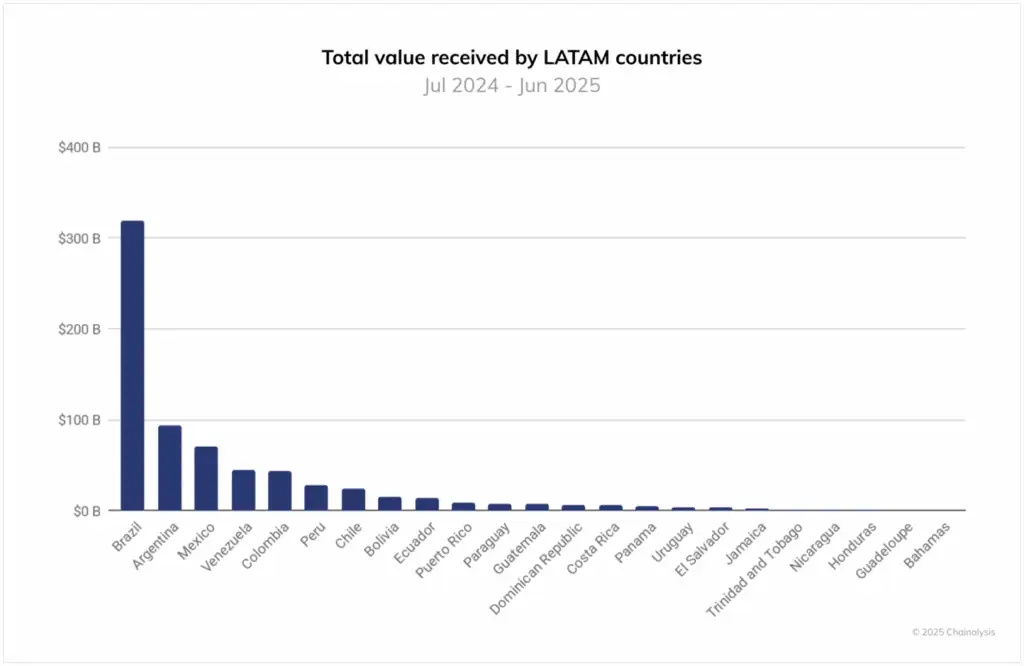
Source: Chainalysis
Additionally, in contexts of high inflation such as that of Argentina, with $93.900 billion transacted, or the one of VenezuelaWith $44.600 billion, analysts at the firm emphasize that these dollar-linked currencies function as a parallel savings and trading system.
Currently, more than half of cryptocurrency purchases made with Venezuelan bolivars, Colombian pesos, Argentine pesos, or Brazilian reais are for stable-value cryptocurrencies. Based on this, analysts emphasize that the future of payments in the region has shifted away from the volatility of Bitcoin and towards [the following sentence appears to be incomplete and possibly unrelated: "the future of payments in the region has shifted away from the volatility of Bitcoin to focus on the..."] digital dollarization of the daily economy, turning stablecoins into an invisible but ubiquitous infrastructure.
Blockchain is transforming money transfers and payments in the region
In addition to the use of stablecoins in everyday payments, the sending money via blockchain It has also become a daily practice that is redefining how capital flows between countries in the region and the world. The figures support this shift, with monthly volumes reaching $87.700 billion, demonstrating a robust market far from any experimental phase.
The rise of digital remittances This has had a direct impact on commerce and day-to-day financial transactions. The available liquidity and market depth allow many retail businesses to manage their payments on blockchain infrastructure, significantly reducing the costs associated with intermediaries. Thus, this process, which previously involved multiple steps, waiting times, and high fees, is now executed more efficiently and predictably thanks to blockchain technology and cryptocurrencies.
Another important point that reveals the Chainalysis report The fact is that, in Latin America, user behavior sets it apart from other regions. While decentralized finance (DeFi) is gaining ground in some markets, in this region Most activity is concentrated on centralized platformsApproximately 64% of cryptocurrency transactions are carried out through these services, where users particularly value trust, customer service, and ease of access and use.
In short, this reality of preferences among Latin American users has driven the consolidation of these platforms as key players within the regional financial system. Beyond the exchange of digital assets, many already integrate solutions for payroll payments, public services y daily transfers.
As the crypto ecosystem expands across Latin America, the use of cash is declining. According to Chainalysis, this shift positions blockchain technology as a new financial efficiency standard in the region, reducing costs and facilitating unprecedented capital mobility.
Trade stablecoins here