
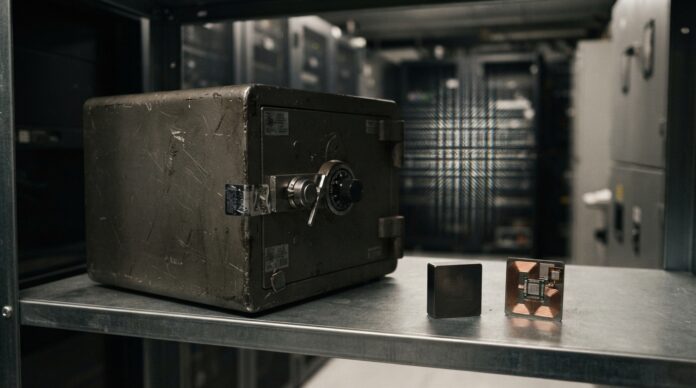
The Ethereum-compatible network Monad proposes a structural change to the security of crypto wallets. The goal is to allow users to replace their private keys without changing their address, thus preparing for the future threat of quantum computing and facilitating account recovery.
Monad's proposal to update security
The Monad network, an Ethereum-compatible blockchain designed for high-speed transaction processing, proposes a structural change to the security of crypto wallets. The document suggests separating a wallet's permanent address from the cryptographic credentials that control it.
Historically, in the blockchain ecosystem, your public address and private key are mathematically inextricably linked. If you lose access to that private key, you lose control over the assets stored at that address. The new architecture proposed by the developers of Monad seeks to break this limitation, allowing users to replace lost or outdated keys without having to abandon their original address or transfer their funds to a new account.
This development didn't come out of nowhere. The team behind Monad has captured the industry's attention after closing significant funding rounds that support its research into complex infrastructure solutions, with the potential to redefine security standards in the industry.
How does key and address separation work?
In the early days of the crypto ecosystem, custody relied on methods such as writing seed phrases on paper or using specialized hardware. While these methods remain valid, they have a single point of failure: human error. If the paper is destroyed or the device is lost along with its backup, the assets become inaccessible forever.
Monad's proposal introduces a native abstraction layer. By decoupling account identity (the address you share to receive funds) from authentication logic (the key you use to sign transactions), a range of possibilities opens up. If you suspect your private key has been compromised, you could simply update it, keeping your public address unchanged. This technical flexibility paves the way for integrating modern authentication methods, such as biometric passkeys.
The threat of quantum computing to the crypto sector
One of the main drivers behind this initiative is preparing for future technological threats. Quantum computing poses a long-term challenge to traditional cryptography. Quantum computers have the theoretical potential to solve complex mathematical problems at speeds unattainable for classical computing.
The adoption of post-quantum signature schemes will eventually require users to migrate their keys. Thanks to this approach, this transition could be carried out without the need to rebuild entire portfolios or manually move funds.
In conclusion, Monad's proposal marks a crucial step towards greater resilience and usability in the blockchain space, paving the way to safeguard digital assets against the computational evolution of the coming decades.
Investing in cryptoassets is not fully regulated, may not be suitable for retail investors due to high volatility and there is a risk of losing all invested amounts.
Generative artificial intelligence tools were used to create this article.