
BlackRock's Bitcoin spot ETF, the iShares Bitcoin Trust (IBIT), has surpassed the company's gold exchange-traded fund, the iShares Gold Trust (IAU), in terms of assets under management.
The Bitcoin and cryptocurrency market has seen exponential growth in recent days, setting one of the most important milestones in its history and confirming that Bitcoin is a legitimate and viable investment asset.
Recently, BlackRock’s Bitcoin spot ETF ranked above its gold ETF, an achievement that reflects the growing popularity of Bitcoin and investor confidence in digital assets. According to the company’s data, IBIT holds around $34.340 billion in assets under management, while IAU holds around $32.950 billion, as of today.
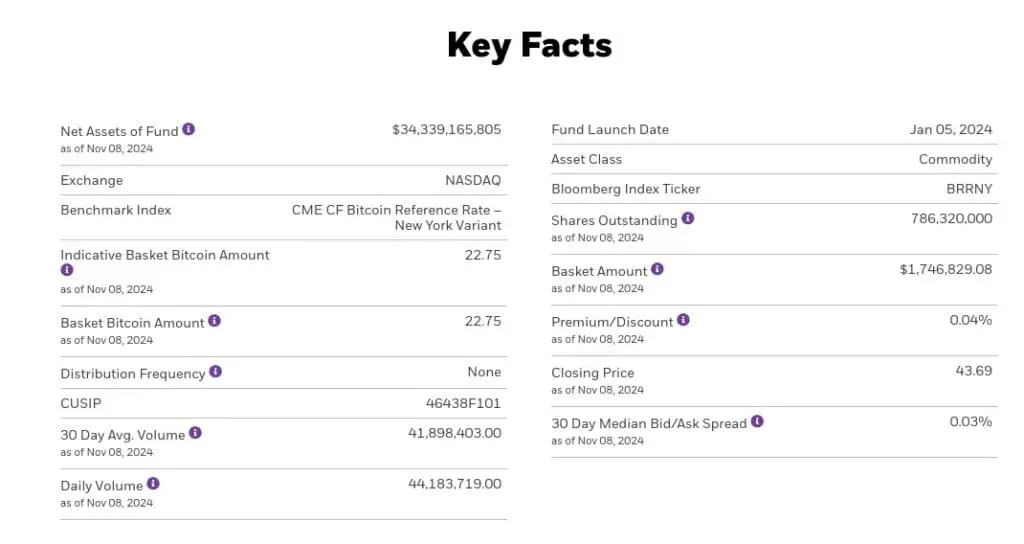
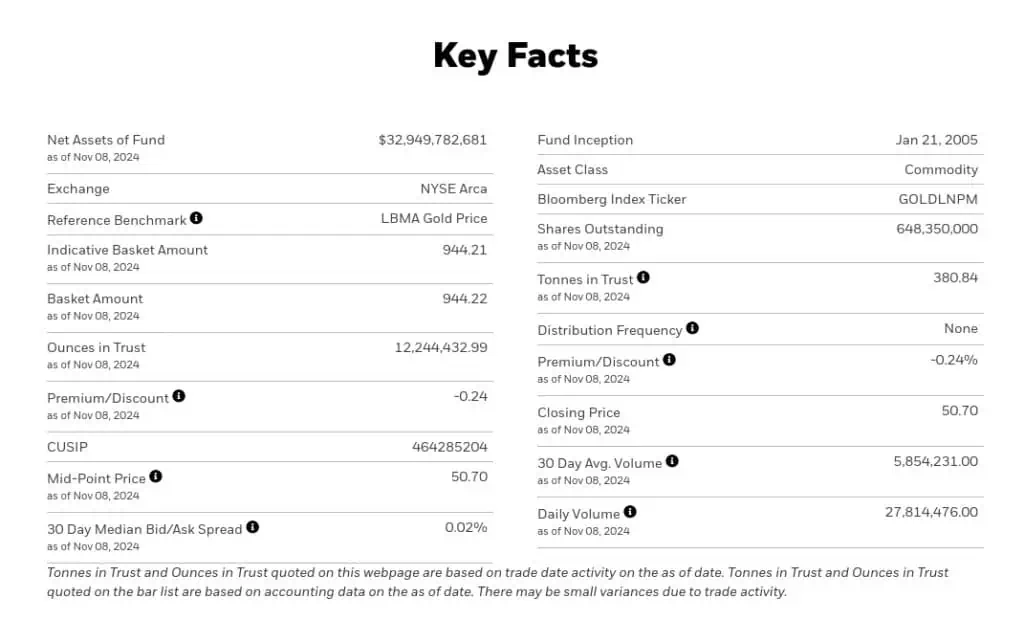
Source: BlackRock
BlackRock sets a milestone in the cryptocurrency market
Since its approval by the Securities and Exchange Commission (SEC) in the United States, BlackRock’s Bitcoin spot ETF, known as IBIT, has shown impressive growth, reaching an AUM of approximately $34.340 billion, and positioning itself as the company’s largest ETF. This turnaround has occurred in a record time of just ten months, since the ETF was approved by the SEC in the United States.
The speed with which IBIT has achieved this growth is remarkable. To put it into perspective, market experts have pointed out that it took BlackRock's gold ETF, IAU, almost two years to reach similar figures.
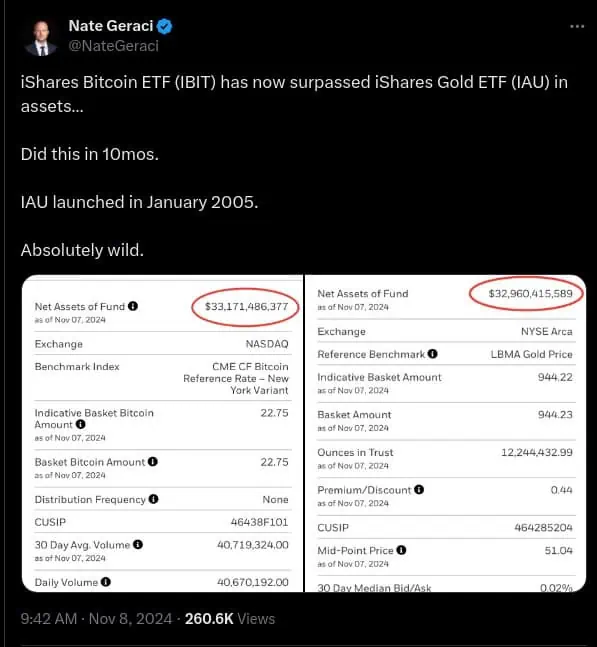
Nate Geraci, president of ETF Store, called IBIT's growth “absolutely wild.” In January, before the SEC gave the go-ahead for Bitcoin spot ETFs to be listed on the U.S. market, Geraci argument that these financial instruments would break all historical launch records established in the traditional market and, it seems, that their predictions have been coming true.
Bitcoin price at new ATH and its impact on IBIT
The success of IBIT, in addition to the massive and unprecedented influx of capital that this fund has attracted, is also related to the price increase that the cryptocurrency has been experiencing in recent days, driven by the election results in the United States.
In the past week alone, Bitcoin has set and also surpassed new all-time highs or “ATHs,” with the current ATH being $77.252,75. This ATH was set on November 8, 3 days after the US presidential election, in which Donald Trump was declared the winner.
Experts have noted that the cryptocurrency's price surge has been key for IBIT. As the price of BTC has reached new highs, the spot ETF has attracted more investors, significantly increasing its AUM. Last Thursday, the Bitcoin ETF recorded net inflows of over $1.100 billion, marking a new all-time high. In total, IBIT has accumulated more than $27.390 billion in net inflows of capital since its launch, making it one of the most successful ETFs of 2024.
Competition in the ETF market
As for IAU, BlackRock's gold exchange-traded fund, launched in 2005, has traditionally been one of the largest and most trusted ETFs in the world. However, the recent trend shows that investors are starting to see Bitcoin not just as a cryptocurrency, but as an increasingly attractive alternative, even superior to gold. Therefore, the success of IBIT is not only a reflection of Bitcoin's growth, but also a sign of the competition in the ETF market.
The approval of IBIT has opened a new door for investors looking to gain exposure to Bitcoin without having to buy and store the cryptocurrency directly. This model has proven to be attractive to a wide range of investors, from those with experience in cryptocurrencies to new investors looking to diversify their portfolios with digital assets.
Furthermore, the anticipation of a more favorable regulatory environment for cryptocurrencies in the United States under the Trump administration has encouraged many investors to diversify their portfolios towards Bitcoin and cryptoassets.
In short, IBIT's growth is not only an indicator of confidence in Bitcoin, but reflects a fundamental shift in how investors perceive and value cryptocurrencies versus traditional assets like gold.