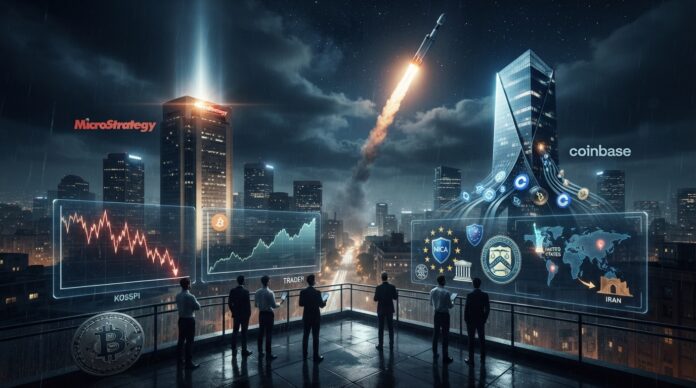
South Korea's KOSPI stock index is currently experiencing higher daily fluctuations than Bitcoin. While the traditional Asian market is undergoing significant volatility driven by the technology sector and the heavy use of derivatives, the leading cryptocurrency is maintaining relative stability, defying historical perceptions of its behavior in financial markets.
This dynamic presents a revealing scenario for those seeking to build their portfolio, demonstrating that traditional stock markets can also face extreme turbulence and trading suspensions, redefining the concept of stability in the contemporary economy.
The data behind the crypto calm and the stock market storm
Analysis of market behavior over the past few months reveals surprising figures that shatter traditional myths. Since the beginning of June, The South Korean benchmark index has fluctuated by an average of 3,8% dailyThis figure far exceeds the 1,7% recorded by BTC during the same period. This difference is not an isolated event lasting only a few days, but rather marks a sustained trend that prompts reflection on the maturity of the different assets.
If we broaden the perspective to a twelve-month timeframe, the annualized volatility of the KOSPI has climbed to 57%, surpassing Bitcoin's 47%. Historically, the crypto ecosystem has been labeled by traditional analysts as a highly volatile environment. However, current data demonstrates that when evaluating options for buy BitcoinUsers are faced with an asset that, in the current macroeconomic context, shows more predictable behavior than certain top-tier stock exchanges.
The impact of artificial intelligence on market concentration
To understand why the South Korean market is experiencing such turmoil, it's crucial to analyze its internal structure. The KOSPI index suffers from a structural arithmetic problem: an extremely high concentration in very few companies. Two tech giants, Samsung Electronics and SK Hynix, account for roughly half of the index's total market capitalization. Both companies are key manufacturers of hardware related to the global rise of artificial intelligence and data processing tools.
The AI craze has caused the shares of these companies to experience volatility of 78% and 90%, respectively. These extreme levels, usually only seen in niche thematic assets, have dragged down the entire national index. When you decide to add traditional assets to your portfolio based on geographic indices, it's crucial to understand that apparent diversification can mask massive exposure to a single industry sector, leaving you vulnerable to its cycles of euphoria and correction.
Leverage and the domino effect of exchange-traded funds
The South Korean financial ecosystem has suffered not only from technological concentration but also from the proliferation of financial instruments designed to amplify market movements. Attracted by the initial rallies, market participants massively demanded leveraged exchange-traded funds (ETFs), known as "2X" funds, which aim to double the daily performance of individual stocks like SK Hynix.
These leveraged funds quickly became the market's center of gravity, moving astronomical trading volumes that exceeded 212 trillion won in June alone. However, leverage works both ways. When the trend reversed, the fall was devastating. The combined assets of these funds collapsed by 41% in just two weeks, dropping from 15,9 trillion to 9,3 trillion won. This phenomenon demonstrates how financial derivatives in traditional markets can generate systemic risk that far exceeds the natural volatility of the underlying asset.
Suspensions of quotations and institutional intervention
The magnitude of the declines in the South Korean stock market has forced authorities to intervene drastically. Recently, the index suffered an 8,95% plunge, breaking through key levels and triggering the seventh market-wide circuit breaker this year. This regulatory mechanism halts all trading of listed shares for 20 minutes to try to curb panic selling.
In addition to these complete suspensions, the market has experienced dozens of scheduled trading halts, known as "sidecars," which pause specific orders following sharp movements in futures. Adding to this instability was the country's central bank's decision to raise interest rates by 25 basis points, further straining an already tense environment. For those following the news... news.bit2me.comIt is evident that emergency interventions and market stops are common tools in traditional finance when liquidity and order collapse.
The maturity of Bitcoin and the European regulatory framework
In stark contrast to the Asian stock market chaos, Bitcoin has maintained a relatively stable price, hovering around $60.000 with remarkable composure. This consolidation suggests an evolution in the structure of the crypto market, where global liquidity and institutional participation are mitigating the extreme swings that characterized the asset in its early years.
Furthermore, the environment in which crypto assets operate is changing profoundly, especially in Europe. The implementation of the MiCA Regulation establishes a regulatory compliance standard that requires service providers to operate in an audited and transparent manner. This legal framework provides users with a secure and structured environment to manage their digital assets. If you would like to learn more about how regulation and blockchain technology are transforming finance, you can explore the educational resources available at [link to resources]. Bit2Me Academywhere you will learn to navigate this ecosystem with known and managed risk.
FAQ
Why is the South Korean stock market so volatile?
The high concentration of the KOSPI index in technology companies linked to artificial intelligence, coupled with the widespread use of leveraged exchange-traded funds, has generated extreme volatility. This combination has led to multiple trading suspensions and sharp declines in recent months.
Does this mean that Bitcoin is an asset without fluctuations?
No, Bitcoin remains an asset with known and managed risk, and its price fluctuates. However, recent data shows that its annualized volatility of 47% is lower than the South Korean market's 57%, reflecting a stage of greater consolidation and maturity in its market structure.
How does the MiCA Regulation affect the perception of crypto assets?
The MiCA Regulation establishes clear and strict rules for service providers in Europe, requiring transparent and audited operations. This creates a much more structured and reliable environment for users who choose to build their portfolios with crypto assets, setting it apart from the instability seen in other markets.
Recent developments in global markets clearly demonstrate that extreme volatility is not unique to the crypto ecosystem. Severe fluctuations and trading suspensions on established traditional exchanges underscore the importance of analyzing financial data with perspective, understanding the underlying factors, such as excessive leverage and sector concentration, that truly drive each market.
As technology advances and regulatory frameworks like MiCA take hold in key regions, the line separating traditional finance and digital assets is becoming increasingly blurred. This convergence offers new insights into global financial stability, reminding users of the importance of education, conscious diversification, and choosing transparent platforms to manage their capital.
Investing in cryptoassets is not fully regulated, may not be suitable for retail investors due to high volatility and there is a risk of losing all invested amounts.