

July 1, 2026, is not just another date on the European crypto calendar. It marks the definitive end of the MiCA transition period, and any exchange still operating in the European Union without a CASP license is violating European law. For millions of people who regularly used Binance, the news came with only a few weeks' notice: the exchange failed to obtain authorization in time and has announced the cessation of its services for users residing in the EU.
What is MiCA and what changed on July 1, 2026?
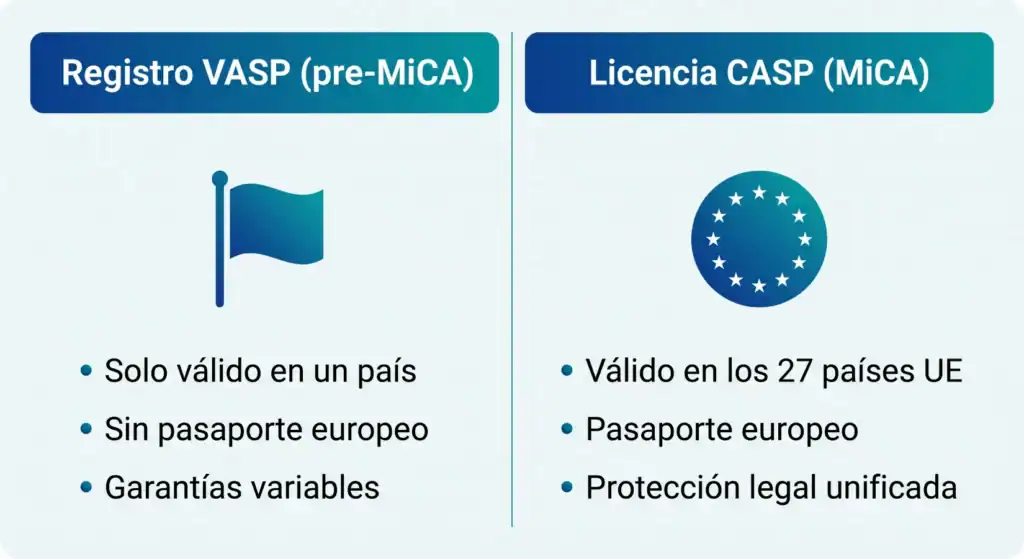
MiCA—Markets in Crypto-Assets—is the European Union regulation that establishes a unified legal framework for all cryptocurrency service providers in the 27 member states. Its aim is to replace the patchwork of national registries that allowed many platforms to operate in regulatory gray areas with a single authorization system using a European passport.
Before MiCA, an exchange could be registered as a Virtual Asset Service Provider (VASP) in France, Italy, or Spain and operate within each country's national framework. These registrations were not equivalent to a license, did not confer European passporting rights, and did not impose the same user protection obligations that MiCA now requires. In practical terms, this meant that millions of people used platforms with very different safeguards depending on the country.
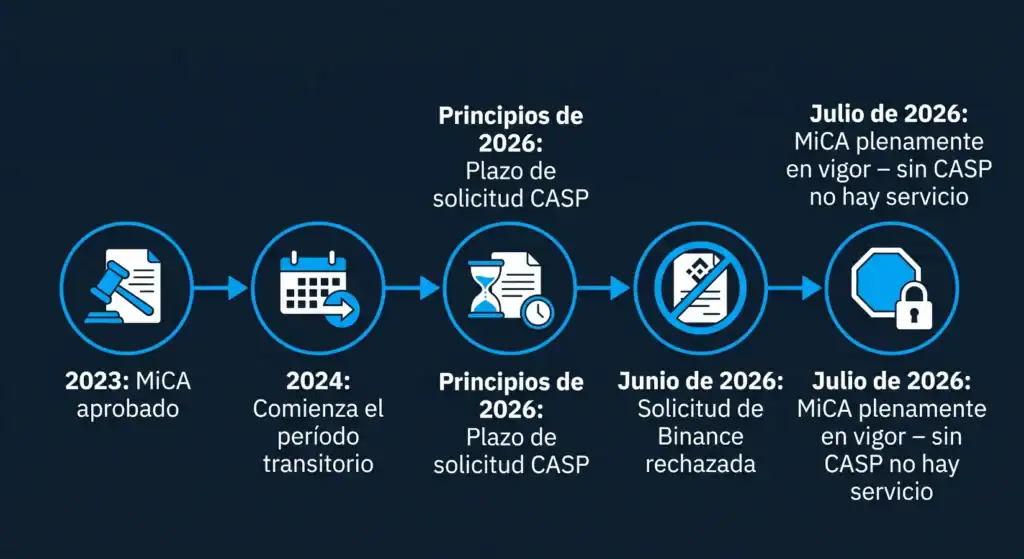
What makes July 1, 2026, decisive is its status as a point of no return. Until that date, exchanges operating under previous national regulations could remain active thanks to a transition period. From that date onward, any entity providing crypto-asset services in the EU without a CASP (Crypto-Asset Service Provider) license is violating European law. ESMA, the EU securities market regulator, has emphasized that unauthorized platforms must have their orderly exit plans in place before July 1, and that users who remain on unauthorized platforms lose the legal protections guaranteed by MiCA.
The figure that illustrates the scale of the change: as of May 2026, approximately 210 providers had obtained full CASP authorization in 23 Member States. Before MiCA, there were more than 1.200 entities with national registrations in the EU. The conversion rate is less than 18%.
Binance's application in Greece: what happened
Binance submitted its formal MiCA license application to the Hellenic Capital Market Commission (HCMC) Greece on January 23, 2026. To anchor its European operation, it simultaneously established a local holding company called Binary Greece. The choice was not random: Germany had granted more than 45 MiCA licenses by that date, the Netherlands 22, and Greece none, which in principle could offer a faster and less competitive processing.
Co-CEO Richard Teng explained in the GFTN Forum in TokyoIn February 2026, Binance stated that it also valued local talent and the country's security profile. The exchange asserted that it had worked constructively with regulators for 18 months and considered itself compliant with all MiCA requirements.
The HCMC rejected the application. Without authorization from any other European regulator before June 30, Binance announced that it cannot continue operating for users residing in the EU from July 1, 2026. The situation was foreseeable since mid-June, when sources familiar with the matter indicated to Reuters that the Greek regulator was likely to reject the application.
An important point to keep in mind: Binance's previous national registrations in France, Italy, Spain, Poland, Sweden, and Lithuania were not equivalent to a MiCA license nor did they confer European passporting rights. ESMA itself has emphasized this on several occasions.
The ESMA Provisional Registry: the tool every user should know
ESMA It maintains a Provisional Register (MiCA)—available on its official website—which is updated weekly and lists all CASPs authorized under the regulation. It is the most direct tool for verifying whether an exchange can legally operate in the EU.
The logic is simple: an exchange listed in the register has an active CASP authorization and can operate from any EU member state. An exchange not listed in the register does not have a MiCA license and, as of July 1, cannot provide services in the EU.
As of May 2026, several leading exchanges were already listed as authorized CASPs. In Spain, only four entities have MiCA authorization from the CNMV: BBVA, Cecabank, Openbank (via bank notification), and Bit2Me, which was the first cryptocurrency platform to obtain full CASP authorization in Spain.
Consulting the ESMA Provisional Register should be the first step before choosing any platform, regardless of its size or brand recognition.
Current status: Binance and MiCA as of July 2026
The scenario as of the closing date of the transition period is as follows:
- Binance does not have a CASP license in any EU member state.
- The Greek HCMC rejected his request.
- The exchange has confirmed the cessation of services for users residing in the European Union as of July 1, 2026.
- Previous national registries — in Spain, France, Italy and other countries — have no legal effect under the new framework.
This suspension is not a one-off setback or a temporary sanction. It is the direct consequence of failing to complete the authorization process within the timeframe established by the regulations. MiCA does not distinguish between large and small exchanges: it distinguishes between those that are licensed and those that are not.
What happens to your crypto assets on Binance?
With the operational shutdown confirmed, Binance is obligated to implement an orderly exit plan that guarantees users' access to their assets. In practice, this means you should be able to withdraw your crypto assets, either by transferring them to another platform or to a self-custody wallet.
There are three important things to keep in mind. First, the timeline and specific details of the exit will depend on how each country's national regulators implement it. Second, ESMA has explicitly urged users to transfer their crypto assets to an authorized CASP or a self-custody wallet if their platform is not listed as authorized. Third, operating on an unauthorized platform after July 1 will result in the loss of the legal protections that MiCA guarantees: asset segregation, custody obligations, regulated communication, and active AML supervision.
The practical recommendation is to act as soon as possible, without waiting until the final days of the orderly exit process. Mass withdrawals create congestion and can take longer than expected.
What to look for in a Binance alternative regulated under MiCA?
If you're considering where to move your crypto assets, these are the five criteria that MiCA establishes as guarantees for the user on an authorized platform.
- Active and verifiable CASP license. The exchange must be listed in the ESMA Provisional Register. A license in an EU country grants European passporting: you can use the platform from any member state. This is the most important criterion and the easiest to verify.
- Real operational headquarters in the EU. MiCA requires an effective presence in the territory, not merely instrumental structures. The supervisory authority must have actual jurisdiction over the entity. An office address in an EU country without any real staff or operations does not meet this requirement.
- Separation of customer assets. Authorized CASPs must keep user assets segregated from the company's own funds. This means that if the platform goes bankrupt, your crypto assets are not part of the bankruptcy estate.
- Transparency and regulatory communication. The formal obligation to inform users about relevant changes, risks, and operational status is a MiCA requirement. Unauthorized platforms do not have these formal obligations.
- Active AML/CFT supervision. CASPs under MiCA are subject to strict anti-money laundering and counter-terrorist financing requirements, audited by the national regulator. This layer of protection also benefits the user.
Bit2Me, an authorized CASP based in Spain
Bit2Me is one of the leading cryptocurrency platforms based in Spain and the first to obtain full CASP authorization from the CNMV under the MiCA Regulation. It operates as BITCOINFORME, PSC, SL, authorized and regulated by the CNMV in Spain in accordance with Article 59 of Regulation (EU) MiCA.
Beyond the regulatory framework, the platform boasts ISO 27001 and ISO 22301 cybersecurity certifications, over one million users, and a suite of products including Wallet, Brokerage, Earn, Card, Pro, Loan, DCA, TAX, and Academy, among others. It has been operating since 2014 and is backed by Telefónica Ventures, Investcorp, and Ledger Enterprise, among others.
Binance's closure in Europe is not a market anomaly. It is the first visible consequence of a structural change that has been brewing for years. MiCA did not arrive unexpectedly: the regulation was approved in 2023, the transition period lasted three years, and the deadlines were available to all stakeholders from the outset. Exchanges that are licensed today invested time and resources in complying with the requirements. Those that are not licensed, for whatever reason, cannot legally operate in the EU.
For a user holding cryptocurrencies on Binance, the most urgent step is to verify the orderly exit process and decide where to move them. ESMA's recommendation has been repeated for months: check that your next platform is listed on the ESMA Provisional Register as an authorized CASP before transferring anything. It's a two-minute check that can prevent many problems.