
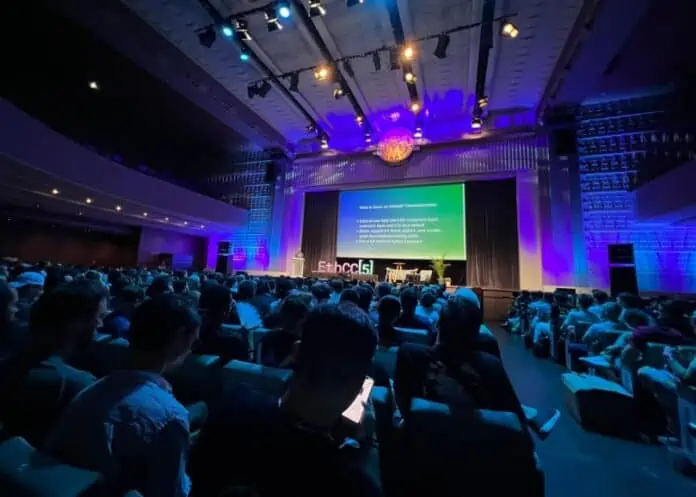
Ethereum is 40% developed and has potential, Vitalik Buterin commented while sharing the Ethereum roadmap after The Merge.
As the event that will switch Ethereum from the consensus mechanism approaches Proof of Work to the consensus mechanism Proof of Stake, the expectations of the crypto community are also growing, which is why Vitalik Buterin, the young creator of Ethereum, dedicated his participation in the fifth edition of the Ethereum Community Conference (EthCC), held in Paris (France) this week, to explaining the long-term objectives of the network after the long-awaited merger, The Merge.
It may interest you: Average network fee on Ethereum has dropped by more than 90% since November
What to expect from Ethereum after The Merge?
During his presentation at EthCC 5, Buterin shared with the crypto community the roadmap of the post-merge Ethereum network.
In this, he revealed the 4 key phases that follow for the development of the blockchain, after The Merge transition.
The next 4 phases, called The Surge, The Verge, The Purge y The Splurge, as detailed by crypto analyst Miles Deutscher on his Twitter account, will introduce the sharding On Ethereum, the Verkle tree will reduce the hard drive space required for validators and introduce a number of miscellaneous updates that will optimize and secure the network, the crypto analyst commented.
For his part, Buterin stated that Ethereum development, despite being the most widely used blockchain for building new projects in the blockchain industry, It is only at 40% and that The Merge merger, which will lead the network to become a proof-of-stake (PoS)-based chain to increase its scalability and significantly reduce its energy consumption, will raise its development to 55%.
Following The Merge and the following 4 key phases for the development of the blockchain network, Ethereum is expected to unlock its true capacity and potential.
Scalability on Ethereum Layer 2
For Buterin, the separation of Ethereum's layer 1 and layer 2 is also essential.
In his presentation, the blockchain developer emphasized that Ethereum's layer 1 should focus on the security, stability, and reliability of the blockchain, while layer 2 should focus on speed, scalability, and performance.
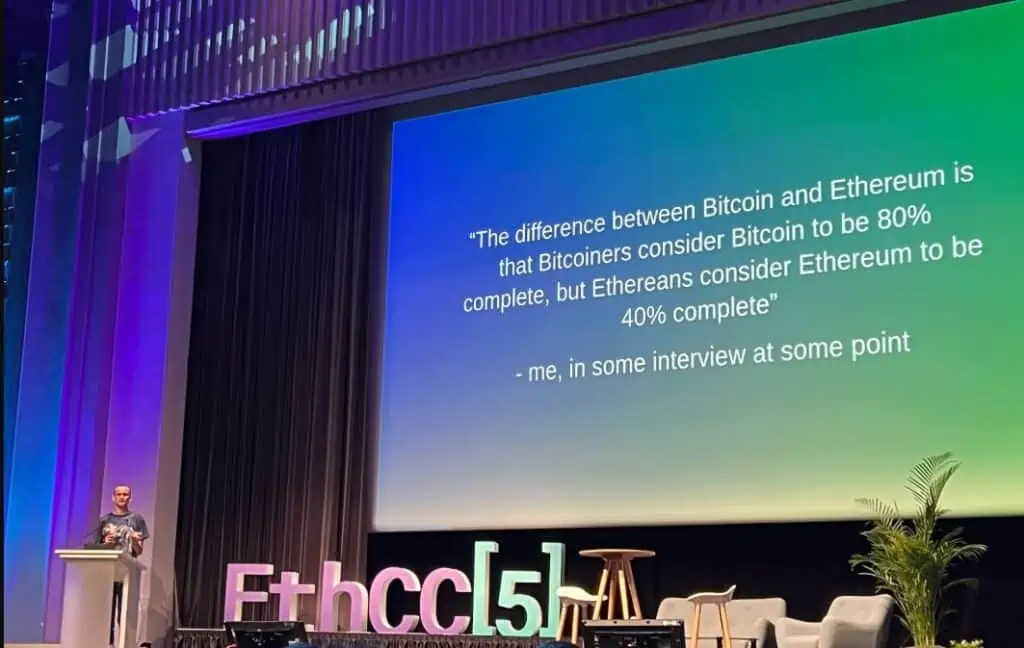
Buterin too he highlighted that Ethereum should focus on decentralization rather than complexity at the consensus layer. Specifically, the blockchain developer indicated that he would be “scared” of adding support for multiple complex virtual machines to the blockchain network.
Ethereum's goals are long-term
On the other hand, Buterin explained that the transition that the network is currently experiencing, with the future arrival of The Merge, is a process that will allow Ethereum to become a much more robust, powerful and efficient blockchain.
However, he spoke of this as a long and complicated process which requires time and vision.
Thus, although the crypto community has high expectations in the short term with the arrival of The Merge, which will possibly occur next September, Buterin is betting on the long term to achieve major changes and improvements in the network most used for the development of smart contracts and dapps in the crypto industry today.
Prior to the merge event between the execution layer (Eth1) and the consensus layer (Eth2) of Ethereum, the network developers will migrate the public testnet Goerli to the Beacon Chain; which will be the last implementation of the Ethereum testnets on Ethereum 2.0 and will occur at block height 10.790.000, according to shared developer Terence Tsao on his Twitter account earlier this week.
Continue reading: Polygon zkEVM, Polygon's new solution to scale Ethereum