

The Aptos and Aave communities are defining the future of their protocols through key votes on supply limits and economic models.
Recently, two of the most relevant protocols in the crypto ecosystem, Aptos and Aave, concluded independent voting processes that seek to adjust their long-term financial structures.
Although both projects operate with different architectures and purposes, they coincide at a turning point: the transition towards sustainability models where economic value is directly aligned with network activity and token holder participation.
For industry experts, this exercise in digital sovereignty reflects an increasing institutional maturity in Decentralized Autonomous Organizations (DAOs), which now prioritize fiscal efficiency and reducing programmed inflation over the initial growth subsidies that characterized their launch stages.
Buy DeFi assets on Bit2MeAptos sets a supply limit and turns towards deflation
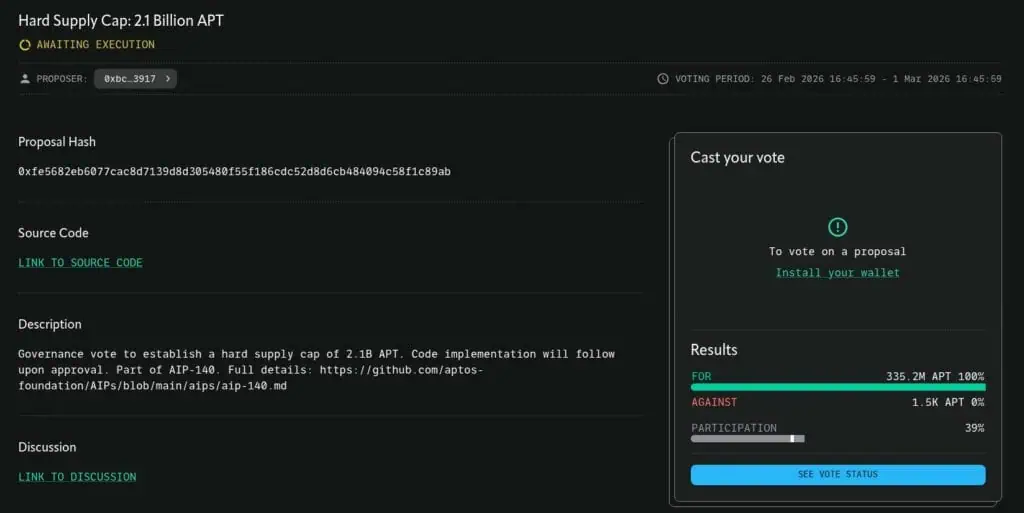
The Aptos community ratified a structural transformation in its monetary policy through a vote that concluded on March 1. proposal The main principle of governance establishes a maximum supply limit of 2.100 billion APT tokens, eliminating the possibility of infinite emission.
The proposed change in the APT token issuance It received massive support. 335,2 million APTs voted in favor, compared to only 1.500 APTs against. According to the protocol's governance data, participation reached 39% of the voting power, exceeding the minimum threshold of 35% required to validate the process.
The new scheme presented in this governance proposal seeks to strengthen the deflationary nature of the network. To achieve this, the Aptos Foundation proposed reduce the staking reward rate from 5,19% to 2,6%. Furthermore, it plans increase gas rates 10 times its current value.
According to the technical report of the proposal in question, this increase does not compromise the protocol's competitiveness, as stablecoin transfers would remain at levels of $0,00014. The goal is for the increase in token burning, driven by the transaction volume on decentralized platforms like Decibel—a DEX that projects burning more than 32 million APTs annually—to eventually outpace the issuance of new assets.
Additionally, the Aptos Foundation committed to permanently block 210 million APTs, equivalent to 18% of the current circulating supply of the cryptocurrency, to secure the network with no intention of selling.
Join now and start trading with APT todayAave is moving towards a system focused on token value
In parallel, the Aave decentralized lending protocol overcame a critical stage in its governance process with the approval of the proposal called "Aave Will Win".
In a temporary verification vote or Temp CheckThe framework received 52,58% support, while 42% of voters opposed it. However, according to experts, this result allows the initiative to move forward to the next phase. Request for Final Comment (ARFC), where the details will be finalized before a definitive technical implementation in the DeFi protocol.
The core of this proposal, championed by the founder Stani KulechevIt proposes that 100% of the revenue generated by Aave products be allocated directly to the AAVE token and the DAO treasury.
According to Kuleshov's statements on X, this move aims to align the economic incentives between developers and asset holders. However, the process has revealed internal debate regarding the distribution of funds. Marc Zeller, founder of the Aave Chan Initiative (ACI), noted in a subsequent analysis that there are doubts about the decentralized authority's independence from Aave Labs. In fact, key service providers such as BGD Labs and ACI itself have announced that they will not renew their contracts by mid-2026, citing disagreements over the protocol's strategic direction, which underscores the complexity of managing consensus in large-scale organizations.
Buy AAVE on Bit2Me: create your accountThe communities decide the financial direction of their protocols
In general terms, the current direction of governance in the DeFi ecosystem shows how it is possible for communities to manage their own protocols.
The recent measures adopted by Aptos and Aave demonstrate that collective decision-making goes beyond mere consultation and directly impacts the financial sustainability of projects. In both cases, the debate centers not on the accelerated expansion of liquidity, but rather on building more robust, efficient, and responsible structures.
However, it's important to remember that decentralization in practice doesn't always guarantee balance. For example, disagreements persist regarding the concentration of voting power, a phenomenon that calls into question the extent to which participation truly reflects the diversity of a community. Even so, the ongoing debate in these communities about how to manage this concentration and other issues, as noted Mikhail Egorov, founder of Curve Finance, is what keeps alive the essence of decentralized governance and the legitimacy of decisions within the blockchain ecosystem.
Access DeFi assets from Bit2Me