

The Ethereum Foundation is mobilizing an additional $120 million into DeFi, and with it, the debate continues over whether the foundation is doing the right thing for the future of the Ethereum ecosystem.
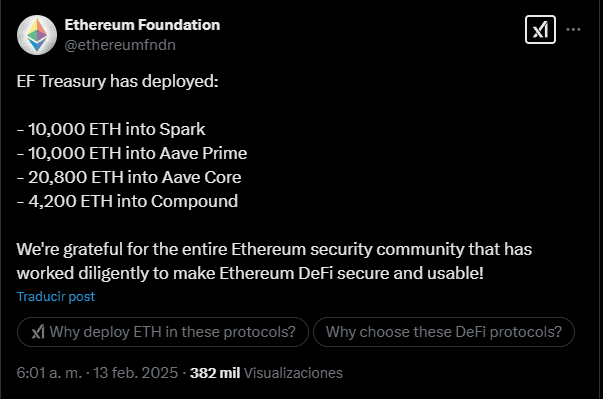
In recent months, the Ethereum Foundation (EF), the entity in charge of coordinating the development of the Ethereum network, has generated an intense debate within the crypto community. Its latest move has been the transfer of $120 million in ether (ETH) to two DeFi protocols: Aave and Spark.
The move, which seeks to generate returns without selling their ETH holdings, has been viewed with suspicion by many in the community. While some see this strategy as an innovative way to leverage the foundation's assets, others criticize it as poorly aligned with the organization's original values and potentially damaging to the Ethereum ecosystem.
But the transfer of funds is not an isolated event. In the previous weeks, the EF had moved 50.000 ETH, valued at more than $167 million, to a multisig wallet with the aim of participating in the DeFi ecosystemThese moves reflect a shift in the foundation's financial strategy, which is seeking to maximize the value of its treasury amid growing pressure from the community. However, this approach has raised questions about transparency, governance, and the long-term impact on Ethereum's development.
Reasons behind the transfer
La Ethereum Foundation He explained that the transfer of $120 million to Aave and Spark responds to a double objective: Generate returns and support the DeFi ecosystemBy depositing their ETH into these protocols, the EF becomes a liquidity provider, allowing users to lend and borrow assets within the platforms. In return, the EF earns interest on their deposits, providing an alternative to selling ETH to cover their operating expenses.
This approach represents a way out of the pressure exerted by the community, which has long criticised the lack of transparency in the management of the EF's treasury. The foundation has been accused of generating «selling pressure» by converting their ETH into stablecoins to pay salaries and operating expenses. But by investing in DeFi, the EF seeks to avoid selling its assets on the open market, which could stabilize the price of ETH and benefit the entire community.
However, there are also more complex motivations behind this decision. The EF is facing an increasingly competitive environment, with other chains such as Solana gaining ground in the DeFi space. By actively participating in the ecosystem, the foundation seeks not only to generate income, but also to strengthen its position within the market and demonstrate its commitment to innovation and network development.
Criticism and opposition: Why is the community against it?
While investing in DeFi may seem like a shrewd strategy, a significant portion of the Ethereum community has expressed discontent with this decision. Historically, the EF has been criticized for not being clear enough in managing its finances. The recent transfer of funds has been no exception, with many questioning how the decision was made and what governance mechanisms were used. The lack of detailed information on deposit terms, interest rates, and associated risks has generated distrust.
On the other hand, the Ethereum Foundation, as a non-profit organization, is mandated to act in the best interest of the Ethereum network and its community. However, by investing in specific DeFi protocols, some question whether the foundation might be favoring certain projects over others. This could lead to inequities in the ecosystem and affect the EF’s neutrality.
While the EF hopes to avoid selling pressure by not selling ETH on the open market, some analysts point out that the concentration of large amounts of ETH on DeFi platforms could have unintended effects. On the one hand, the additional liquidity could benefit the protocols, but on the other, if these funds need to be withdrawn quickly, they could create volatility in the market. In the end, this scenario does not help ETH's price stability.
Finally, although current yields on deposits in Aave y Spark Although the returns are modest (around 1,5% annualized), some argue that this return does not compensate for the risks associated with holding large amounts of ETH on third-party platforms. DeFi protocols, while innovative, are not without risks, including smart contract flaws, security exploits, and changing market conditions.
INVITE AND WINImpact on the Foundation's vision
The EF's decision to transfer $120 million to DeFi protocols has sparked intense debate about the future of the organization and its role in the development of Ethereum.While the move has the potential to generate additional revenue and strengthen the ecosystem, it also poses significant challenges that could impact the perception of the EF and ultimately the development of the network.
First, the community reminds them that the Ethereum Foundation was founded with the goal of supporting the development and adoption of Ethereum, acting as a neutral entity that coordinates efforts and allocates resources. However, the recent transfer of funds has led some to question whether the EF is prioritizing financial gains over its original mission. This perceived shift in the foundation’s strategy could erode community trust, which has been a key pillar of Ethereum’s success to date.
Furthermore, the lack of transparency in the management of the EF’s treasury has created a climate of mistrust. Many in the community feel that the foundation has not been sufficiently forthcoming about its financial decisions and that changes in strategy have not been adequately explained or justified. If this perception persists, it could affect the EF’s ability to raise funds and obtain support for future projects.
LINK CARD AND EARNImpact on related projects
But Ethereum's development is also a collective effort that relies heavily on collaboration between the Ethereum Foundation, developers, researchers, and the broader community. If the EF loses the community's trust, this could have significant repercussions on the network's progress.
On the one hand, a decrease in trust could lead to a reduction in donations and support for the EF, which would limit its abilities to fund key projects. On the other hand, if the EF is perceived as an organization that prioritizes financial gains over innovation and development, it could discourage developers and projects that have been attracted by Ethereum’s original values.
Furthermore, active participation by the EF in the DeFi ecosystem could lead to a concentration of resources on certain projects, which could limit diversity and innovation in the space. If the EF focuses on supporting a few large protocols, it could marginalize emerging and experimental projects that have historically been the drivers of innovation in the blockchain space.
Investing in cryptoassets is not fully regulated, may not be suitable for retail investors due to high volatility and there is a risk of losing all invested amounts.