
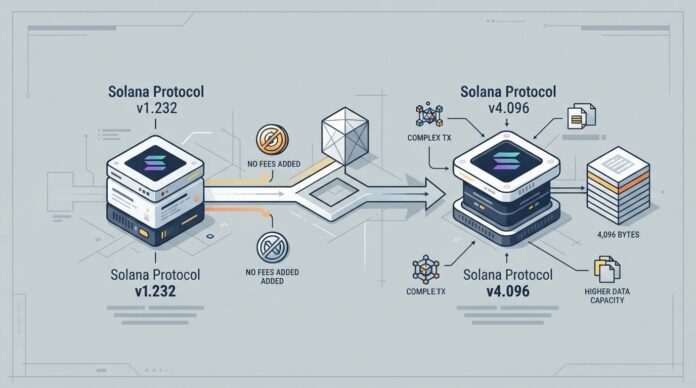
The Solana blockchain network implements a significant technical upgrade that expands the maximum size of your transactions from 1.232 bytes to 4.096 bytesThis change, introduced through the Transaction v1 format, allows for more complex cryptographic operations to be executed in a single move, optimizing the protocol's efficiency and offering new possibilities to developers in the crypto ecosystem.
With this improvement, the infrastructure takes a step forward in resolving structural bottlenecks, allowing more sophisticated decentralized applications to operate smoothly without compromising the speed that characterizes this network.
The technical leap: from 1.232 to 4.096 bytes in Solana
To understand the magnitude of this upgrade, it's essential to analyze Solana's original architecture. From its inception, the network imposed a strict limit of 1.232 bytes per transaction. This restriction wasn't arbitrary; it stemmed from the initial network design, where each operation had to fit neatly within a standard internet data packet (MTU) of approximately 1.280 bytes. This approach ensured that data traveled across the network without fragmentation, keeping latency to a minimum.
However, as the crypto ecosystem has matured, developers' needs have evolved. In 2022, Solana changed how transaction traffic is transmitted, adopting more robust protocols that made the previous cap less necessary. By tripling the capacity to 4.096 bytes, the network removed a long-standing barrier. Unlike other smart contract networks that don't have a rigid size limit per protocol, Solana maintained this restriction, forcing developers to break complex operations into multiple steps.
The new limit of 4.096 bytes is not a random figure either. It corresponds exactly to four kilobytes (4KB), which is the standard size of a memory page used by validator hardware. Exceeding this threshold would force a single transaction to span multiple memory pages, increasing processing costs and slowing down the machines that keep the network secure and operational.
What does the new Transaction v1 format allow?
The increased capacity opens the door to a new generation of decentralized applications (dApps). Operations that previously had to be divided into multiple transactions can now be managed in a single block of instructions under the Transaction v1 format. This has a direct impact on user experience and the security of smart contracts.
Among the use cases that will benefit most are extensive cryptographic proofs, such as zero-knowledge proofs, which require vast amounts of data to verify information without revealing it. Similarly, multi-signature payments, which require approval from multiple parties before execution, now have the necessary space to include all signatures in a single transaction. Confidential transfers and more advanced decentralized finance (DeFi) protocols will also find this additional space the ideal environment for frictionless operation.
It is important to note that existing transaction formats will remain compatible. Applications and interfaces are not required to migrate to v1 unless they specifically require this additional space, ensuring a smooth transition for those who choose to upgrade. acquire SOL and use the network in their daily lives.
Impact on the ecosystem of applications and browsers
Although the upgrade is highly beneficial, it requires adjustments from infrastructure providers. The most significant change involves the software that reads data from Solana. Services that extract blocks and transactions, such as Remote Procedure Call (RPC) nodes, must be updated to recognize the v1 format. If they are not, requests may fail due to this new data structure.
Digital wallets, block explorers, and trading applications rely on these services to display what's happening on the blockchain. If the underlying infrastructure isn't up to date, incorrect data on the backend can translate into erroneous information on the user's screen. For example, the v1 format stores priority fee information in a different location. Outdated software might show a zero fee as paid, even if the user paid extra to expedite their transaction.
To stay informed about how these technical updates affect the market and the tools you use, you can check regularly. news.bit2me.com, where we analyze the evolution of blockchain infrastructure.
Network efficiency, validators and tariff management
The increase in transaction size leads to higher network bandwidth consumption. Although the update does not introduce a new per-byte fee, developers anticipate that users may need to offer higher priority fees when large transactions compete for block space during periods of high demand.
A priority fee is an optional additional payment that users can add to expedite transaction processing by validators. Because it occupies more space, a 4.096-byte transaction competes differently in Solana's local fee market compared to a 1.232-byte transaction. However, Solana's architecture is designed to handle this load thanks to its parallel processing system, which isolates demand spikes in specific fee markets without congesting the entire network.
Regulatory context and transparency under MiCA
The technical maturation of networks like Solana is a fundamental step towards their integration into the regulated European financial system. With the entry into force of the MiCA (Markets in Crypto-Assets) Regulation, the European Union establishes a clear framework that requires transparency, security, and auditability from crypto-asset service providers.
Updates that improve efficiency and reduce the likelihood of failures in complex transactions contribute to creating an environment with known and managed risk. For platforms authorized by the CNMV (Spanish National Securities Market Commission), operating on blockchain networks that demonstrate technical evolution capacity and stability is essential to offering transparent and regulatory-compliant services. If you would like to learn more about how blockchain technology aligns with the new regulatory standards, the Bit2Me Academy It offers detailed educational resources on how these networks work.
FAQ
Is it mandatory to upgrade to the Transaction v1 format?
No, previous transaction formats will remain fully supported. Only developers and applications that require the additional 4.096 bytes of space for complex operations will need to implement and use the new v1 format in their smart contracts.
Will fees increase for using larger transactions?
The update does not introduce a new base fee per byte. However, since larger transactions consume more bandwidth, users may need to add higher priority fees during periods of congestion to ensure their transactions are processed quickly by validators.
Why has the limit been set at exactly 4.096 bytes?
The 4.096-byte limit corresponds to four kilobytes (4KB), which is the standard size of a memory page in modern hardware used by validators. Exceeding this size would make processing inefficient and more costly for the machines that maintain the network.
What happens if an application doesn't update its reading software?
If a block explorer or wallet is not updated to recognize the v1 format, it could misinterpret on-chain data. This can result in display errors, such as showing incorrect priority fees or failing to load recent transaction history.
Solana's technical evolution demonstrates the continued maturity of the blockchain infrastructure. By optimizing transaction sizes without compromising the performance of validator hardware, the network is poised to host far more sophisticated and secure decentralized applications.
Understanding these protocol-level updates is fundamental to understanding how the future of the crypto ecosystem is being built. The implementation of Transaction v1 marks a milestone in the pursuit of technical efficiency, laying a solid foundation for future innovations in the distributed ledger technology space.
Investing in cryptoassets is not fully regulated, may not be suitable for retail investors due to high volatility and there is a risk of losing all invested amounts.
Generative artificial intelligence tools were used to create this article.