

Ethereum's staking network, Ethereum 2.0, has nearly $6 billion worth of ETH staked on the network as it prepares to launch its first hard fork on the Beacon Chain.
Ethereum (ETH), the second network blockchain of the market, is close to reaching $2.000 USD per unit, while its staking network, Ethereum 2.0, based on the protocol of Proof of Stake (PoS), which will migrate the mainnet to a new consensus model, is close to reaching $6 billion in ETH staked. At the time of this writing, the Beacon Chain has a total of 3.094.850 ETH deposited in the network, which have a unit value of $1.790 USD.
On the other hand, Ethereum co-founder, Vitalik Buterin, published a Valid identity document where he explains his proposal for the first hard fork, or hard fork, that will take place on the staking network, and that will allow developers to prepare ETH 2.0 for new updates and improvements in the future. Let us remember that ETH 2.0 is the new blockchain that Ethereum developers are preparing to deal with the scalability, performance and cost problems that the network currently faces, which processes only about 20 transactions per second (TPS) and is falling into the hands of large corporations due to high gas fees; a situation that prevents retail investors from using the blockchain and makes it impossible to interact with the thousands of applications and projects that are created on this chain.
Ethereum 2.0 was officially born on December 1, 2020, but it will not be ready for another 2 years, since its launch is being carried out progressively, in several stages. The Beacon Chain is the first phase or stage of the blockchain under construction that will be the new main network and the future of Ethereum.
It may interest you: It's official! Ethereum 2.0 began with the generation of the Genesis block on the Beacon Chain
2,6% of ETH in ETH 2.0
According to data from CoinMarketCap, Ethereum has a total of 114,68 million ETH in circulation At the time of writing this article, just over 2,6% of the total coins currently in existence are deposited on the Beacon Chain.
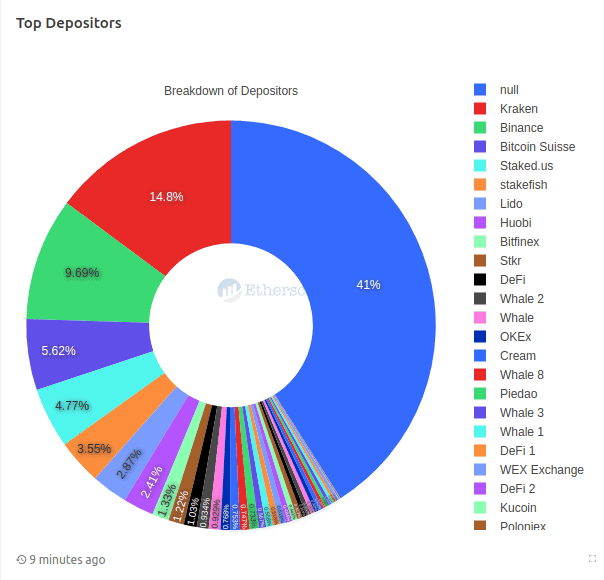
Staking by network validators has grown considerably since the official launch of Ethereum 2.0 in December. Thus, after 2 and a half months, ETH 2.0 exceeded by more than 490% the minimum amount of ETH and validators required to become operational, which was 524.288 ETH and 16.384 validators.
Source: Etherscan
Today, the vast majority of validator nodes that exist on ETH 2.0 remain anonymous, data from Etherscan; followed by several exchanges de cryptocurrencies, which have become the main staking service providers for this network.
The future of Ethereum
Ethereum 2.0 is set to become the new main blockchain of the second most popular cryptocurrency on the market, so its developers are preparing new updates that will allow the network to be tested in all possible scenarios, in order to implement deep changes and improvements in the future.
Improvements and integrations proposed by Buterin
As Buterin explains in his paper, the hard fork proposal, which will possibly be called HF1, seeks, among many things, integrate support for thin clients, with the aim of improving some weak points of the Beacon Chain, which were discovered after the generation of the genesis block. The hard fork will also allow testing the effects of a hard fork on the network, before the implementation of more complex processes, such as sharding.
The proposal also includes the Creation of a “random synchronization committee”, made up of 1024 validators, which will allow light clients to stay updated with a low amount of overhead. According to the developer, the required capacity will be at least 20 kB per day, and about 500 bytes for the verification of a single block. This integration will allow light clients to be viable from mobile devices. Likewise, the validators that will make up the committees will be chosen at random approximately every 27 hours.
Also, to reduce the complexity of processing "empty epoch transitions", Buterin proposes carry out an accounting reform, which consists of extending the changes to the validator set and the counting of penalties to once every 64 epochs, instead of being done every single one.
Another of the proposals that Buterin presents in HF1 is to reduce the penalties, known as slashing, due to 0,1% inactivity, but this only applies to honest nodes that have an imperfect connection to the network. The proposal also seeks to introduce several important improvements to prevent the execution of reorganization attacks, which, however small, can allow some staking pool or malicious actor to attack the network with more than 34% of the validators under their control.
Ethereum 2.0 by 2022
According to the developers' estimates, if the implementation of the Ethereum 2.0 phases occurs as planned, the network will be fully available by 2022. In the meantime, and until then, Ethereum 2.0 has to coexist in parallel and independently with Ethereum. Regarding the proposal presented by Vitalik Buterin, there is still no definite date for its implementation, if it is approved.
Continue reading: Ethereum 2.0 Improvement Plans Boost Network Adoption