
Bitcoin miners will expand their operations to jurisdictions that guarantee energy supply and affordability, CoinShares noted in a recent study.
The study, titled “CoinShares Mining Report Update: Our Insights at the 2024 Halving,” which was presented by CoinShares’ head of research, James Butterfill, along with other executives from the digital asset investment products firm, highlights the growing importance for Bitcoin miners of using stranded energy, both to obtain higher revenues and to improve the narrative of the blockchain network’s energy efficiency.
According to study CoinShares says Bitcoin miners can increasingly move to sites with stranded power, which they can leverage to keep their mining equipment alive and sustain their blockchain activities more responsibly and efficiently.
Mining costs will increase due to halving
One of the situations that will accelerate the relocation of miners to places with energy security, according to CoinShares, is the halving. The firm highlighted that the costs of mining bitcoins will possibly increase with the arrival of the fourth halving to the blockchain, which will encourage miners on the network, especially those who rely on technologies such as AI and high-performance computing, to look for areas with more favorable conditions to sustain their activities.
“Substantial cost increases are expected due to the block reward halving, with electricity and overall production costs nearly doubling,” the firm stressed.
While Bitcoin miners' earnings were expected to drop after the activation of the new halving, the deployment of the Runes protocol, developed by Casey Rodarmor, significantly increased miners' earnings in the post-halving blocks. However, several experts believe that the hype caused by this protocol could be temporary and that commission fees, which have been the main source of income for Bitcoin miners in recent days, will return to normal.
As reported by this outlet, Bitcoin transaction fees exceeded $200 on the day of the halving. However, at the time of writing this article, they have dropped significantly, around $12 dollars, for high priority transactions.
Because of this, CoinShares estimates that the network's miners will implement various mitigation strategies to reduce mining costs, including moving to sites with stranded power. The firm also emphasized that the new halving could cause up to 10% of Bitcoin miners to go offline in the short term, due to the low profitability of less efficient equipment.
The average cost of mining bitcoins is $53.000
Currently, the average cost of mining bitcoins from the network for publicly traded mining companies is $53.000, CoinShares noted in its recent study.
The firm said these costs were based primarily on data recorded in the fourth quarter of 2023 and discussions with major companies engaged in mining bitcoins on the blockchain.
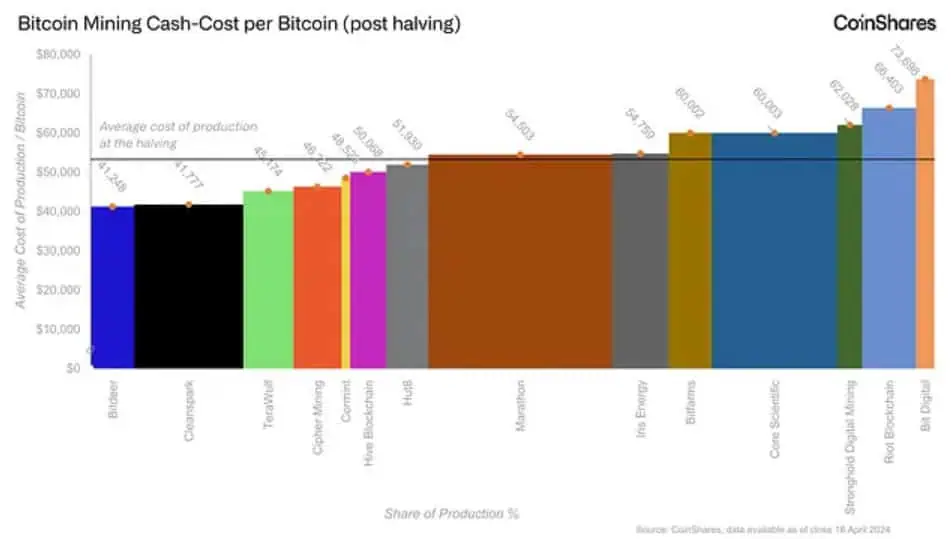
Source: CoinShares
Bitcoin is currently showing a significant recovery in its price after the halving, rising to $66.200 at the time of this writing.
Regarding the price of Bitcoin, CoinShares implemented a new data model to assess how the rise of the cryptocurrency influences mining costs and, therefore, miners' decision-making. The firm concluded that, although Bitcoin prices tend to have a large impact on hash prices in the short term, making mining the cryptocurrency more expensive, in the long term the increase in BTC prices tends to encourage more companies to mine.
Based on this model, one of the possible scenarios highlighted by the firm is that, by the end of 2025, the average cost of mining bitcoins could reach around $85.000 per BTC, while commission fees could represent around 80% of the income of miners on the blockchain network.
Continue reading: Glassnode: Bitcoin miners earned over $100 million on halving day