
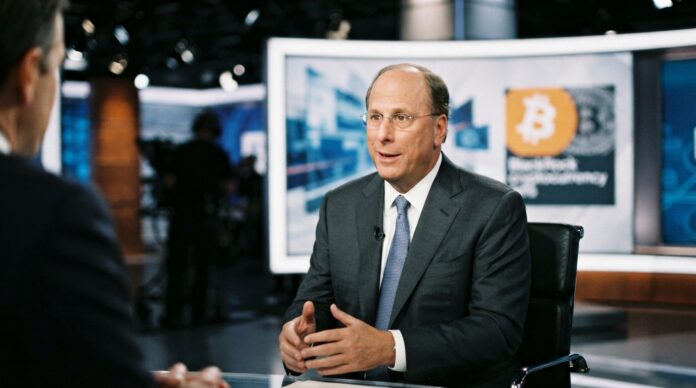
Bitcoin's price has experienced a correction of nearly 50% since its last all-time high. However, BlackRock, the world's largest asset manager, maintains that the core thesis of this cryptocurrency as a global monetary alternative and portfolio diversifier remains intact despite current fiscal dynamics.
The institutional perspective versus market correction
Despite the significant fluctuations the crypto market has experienced recently, the long-term outlook of major financial players remains solid and grounded in in-depth macroeconomic analysis. Robert Mitchnick, global head of digital assets at the asset manager, highlighted in a recent report that The nearly 50% drop in Bitcoin's price from its all-time high does not alter its fundamental value.For the entity, the asset continues to play a crucial role as a global monetary alternative and as a unique element to diversify and build your portfolio for the long term.
The analysis underscores that current macroeconomic dynamics, marked by the steady increase in government debt and fiscal deficits both in the United States and globally, show no signs of slowing down. In this context of quantitative easing, Bitcoin's value proposition strengthens considerably, presenting itself as a hedge against expansionary monetary policies and the continued issuance of fiat currency by central banks worldwide.
BlackRock's stance resonates with that of numerous industry analysts who observe how structural inflation is eroding the purchasing power of traditional currencies. By maintaining a firm position on Bitcoin's utility, the institution sends a clear signal to the market: short-term price corrections do not invalidate the macroeconomic adoption thesis.
Global debt and the need for assets with limited supply
One of the report's central arguments is the inevitability of traditional currency devaluation in the face of mounting debt obligations. Given the lack of a credible path to fiscal consolidation by governments, analysts point out that these dynamics reinforce the strategic case for acquiring assets whose supply is strictly limited and, more importantly, beyond the discretion of central or political authorities.
The report draws a revealing comparison: while gold is governed by geology and the physical limitations of its extraction, Bitcoin is governed purely by mathematics and code. This digital nature guarantees its programmed scarcity, with a maximum supply of 21 million units that can never be altered by political decisions or state funding needs.
This technical feature is fundamental to understanding why institutions of this caliber continue to show sustained interest in the crypto ecosystem. The immutable transparency of the blockchain network and the predictability of its issuance, which is halved approximately every four years through a process known as halving, stand in stark contrast to the opacity and flexibility of traditional financial systems. To delve deeper into how this underlying technology works and its economic implications, you can explore the detailed educational resources available at [website address]. Bit2Me Academy.
Market maturity: from volatility to relative stability
The report also directly addresses the historical volatility that has characterized Bitcoin throughout its 17-year history. However, the organization emphasizes that this volatility has shown a clear downward trend over the last decade. This change in behavior is not accidental; it is directly attributed to the maturing of the market structure, supported by the sustained growth of derivatives markets and the expansion of exchange-traded products.
As the crypto market infrastructure becomes more robust, auditable, and transparent, the perception of risk associated with these assets is evolving positively. The massive influx of institutional capital provides liquidity that cushions the sharp price movements that were common in the asset's early years. Furthermore, Bitcoin's uncorrelated performance compared to traditional equity and fixed-income markets remains a key attraction for its inclusion in diversification strategies.
It's important to note that, while the asset carries a known and managed risk, current tools allow users to interact with the ecosystem in a much more sophisticated way. The narrative is shifting from a purely speculative asset to a digital store of value recognized by major Wall Street players.
In conclusion, BlackRock's analytical support confirms that Bitcoin's relevance transcends short-term price cycles. Against a macroeconomic backdrop dominated by global debt and inflation, Bitcoin's algorithmic scarcity and independence solidify its position as a cornerstone of modern investment portfolios.
Investing in cryptoassets is not fully regulated, may not be suitable for retail investors due to high volatility and there is a risk of losing all invested amounts.
Generative artificial intelligence tools were used to create this article.