
TRON is solidifying its financial model with $624 million in annual revenue and zero inflation costs, according to Kaiko experts.
Kaiko's assessment comes at a time when financial institutions are demanding greater transparency and robustness from blockchain platforms. With the expansion of cryptocurrency exchange-traded funds (ETFs), financial analysis has shifted its focus from solely market activity to measuring the true economic performance of each network.
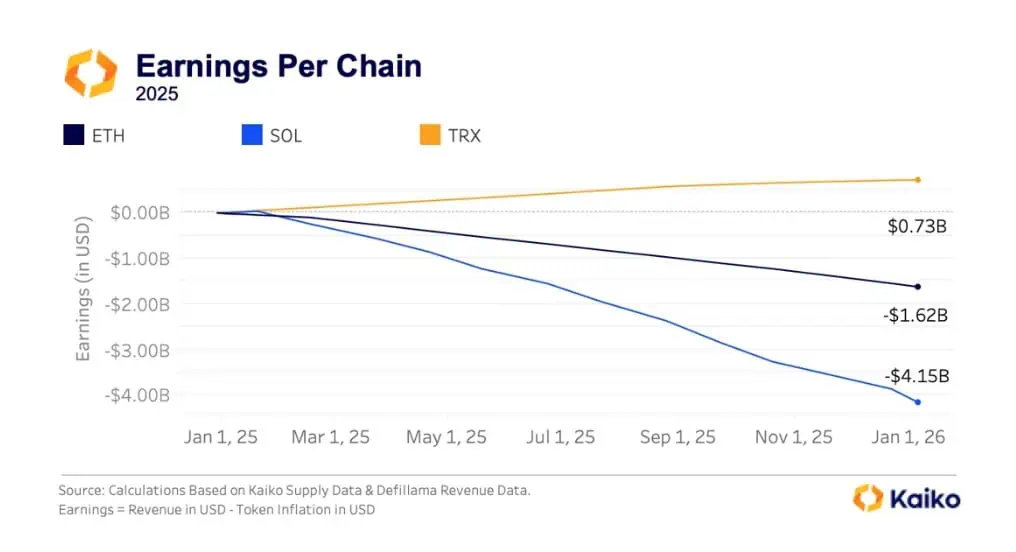
According to the study, most blockchains are currently operating at a loss because their issuance costs exceed their transaction fees. Ethereum and Solana are among the most affected by this imbalance. In contrast, TRON stands out as an exception, maintaining a positive balance that confirms the sustainability of its financial model and the efficiency of its operational structure.
According to Kaiko analysts, these results reflect a well-designed system that manages to generate stable revenue without sacrificing value for its users.
Create your account and access TRX todayTRON consolidates its dominance as the most used network for moving stablecoins
While much of the blockchain industry competes to capture users' attention through cutting-edge applications, video games, or decentralized social networks, TRON has prioritized a less visible but highly lucrative infrastructure. The network has specialized in the global transport of value, becoming the main support for the movement of Tether's stablecoin, USDT.
According to Kaiko, this blockchain specialization allowed it to generate $624 million in revenue over the past year, a figure supported by consistent demand for low-cost transactions.
Source: Kaiko
According to Kaiko's analysis, TRON's performance is not based on the speculative momentum of digital assets, but rather on concrete, everyday utility. Its function as a payment network has made it a stable tool within an environment still dominated by volatility. This regularity in transaction demand has guaranteed a sustained economic flow, preventing profitability from depending on the creation of new tokens or temporary projects.
In short, TRON found its balance in the simplicity of offering a basic service that millions of users require every day.
Buy TRX at Bit2Me, frictionlessThe network that has managed to sustain itself without diluting the value of its tokens
Kaiko's report highlights that, in the competitive world of blockchain, few networks have managed to combine stability, efficiency, and profitability as TRON has. According to analysts, while many Layer 1 chains face the dilemma of funding their security at the expense of their own token value, TRON has built a model that defies this trend.
Ethereum exemplifies the challenges of maintaining such a robust infrastructure. During the last period, it generated approximately $260 million in fees, but had to absorb issuance and validation costs exceeding $1.600 billion. Solana also faced similar pressures. Its revenue was around $170 million, yet its token inflation surpassed $4.000 billion, a disparity that directly impacts long-term investors.
In contrast, Kaiko highlights that TRON's approach has been different. In 2025, this network managed to ensure that the number of tokens burned exceeded the number of new tokens issued, generating a deflationary effect. This move reduced the inflationary pressure affecting other networks and strengthened its revenue structure. Laurens Fraussen, a researcher at the firm, asserts that this behavior makes TRON one of the few platforms with sustainable revenue and a stable financial foundation.
“Looking at the 2025 results data, Solana (SOL) posted a net loss of $4.150 billion, while Ethereum (ETH) lost $1.620 billion. ETH generated $260 million in revenue, SOL generated $170 million in fees, and Tron (TRX) raised $732 million. However, only Tron’s revenue exceeded its inflation costs, resulting in positive profits and net token deflation.”, they said the firm's analysts.
This characteristic has begun to attract the attention of major investors who prioritize projects with a real capacity to generate positive cash flow. Beyond the technology that underpins each blockchain, the market is now paying closer attention to which networks manage to be self-sufficient without diluting the value of their own participants, and in this area, TRON seems to be making steady progress.
Access your wallet and trade with TRXTransparency, trust and business maturity
In addition to what was noted in the Kaiko report, TRON's trajectory is beginning to show clear signs of maturity within the global financial landscape.
Recently, the protocol's founder, Justin Sun, reached a $10 million settlement with the U.S. Securities and Exchange Commission (SEC), a move the market interpreted as an attempt to resolve long-standing legal disputes and move toward a more stable environment. This gesture coincided with the listing of TRON-linked financial instruments on the Nasdaq, another indication that the network is seeking to solidify its presence in regulated markets and project greater confidence to traditional players.
By reducing legal uncertainty and showcasing a structure capable of generating sustained profits, TRON is attempting to cultivate an image of a profitable project that transcends mere technical innovation. Industry analysts observe that this focus on capital efficiency and profitability could usher in a new era in the valuation of blockchain networks, where economic performance becomes just as important as technological development or reach.
 Certificate
Blockchain Course
Basic levelTake this course where we explain blockchain in a clear, simple and concise way so that you have a very clear idea of what this new technology consists of.