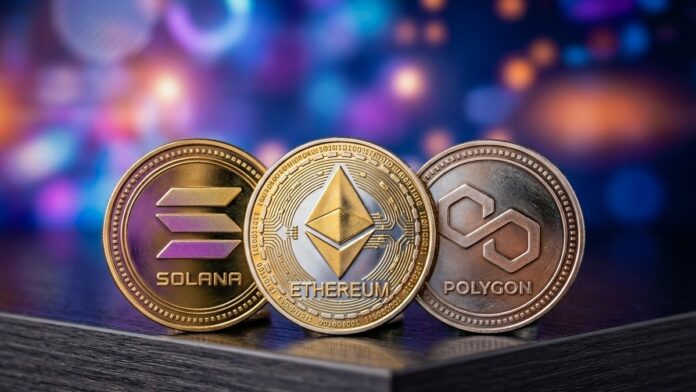
The scalability dilemma has been solved by data. Read the Chainalysis report that analyzes institutional capital flows and defines which blockchain ecosystem will dominate financial infrastructure in 2026.
Real-world asset tokenization (RWA) has moved beyond the proof-of-concept stage to become the cornerstone of the banking operational efficiency in this 2026.
Although on-chain analytics platforms like Santiment detect a decline in public interest in RWAs, institutions continue to build them, and the recent Chainalysis report confirms this. Valid identity document It reveals that the decision-making of traditional financial institutions is no longer based on the prestige of a brand, but on a matrix of technical risks where predictability trumps gross performance.
The firm's analysts emphasize that There is no single "best" blockchain across the board.Conversely, the network architecture must align with the nature of the asset: while a money market fund requires the security of a final settlement layer, a high-frequency trading application demands immediate transaction finality. This pragmatic approach is forcing banks to abandon maximalism and adopt a multichain modelwhere interoperability becomes the standard for survival.
Access crypto assets on Bit2MeCost, speed, and purpose: variables that define the use of blockchain networks
For a bank treasurer, an economical transaction is desirable, but a transaction with unpredictable costs is a systemic danger. The report from the specialized firm identifies networks such as Bitcoin They present a high "tail" risk, with commission spikes triggered by data registration protocols that have nothing to do with financial settlement. What good is a secure network if the cost of operating on it can multiply by a hundred in one hour of congestion? The institutional response has been clear: to seek the stability. In this sense, Ethereum —after consolidating the improvements of its Dencun update— and Layer 2 networks such as Base u Optimism They are positioned as the preferred rails for the retail public because their cost structures are noticeably flatter and more manageable.
This search for stability also extends to the Processing speedwhere the market often confuses gross yield (TPS) with time to completion. While Solana It leads the ecosystem in transactions per second, processing more than double that of its closest competitor; the finality of the transaction —the point where a payment is irreversible— is the metric that really concerns law firms.
Arbitum It currently leads in completion speed, a decisive factor when moving millions of dollars in tokenized bonds. However, Chainalysis experts also warn about "soft finality" in L2: while the user sees a quick confirmation in L2, the final write to the main network can take minutes or even hours. This technical distinction determines whether an asset is suitable for instant global settlement or requires an operational waiting period.
Create your account and explore cryptoLiquidity, risk, and control in today's blockchain networks
Another important point for financial institutions exploring the world of blockchain is the network resiliencewhich is not only measured by its code, but by who has the keys and the type of activity that circulates within it.
The analytics firm has mapped liquidity versus illicit exposure, placing Ethereum, Solana, and Base in an ideal quadrant with less than 1% suspicious activityThis "green zone" explains why giants like BlackRock have expanded their BUIDL fund through these specific networks.
On the other hand, ecosystems like TRON offer massive liquidity for stablecoin payments, but their exposure to illicit flows is close to 4%. While this figure doesn't negate the network's enormous potential, analysts suggest it necessitates that institutions implement much more aggressive knowledge, technology, and security (KYT) monitoring tools to avoid regulatory friction.
Are banks willing to absorb that additional compliance cost? According to Chainalysis, most prefer environments with higher on-chain hygiene from the source.
Finally, another determining factor analyzed in the report is the dependence on liquidity Regarding centralized entities, Solana, for example, has shown a market concentration of over 60%, meaning that a problem in a major exchange could contagiously dry up the liquidity of the entire network.
In contrast, Bitcoin and Ethereum maintain much more diversified foundations that are more resilient to external shocks. A final point analyzed in the report is the Governance, which appears as the tie-breaking criterion in emergency situations.
While Bitcoin's immutability prevents tampering, Proof-of-Stake (PoS) systems like Arbitrum have security councils capable of pausing or reversing transactions in the event of a massive hack. For a regulated institution, knowing that an "emergency button" or a clear governance structure exists is often the final requirement for obtaining approval from the risk department.
 Certificate
Blockchain Course
Basic levelTake this course where we explain blockchain in a clear, simple and concise way so that you have a very clear idea of what this new technology consists of.