
Millennials and Generation Z are the most involved in digital transformation, while Baby Boomers and Seniors are the least involved in adoption.
One of the biggest challenges in the crypto world is the adoption of blockchain technology Cryptocurrencies were created to democratize finance and offer everyone access to global financial solutions, as well as to a technology that is set to revolutionize society.
However, adoption remains a barrier to widespread use of cryptocurrencies around the world, whether as payment method or investment.
Lack of knowledge about how blockchain works, lack of resources to educate and train users on how it works, and pressure from regulators on crypto assets and crypto technology companies are some of the main barriers preventing the widespread adoption of cryptocurrencies.
On the other hand, we cannot forget the age barrier to adoption, not just cryptocurrencies, but technology in general. It is normal to assume that young people are more engaged with technology than older generations, but the truth is that it is much more complex.
A recent report on the level of adoption of new technologies, carried out by Stripe and PYMNTS in 15 countries in Europe, Asia and Latin America, and titled «Benchmarking the transformation of the digital world», shows that there is still a long way to go, as digital transformation is still at 27%. In some countries, especially in Europe, adoption is slowed down due to the lack of involvement of older generations.
The study has developed a "Connected Economy Index" (GCE) which measures the adoption process of new technologies such as Bitcoin and its relationship with the age groups of the population, with a range between 0 and 40, the latter figure indicating a higher level of digital adoption.
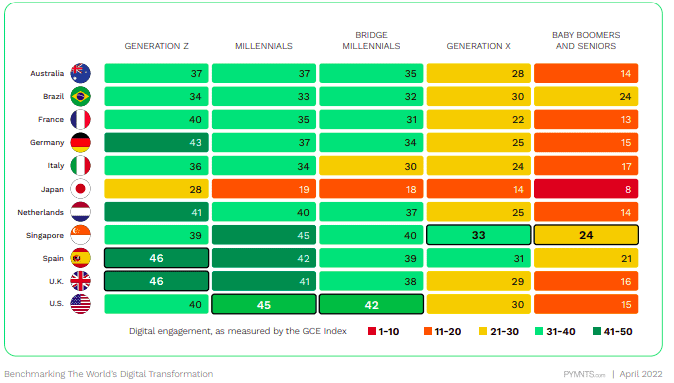
The study shows that the average GCE is 27, indicating that there is still a long way to go for widespread adoption. However, it is worth noting that, at the top of countries with Spain and Singapore have the highest adoption of digital payment systemsThe United Kingdom is in third place, and the United States is in fourth place.
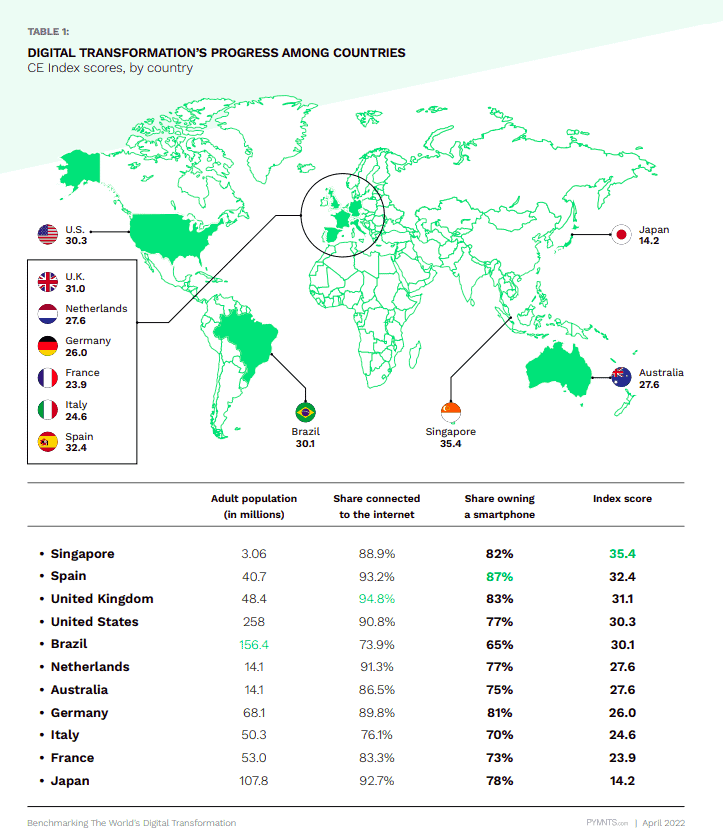
An interesting fact that this study has found is that, although 87% of people in the 11 countries studied are connected to the Internet, only 19% of the population in these countries uses the technology for payments or other use cases. In this regard, countries like Singapore, where older people are connected, tend to have higher adoption.
In most cases, users are 40% more engaged with technology use cases than They do not imply the need to make a purchase. Furthermore, to engage older segments, technology must remove barriers to use, with entry ramps that have less friction.
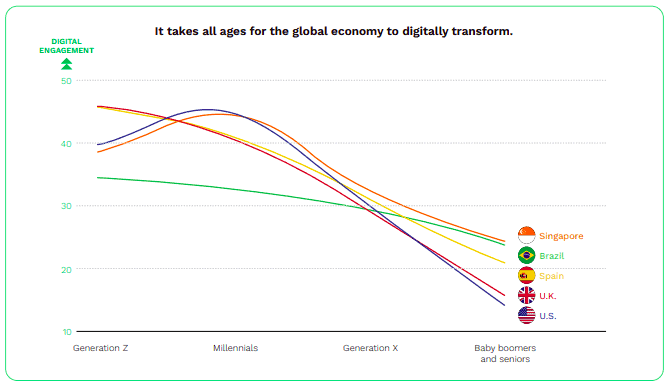
In this sense, although it is common to think that it is the Millennial generation and later that have a greater adoption, in reality, there are countries, such as Singapore or Spain, in which a large segment of Seniors of 40 years have adopted and use technology in their daily lives. In contrast, Japan and the United States are at the bottom of the list in terms of digital adoption among older people.
When it comes to payments, most users are comfortable using methods such as credit cards or digital wallets in which they have previously stored funds. However, they are not yet comfortable with methods such as cryptocurrencies, and many are calling for some kind of national solution.
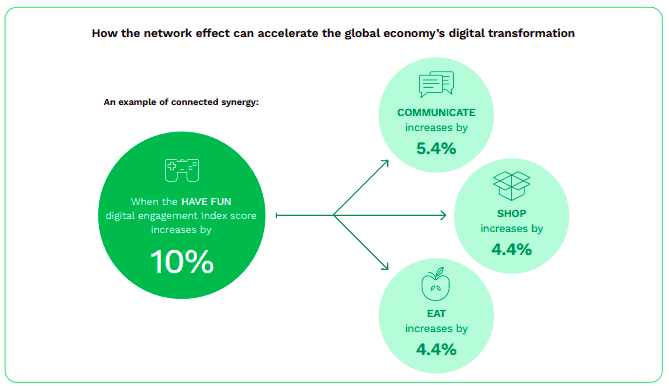
On the other hand, adoption is contagious, since Users naturally expand their digital footprint activities that share similar characteristics. For example, 60% of users who watch streaming videos also tend to use social networks or chat applications.
The study identifies ten pillars, corresponding to ten categories of use or technologies, that are directly involved in adoption:
- Banking
- Health
- Communication
- Food
- Leisure
- Lifestyle
- Mobility
- Payments
- Venta
- Work
However, one of the main barriers to adoption is the need for involve a large percentage of the population. In this sense, although more than 80% of the population of the 11 countries studied are connected to the Internet, only 19% of people have really adopted the technologies and have become involved in any of the ten pillars.
The report details that the fact that older generations are falling behind in the use of digital payment technologies is causing delays in economic development and is slowing down widespread adoption. In this sense, the nations that are making the most progress are those in which the incorporation of users to technology is independent of their age, such as in Spain or Singapore.