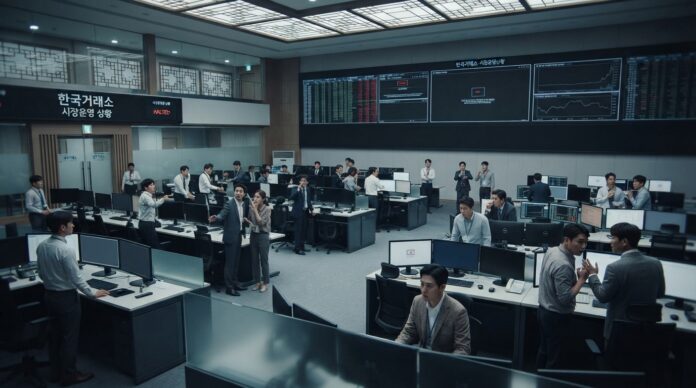
Extreme volatility has shaken Asian markets. South Korea's stock exchange has had to suspend trading 38 times this year after suffering severe declines in its main indices. This scenario poses new challenges to financial stability in the face of digital assets.
The impact of the declines on the KOSPI index
The Asian financial market is experiencing a period of unprecedented turbulence. The South Korean stock exchange (KRX) has suspended its operations 38 times this yearThis comes after a new wave of downward volatility that plunged the KOSPI index price by 4,46%. According to reports, these interruptions were triggered through activations of a certain type. sell-sidecar, a mechanism designed to halt trading when markets fall by more than 5%, thus preventing a larger collapse.
The KOSPI index has fallen below 6.500 points, accumulating a 28% loss in the last month. Of the 38 trading halts recorded, 20 affected the KOSPI and 10 the KOSDAQ technology index, including general market stoppages of up to 20 minutes that completely paralyzed trading.
Volatility comparison: Traditional markets vs. crypto
Traditionally, stock markets have been perceived as more stable environments compared to the digital asset ecosystem. However, recent data from South Korea challenges this narrative. During June, the KOSPI index experienced such pronounced swings that it surpassed the volatility recorded by Bitcoin (BTC). This phenomenon underscores how traditional markets are also susceptible to severe and sudden corrections.
If you're thinking about diversifying and buy Bitcoin To build your portfolio, it's essential to understand that all markets carry known and managed risk. While Asian markets grapple with these disruptions, in Europe, the MiCA Regulation has established a clear framework that brings transparency to the crypto sector. Blockchain technology offers traceability that stands in stark contrast to the opacity that sometimes surrounds traditional finance during periods of panic selling.
Geopolitical factors and the energy crisis
The instability in the South Korean stock market is not happening in a vacuum. Geopolitical events are having a significant impact on international markets. Tensions between the United States and Iran have escalated, affecting oil tanker traffic in the Strait of Hormuz. This is critical for South Korea, as its energy industry relies on imported fossil fuels for 80% of its needs.
Most of these resources must travel along this maritime route, leaving the country's economy and financial markets extremely vulnerable to any disruption in the global supply chain. This external dependence is one of the main drivers of the current distrust in its stock market.
South Korea's technology sector in decline
The technology sector, a key pillar of the South Korean economy, has also not escaped this downward trend. Despite a brief initial rebound driven by advances in the artificial intelligence industry, tech giants like SK Hynix and Samsung Electronics have suffered declines of 36% and 31%, respectively, over the past month.
These figures reflect a drastic shift in market sentiment, where even the most established companies are not immune to significant corrections. To better understand how macroeconomic cycles affect different sectors and how digital innovation offers alternatives, you can explore the educational resources available at Bit2Me Academy.
FAQ
What is a 'sell-sidecar' mechanism on the stock exchange?
It is a safety tool implemented by stock exchanges to temporarily halt trading when an index experiences a drop of more than 5%. Its main objective is to curb panic selling and allow the market to stabilize before trading resumes.
Why is South Korea's economy so vulnerable to geopolitics?
South Korea relies on fossil fuel imports for 80% of its energy needs. Much of this supply transits the Strait of Hormuz, so any conflict in that region directly impacts its costs and financial confidence.
How does the volatility of the KOSPI compare to that of Bitcoin?
Unusually, during the month of June, the South Korean stock index KOSPI registered higher volatility than Bitcoin (BTC). This demonstrates that traditional markets can also experience extreme fluctuations, debunking the myth that only cryptocurrencies exhibit high volatility.
The situation on the South Korean stock exchange serves as a reminder of the interconnectedness of global markets and the influence of macroeconomic factors. The 38 trading suspensions reflect a highly volatile environment, where energy dependence and geopolitical conflicts play a decisive role in the financial stability of Asian powers.
As the global economic landscape continues to evolve, comparing the volatility of traditional stock market indices with that of digital assets offers a new perspective on risk management. Observing these movements allows for a better understanding of the dynamics that govern the value and resilience of different financial ecosystems today.
Investing in cryptoassets is not fully regulated, may not be suitable for retail investors due to high volatility and there is a risk of losing all invested amounts.