
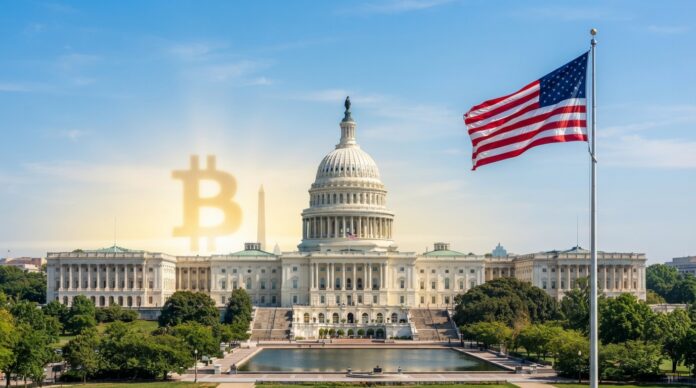
The White House has reached an agreement on the ethical provisions of the CLARITY Act, a key step in its attempt to secure Democratic support in the U.S. Senate. This legislative advance seeks to definitively structure the cryptocurrency market in the United States.
While Europe is moving forward with clear regulations like the MiCA Regulation, the United States is trying to accelerate its own regulatory framework. This reduction in political uncertainty has already generated notable upward movements in major assets like Bitcoin.
The ethics agreement in the US Senate
The White House has agreed to include ethical provisions in the crypto market structure billFormally known as the CLARITY Act (Digital Asset Market Clarity Act), this strategic move seeks to secure the support of Democratic lawmakers in the U.S. Senate. According to recent reports, senior government officials have held key meetings with Republican senators, such as Cynthia Lummis and Bernie Moreno, to reach a consensus on ethical language that satisfies both sides of the political spectrum.
The primary goal of these intense negotiations is to secure bipartisan support in what is expected to be a very close vote. For the legislation to advance in the Senate, it needs to surpass the demanding threshold of 60 votes, a complex task in the current political climate. Ethical concerns are also a major issue; several Democratic lawmakers, including Elizabeth Warren and Chris Murphy, had publicly warned that any legislative proposal would be worthless if it did not address potential conflicts of interest involving senior administration officials, particularly regarding memecoin projects or family-run businesses within the sector.
The administration has stated its firm commitment to working with Congress to advance the CLARITY Act, embracing what they describe as one of the broadest and most comprehensive ethical provisions in recent history. This level of commitment underscores the institutional urgency of establishing a regulatory framework to bring order to the digital asset landscape in the world's largest economy.
The direct impact on the price of Bitcoin
The market reacted swiftly to these legislative developments. The price of Bitcoin (BTC) experienced a significant surge, surpassing the $66.000 mark and reaching highs not seen in the last seven weeks. This bullish behavior reflects the deep sensitivity of the crypto ecosystem to any news that points toward greater legal certainty and institutional clarity in the United States.
When governments move towards creating defined regulatory frameworks, the perception of institutional risk decreases dramatically. This encourages more users and institutions to buy Bitcoin and add this asset to their corporate treasuries or build their long-term portfolio. The expectation that the CLARITY Act may be passed in the near future has injected a strong dose of optimism into the charts, demonstrating that regulation, far from being a hindrance, acts as a catalyst for mass adoption when designed in a balanced way.
Industry analysts agree that price action is closely tied to the potential passage of this law, coupled with a macroeconomic context where new international tariff policies are being debated. The market's technical structure shows signs of strength, driven by the narrative that the United States could finally offer a level playing field for companies and users in the crypto ecosystem.
The historical obstacles of the CLARITY Act
The CLARITY Act's journey has not been without significant challenges. Initially passed by the House of Representatives in July 2025 as part of an ambitious legislative agenda focused on digital assets, the proposal has faced numerous delays in Congress. These setbacks have been driven by both broader government shutdowns and highly specific technical debates surrounding the nature of blockchain technology.
Among the most prominent points of contention in recent months are regulations concerning the tokenization of real-world assets (RWAs), the legal treatment of stablecoin rewards, and provisions to protect software developers from disproportionate enforcement actions. The industry has lobbied heavily to ensure that open source and decentralized protocol development are not equated with the provision of traditional financial services—a crucial distinction for maintaining technological innovation in the United States.
Despite strong public support from numerous crypto industry executives and several lawmakers who urged the passage of the bill honoring historical political figures, uncertainty about whether the project will garner the necessary votes has kept the sector on edge. The inclusion of new ethical provisions appears to be the key to unlocking Democratic support, although some are still calling for additional hearings to fully explore the implications of these measures before a final vote is cast.
The regulatory contrast with the MiCA Regulation
The current situation in the United States contrasts sharply with the regulatory landscape in Europe. While the US Congress continues to debate the fundamentals of market structure and the powers of its agencies, the European Union has already implemented the MiCA Regulation, establishing an indisputable global standard for the industry. This regulatory framework provides clear, uniform, and predictable rules of the game for the issuance of crypto assets and the provision of services across all member states.
MiCA has succeeded in creating an audited and transparent environment where platforms operate under strict capital, governance, and user protection requirements. This regulatory clarity allows companies to plan for the long term and users to operate in an ecosystem with known and managed risk. If you would like to learn more about how these European regulations protect your market share and shape the future of digital money, you can consult the educational resources available at [link to resources]. Bit2Me Academy.
The United States' delay in enacting legislation equivalent to MiCA has generated persistent concerns about a potential brain drain and capital flight to more favorable jurisdictions. The CLARITY Act represents Washington's most serious attempt to close this competitive gap, seeking to harmonize oversight across agencies and provide clear definitions for the classification of digital assets.
The importance of user protection
Beyond the ethical provisions designed for legislators and high-ranking officials, negotiations in the Senate have also placed a strong emphasis on consumer protection. Industry representatives have noted that lawmakers have succeeded in including specific clauses intended to safeguard the interests of retail consumers against potential malpractice.
These protective measures are fundamental to ensuring that exchange platforms operate with maximum transparency. The requirement for segregation of funds, the prohibition of mixing corporate and client assets, and the obligation to conduct regular audits are pillars that any modern regulation must include to be effective.
The convergence between government ethical requirements and consumer protection standards indicates a genuine maturation in the US legislative debate. It is no longer simply a matter of restricting crypto assets, but rather of integrating them into the formal financial system in a way that fosters technological innovation without compromising market integrity or the security of participants.
FAQ
What exactly is the CLARITY Act?
The CLARITY Act is a US legislative project designed to establish a clear market structure for crypto assets. Its primary objective is to define the jurisdictions of regulatory agencies, classify digital assets, and establish strict operating standards for exchange and custody platforms.
Why is the price of Bitcoin reacting to this news?
The crypto market is extremely sensitive to regulation by major economic powers. When advances are announced that promise greater legal certainty and clear rules, institutional confidence increases, which usually translates into increased demand for Bitcoin.
In conclusion, the pursuit of an ethical and bipartisan consensus around the CLARITY Act demonstrates the growing strategic relevance of digital assets in US politics. If it achieves final approval, the regulatory framework will not only provide greater stability to Bitcoin and the market in general, but will also position the United States in a global regulatory race where Europe has already taken the lead with the MiCA regulation.
Investing in cryptoassets is not fully regulated, may not be suitable for retail investors due to high volatility and there is a risk of losing all invested amounts.