

Bitcoin spot ETFs experienced a week of massive capital outflows, despite the recovery shown by the price of Bitcoin.
Although the price of the leading cryptocurrency recovered, trading again above $70.000, the funds linked to its performance reflect a different scenario.
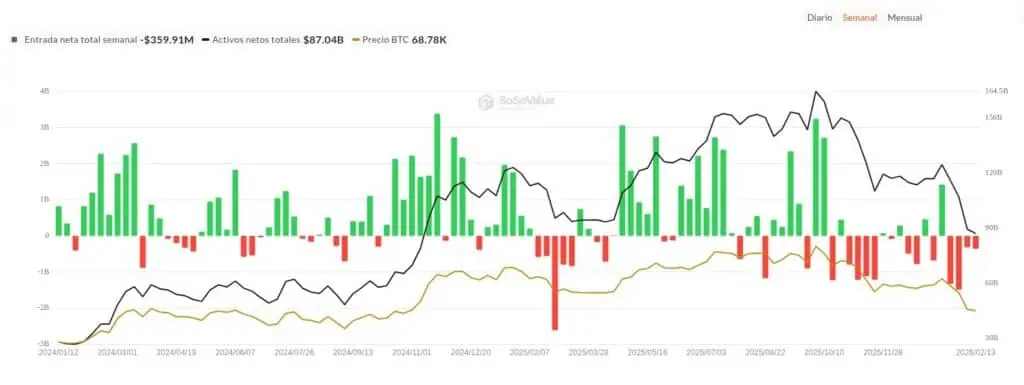
For the fourth consecutive week, Bitcoin spot ETFs registered sustained outflows, according to the latest data from the SosoValue platform. This behavior marks an unexpected shift in the 2026 outlook, surprising analysts who had closely followed its strong performance over the previous year.
Throughout 2025, these funds were seen as the central driving force behind the bullish surge that propelled the cryptocurrency market to new highs. The massive influx of institutional capital solidified Bitcoin ETFs as a key catalyst for mass adoption. However, the current cycle shows different signs, with withdrawals already exceeding $8.500 billion since the beginning of the year.
The figures compiled by the platform specializing in institutional flows reflect that products managed by firms like BlackRock and Fidelity have experienced significant net outflows. This shift is clearly visible in market performance charts. Red liquidation bars dominate the market this year, beginning to erode the ground gained by investors in previous months and revealing a moderation in the enthusiasm that accompanied the initial boom in Bitcoin ETFs.
Invest in Bitcoin and Ethereum: Visit Bit2MeThe change of pace in institutional investment in Bitcoin
According to the data consulted, the dynamics of Bitcoin exchange-traded funds have shifted from an accumulation phase to one of profit-taking or portfolio readjustment.
While optimism in mid-January propelled total assets under management to $124.000 billion, the last week of the month shows selling pressure that has eroded some of that growth. Institutional flows, which previously concentrated in products like IBIT and FBTC with daily inflows in the millions, now reflect an outflow of funds that has exceeded the volume of purchases recorded in previous days.
Market experts point out that this behavior is usually linked to the inherent volatility of the digital asset market and the macroeconomic uncertainty that influences the decisions of large capital managers.
Source: Soso Value
The capital outflow has not been limited exclusively to the ecosystem's main asset, as Ethereum-based listed products have also experienced a slowdown in their adoption metrics, registering outflows of funds for the fourth consecutive week, as have those of Bitcoin.
SoSoValue data reveals that trading volume remains high, while capital is beginning to return with minimum daily inflows of at least $15 million in Bitcoin alone. However, the picture changes when considering large capital, which is now moving in the opposite direction. Traditional investors are opting for caution and registering net weekly withdrawals, a trend that clashes with the fresh inflows that arrived in funds on Friday. This data points to a market undergoing technical consolidation, having reached a point of saturation in institutional buying.
Take advantage of capital turnover: trade altcoinsResilience in the alternative cryptocurrency ecosystem
In stark contrast to the trend observed in larger capitalization exchange-traded funds, investment vehicles based on alternative digital assets have managed to break away from the general trend of the market.
While Bitcoin and Ethereum have recorded four consecutive weeks of net outflows, financial products linked to Solana, XRP, Dogecoin y chainlink They have managed to keep their flows in positive territory in recent weeks. This investor behavior suggests that some institutional flows are seeking diversification opportunities in networks that offer differentiated value propositions, such as Solana's high transaction efficiency or XRP's utility in international payment systems.
Market data indicates that these instruments have consistently attracted capital, acting as a counterweight to the caution that prevails in the funds of the market's two main assets.
The stability of these altcoin funds reflects a maturing of risk perception among investors, who no longer view the market as a monolithic entity that moves exclusively to the rhythm of Bitcoin. According to market reports, interest in Solana has been bolstered by its technical resilience, while Chainlink continues to attract capital thanks to its fundamental role as an oracle provider for smart contract infrastructure.
These regulated investment vehicles allow wealth managers to access the technological innovations of various blockchain networks without needing to directly manage private keys, maintaining controlled and professional exposure. This subtle preference for specific assets demonstrates that the current ecosystem is deep enough to allow other solid projects to continue expanding their assets under management as normal, even during periods of readjustment for industry leaders.
Buy SOL, XRP and LINK, today's favorites