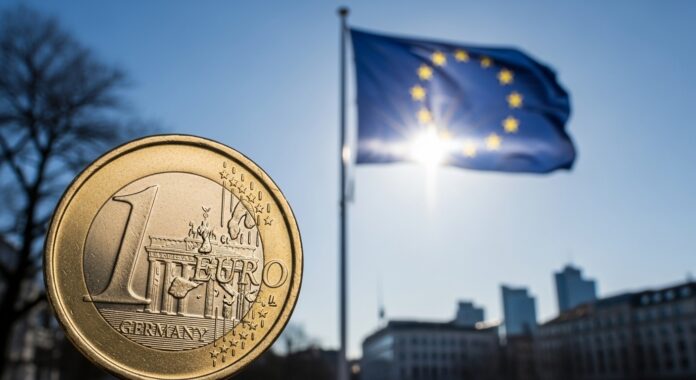
S&P Global has projected exponential growth for euro stablecoins, estimating a market of 1,1 trillion euros by 2030, driven by the tokenization of real assets and MiCA regulation.
While the dominance of the US dollar in the crypto sector has been undisputed for the past decade, a new report from S&P Global Ratings This suggests that the digital euro is awakening. According to the rating agency, stablecoins pegged to the European single currency are positioned to become the backbone of capital market modernization.
Although these stablecoins currently represent a minimal fraction of the global market, the convergence of clear regulation and the rise of real-world asset tokenization (RWA) are paving the way for unprecedented institutional adoption.
S&P estimates that this market, which barely touched the 650 From millions of euros at the end of 2025, it could climb to 1,1 trillion euros by 2030, marking a milestone in the financial architecture of the eurozone.
Trade regulated stablecoins hereTokenization as the engine of 1.600x growth
Unlike dollar-based stablecoins, whose primary use has historically been speculative trading and arbitrage on exchanges, the digital euro is finding its purpose in corporate applications. S&P analysts emphasize that it won't be retail payments that drive the volume of these assets, but rather... need to settle traditional asset transactions —such as bonds, stocks, and real estate— that are being migrated to the blockchain.
This tokenization innovation allows complex financial assets to be divided into manageable digital units, reducing settlement times from days to seconds.
The report, cited by media outlets such as The Block, highlights that Tokenization not only improves efficiency and shortens value chainsBut It also expands access opportunities for investorsThis shift already has the backing of major investment firms like BlackRock and Fidelity, which have recognized its transformative potential. In Europe, the expansion of the digital euro relies on a tokenized payments network capable of attracting corporate demand estimated at over €100.000 billion, driven by companies seeking to manage their liquidity more precisely.
Based on this, the firm's projected growth figures are astounding: a a 1.600-fold increase in just five yearsTo put this in perspective, S&P's most optimistic scenario would see euro-denominated stablecoins representing 4,2% of eurozone banks' overnight deposits by the end of the decade. This deep integration suggests that stablecoins will cease to be a niche product and become a systemic component of the traditional banking system.
Enter Bit2Me and anticipate the rise of the digital euroEurope gains momentum in the stablecoin market under the MiCA framework
While the United States has led in volume thanks to liquidity, Europe is taking the lead through... legal certaintyThe S&P report highlights that the final entry into force of the Cryptoasset Markets Regulation (MiCA) It has eliminated the main obstacle for financial institutions: legal risk. Now, with clear rules on reserves, custody, and issuance, European banks have moved from caution to execution.
This competitive advantage is already materializing in concrete initiatives. A consortium of eleven European banks from nine different countries has already announced plans for the joint issuance of euro-denominated stablecoins through QivalisA platform based in the Netherlands. This move seeks to wrest control of the market from non-bank entities and native cryptocurrency platforms, which until now have operated in a regulatory limbo.
S&P notes that this "fast follower advantage" will allow the Eurozone to close the gap with the $310.000 billion currently circulating in dollar-linked stablecoins.
The firm also indicated that the interoperability with emerging payment systems And improvements in the scalability of blockchain networks, such as Layer 2 solutions, are the technical catalysts that will allow these projections to become reality. At the same time, S&P emphasized that institutional banks no longer see stablecoins as an external threat, but rather as a necessary tool to avoid being replaced by new technological platforms.
Choose the certainty of MiCA: trade on Bit2MeThe next wave of financial digitization
According to S&P Global, the global financial system is moving steadily towards a tokenized model, in which the digitization of value redefines how capital circulates.
While the 2025 market was defined by Bitcoin's consolidation as a reserve asset, experts predict that 2026 and subsequent years will be defined by the digitization of fiat currency for institutional use. S&P's benchmark projection, which anticipates approximately €570.000 billion by 2030 in a base scenario, allocates the vast majority of this value to investment applications.
As central banks around the world, including those in the eurozone, explore their own central bank digital currencies (CBDCs), private stablecoins issued under the MiCA framework will serve as the necessary bridge for immediate liquidity.
The eurozone's €28 trillion market in real-world assets is the ultimate prize. If just 1,2% of those assets are tokenized, as S&P forecasts based on US metrics, the digital euro will not only reach a valuation of €1 trillion by the target date, but will also definitively transform how capital flows across European borders, reducing costs and eliminating unnecessary intermediaries in an increasingly impatient global economy.
 Certificate
Blockchain Course
Basic levelTake this course where we explain blockchain in a clear, simple and concise way so that you have a very clear idea of what this new technology consists of.