

In a rare display of individual success, two lone miners managed to validate entire Bitcoin blocks in less than 48 hours, defying the odds and reopening the discussion about the concentration of computing power on the network.
Just 48 hours after the first solo miner of 2026 managed to claim the full reward of a Bitcoin block using rented hash power, another independent operator has repeated the feat. This second event caps off an extraordinary week for solo miners, establishing Two consecutive victories for this model, in an environment where the probability of individual success is infinitesimal.
Both operators managed to process complete blocks without the intermediation of traditional pools and secured profits close to $300.000 each, a fact that has shaken the usual narrative about the centralization of Bitcoin mining.
Buy Bitcoin directly on Bit2MeThe most recent incident occurred on Wednesday, when an unidentified validator secured the block #932.373 and claimed a total of 3,16 bitcoinsThis figure includes both the fixed reward or subsidy that the Bitcoin protocol grants for the creation of a new block, and the transaction fees included in that block.
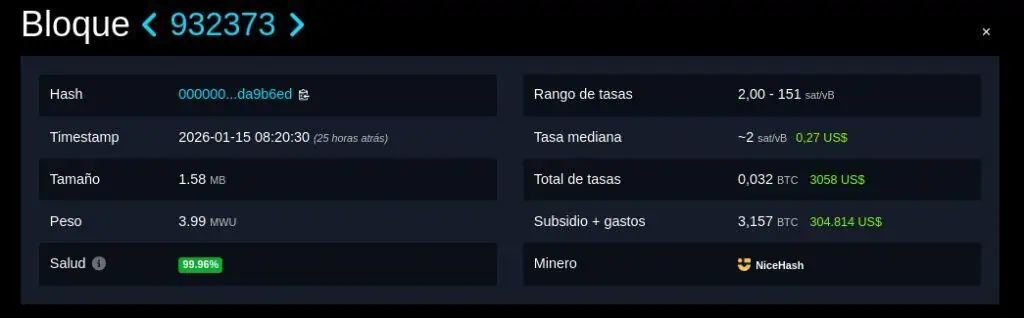
For experts and the community at large, what is surprising about this case is its temporal proximity to the event of the previous Tuesday, when another solo participant achieved a similar success, by solving block #932.129, keeping the entire mining reward.
A winning streak against industry giants
To understand the magnitude of these two consecutive successes, it's necessary to analyze the current network structure. Data from mempool.space and other block explorers reveals that transaction validation is massively dominated by corporate entities. Foundry USA, AntPool, and F2Pool together control approximately 57% of global computing power.
In this scenario, for a single individual to solve the mathematical problem of the blockchain protocol before these giants is comparable to winning the lottery, and for it to happen twice in the same week is... a statistical rarity that is rarely observed.
Technical analysis of these recent blocks suggests that luck wasn't the only factor; operational strategy also played a role. On-chain metadata indicates that both winners used hashrate rental services like NiceHash. This means the operators didn't necessarily own warehouses full of their own ASIC equipment, but instead purchased temporary computing power to feed into the Bitcoin network. While this tactic allows participation without an initial hardware investment, it carries considerable financial risk, as the user must pay for the rental upfront with no guarantee of return. However, in this atypical week, the gamble paid massive dividends by exceeding the combined capacity of industrial pools on two separate occasions.
Enter and get BTC easily and securelyLone miners find a niche in a transforming market
These individual victories come at an interesting time of transition for mining infrastructure, especially in North America. According to research by BlocksBridge Consulting, the share of US mining groups in the network has declined significantly over the past year. While they controlled more than 40% of validated blocks last January, that figure fell to 35% in December. This decline has opened up small gaps that international competitors and, apparently, bold solo miners are exploiting.
The cause of this decline in US dominance is not a lack of resources, but a strategic shift in capital. Multiple publicly traded mining companies, including Foundry USA and subsidiaries of Luxor Technologies, have redirected some of their infrastructure toward data processing for artificial intelligence. The rise of AI offers profit margins that sometimes surpass those of cryptocurrency mining, leading these firms to diversify their operations to sustain their stock valuations. This reality has slightly reduced competitive pressure in the crypto ecosystem, creating an environment where this week's unlikely victories by solo miners could materialize.
Bitcoin's decentralization is still alive
The excitement these headlines generate within the community is understandable, although analysts insist these cases represent exceptions and not signs of a sustained market trend. Solo mining remains a high-stakes gamble, where almost all participants face losses due to high energy and maintenance costs.
That's why mining pools exist, which distribute moderate and regular rewards among thousands of users, thus reducing the ups and downs inherent in individual risk.
Even so, the validation of these blocks by anonymous operators can be interpreted as a sign of the Bitcoin protocol's vitality. It makes it clear that the network, guided solely by its mathematical structure, maintains its neutrality without favoring anyone. Anyone with the necessary processing power and proof of work has the opportunity to solve a block and claim a reward.
Buy Bitcoin and trade with confidence


