

The strategic alliance between Ripple and LMAX Group integrates the RLUSD stablecoin as a unified guarantee in institutional markets, optimizing settlement between currencies and crypto assets.
The institutional finance ecosystem continues its transformation through the convergence of digital assets and traditional markets. In a recent move underscoring this trend, Ripple Labs has secured a strategic $150 million investment in LMAX Group. This multi-year agreement focuses on integrating the RLUSD stablecoin into the global firm's institutional trading systems.
The aforementioned alliance establishes the dollar-pegged token developed by the financial technology company as a main guarantee on platforms that serve banks, brokers, and asset management firms.
This initiative seeks to address one of the most persistent operational challenges in high-volume trading: liquidity fragmentation. Now, financial institutions will use RLUSD to meet margin and settlement requirements across a wide range of instruments. These include the cryptocurrency spot market, perpetual futures, contracts for difference, and certain currency trading pairs. This innovative integration aims to... improve capital efficiency by allowing the consolidation of guarantees across different asset classes, facilitating continuous market access without the usual frictions of traditional banking systems.
A bridge to a more efficient financial infrastructure
The current structure of financial markets forces many firms to maintain separate margin funds for different asset classes, resulting in inefficient capital deployment. Firms operating simultaneously in foreign exchange and digital asset markets often have to duplicate their collateral or navigate slow settlement processes that tie up valuable resources. However, the proposal to use RLUSD across the entire LMAX infrastructure directly addresses this problem.
By consolidating collateral under a single stable digital asset, operational friction is significantly reduced, and liquidity currently fragmented across disconnected systems is unlocked. LMAX custody will provide access to the stablecoin through segregated wallets, while the platform's kiosk system will allow trading between fiat currencies and digital assets using these same collateral.
According to the firms, this connection between LMAX Digital and Ripple Prime will offer institutional clients a unified credit infrastructureThe ability to use a stable digital asset like RLUSD to hedge positions in markets as diverse as perpetual futures and forex trading represents a step forward in modernizing market infrastructure.
According to experts, this practical utility is a determining factor in the institutional adoption of blockchain technology, moving it away from pure speculation and closer to real financial utility.
RLUSD is moving towards a more integrated ecosystem
The development of RLUSD has focused specifically on institutional participants rather than retail cryptocurrency traders. Ripple has emphasized regulatory compliance throughout the development process of this stablecoin to ensure it can be adopted by regulated entities without legal risks.
According to data from the analytics platform RWAxyz, Ripple's stablecoin reached $1.400 billion in total issuance in approximately one year since its launch; a figure that reflects the existing demand for financial instruments that combine the speed of blockchain with the stability of fiat currencies.
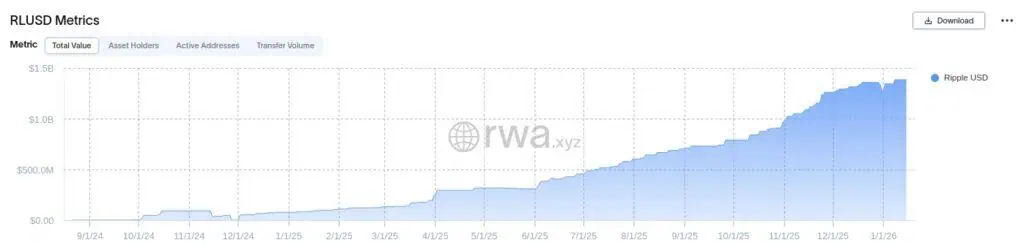
Source: RWAxyz
For its part, the LMAX Group has proven to be a major partner in this integration. Last year, the firm processed $8,2 trillion in institutional trading volumeThis highlights a sustained demand for traditional financing for regulated access to digital assets. The collaboration allows Ripple to access a high-level transaction flow, integrating its technology into the very heart of global financial activity.
LMAX CEO David Mercer, framed This collaboration directly supports the goal of creating unified and regulated markets. Their vision aims for a seamless connection between traditional foreign exchange trading and cryptocurrencies, eliminating the technological barriers that have historically kept these two worlds separate. In short, the alliance not only validates Ripple's technology but also positions LMAX as a pioneer in the adoption of hybrid infrastructures.

Ripple strengthens its institutional presence
The technical implementation of this agreement promises to expedite capital deployment for firms managing diversified portfolios. The ability to perform near-instantaneous settlements and manage margins in real time using the RLUSD stablecoin could set a new industry standard. Financial institutions are constantly seeking ways to reduce costs and counterparty risks, and the use of regulated stablecoins in professional trading environments offers tangible solutions to these needs.
According to experts, as the cryptocurrency market matures, the distinction between traditional and digital finance is becoming increasingly blurred. The integration of blockchain tools into platforms that handle trillions of dollars in annual volume suggests that the future of institutional trading will be hybrid.
The ability to move value between different asset classes without friction is fundamental to the evolution of global markets, and alliances like the one between Ripple and LMAX Group are concrete steps in that direction.


