

The state of Wyoming has launched the Frontier Stable Token (FRNT), the first U.S. state-owned stablecoin, backed by Treasury bonds and deployed across seven blockchains.
The presenter of Crypto in America, Eleanor Terrett, has reported that the state of Wyoming officially launched the Frontier Stable Token (FRNT), becoming the first in the United States to issue a state-backed stablecoin backed by public assets.
According to reports, this launch not only has the potential to redefine the role of local governments in digital financial infrastructure, but also raises key questions about monetary sovereignty, federal regulation, and the future of digital currencies issued by subnational entities.
Bit2Me connects your wallet to the stable ecosystemWhat is FRNT? A state-backed stablecoin backed by public assets
The Frontier Stable Token (FRNT) is a new state-owned stablecoin that represents an unprecedented institutional experiment in the American crypto ecosystem. Unlike private digital currencies like USDC or USDT, the FRNT is issued directly by the state of Wyoming and backed by public assets, such as short-term U.S. Treasury bonds and cash. The stablecoin has a structure that seeks to ensure stability, transparency, and public utility, moving away from corporate models that prioritize shareholder returns.
According to report published by Terrett, the FRNT operates on seven blockchain networksIncluding Ethereum, Solana y Avalanche, and the Layer 2s of the Ethereum ecosystem, Optimism, Base, Polygon y Arbitum.
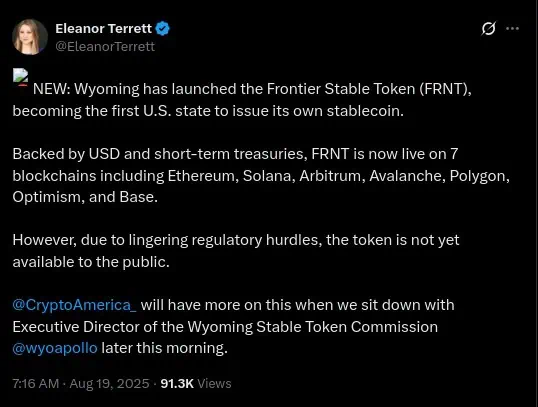
Unlike CBDCs, which are digital currencies issued by central banks, the FRNT does not seek to exercise monetary policy functions, and its interest is allocated to the state education fund. However, its distribution to the public is blockedThis stablecoin reportedly faces persistent regulatory hurdles that prevent its widespread use.
Do not forget that GENIUS Act, passed by Congress during “Cryptocurrency Week” and signed into law by Trump, is the regulation that governs the issuance and management of stablecoins in the country. According to this law, new digital currencies must comply with strict requirements and controls. Some experts have commented that Wyoming’s new stablecoin closely resembles a “disguised” CBDC. In case of doubt, Terrett reported that more details about FRNT would be released later, after interviewing the executive director of the Wyoming Stabletoken Commission. Anthony Apollo.
Create your account and trade stablecoins without barriersDoes FRNT have real utility in the DeFi ecosystem?
As mentioned, the technical deployment of FRNT spans seven blockchains, including Ethereum's L2. This interoperability between chains This could facilitate the stablecoin's integration into various decentralized applications (dApps) and payment platforms, without relying on a single infrastructure. In theory, this could give FRNT a competitive advantage by facilitating fast and flexible transactions in the DeFi ecosystem.
However, the reality is less clear due to federal regulatory barriers that complicate its development and effective use. According to several analysts, these barriers are leaving FRNT trapped in a legal limbo, with uncertainties on critical issues keeping developers and users cautious, uncertain about when or how they will be able to use this digital asset.
On the other hand, while some users in the crypto ecosystem are celebrating this launch, highlighting Wyoming's efforts to stay at the forefront of innovation, others question the need to create a state stablecoin in a growing market that is rapidly approaching 290.000 million in global capitalization.
 Certificate
Blockchain Course
Basic levelTake this course where we explain blockchain in a clear, simple and concise way so that you have a very clear idea of what this new technology consists of.
Hong Kong and the regulated model of HKD-pegged stablecoins
While the legitimacy of state-owned stablecoins like the one issued by Wyoming is being debated in the United States, a diametrically opposite approach has been taken in Hong Kong. The Chinese special administrative region has opted to exclusively regulate stable tokens pegged to the Hong Kong dollar (HKD)The new legislation requires 100% audited reserves, immediate redemption, strict governance and mandatory licensing for issuers, establishing a new framework that seeks to avoid systemic risks and consolidate Hong Kong as a crypto-regulated financial hub in Asia.
Unlike the FRNT, which was designed for national and international use but still faces internal regulatory barriers, the Hong Kong model prioritizes legal clarity and consumer protection. By limiting the circulation of unauthorized foreign stablecoins, the region strengthens its monetary sovereignty and establishes an institutional standard for the issuance of digital assets backed by local currency. This approach has been welcomed by traditional financial players, who see regulation as a way to integrate stablecoins into the banking system without compromising stability.
The contrast between Wyoming and Hong Kong reveals two distinct visions for the future of government-backed digital currencies. While one champions decentralized innovation from the state, the other opts for centralized regulation with strict standards. Both models, however, share a common goal: to redefine the role of digital money in the modern economy, balancing transparency, public utility, and financial sovereignty.
Bit2Me: Your secure access to regulated stablecoins