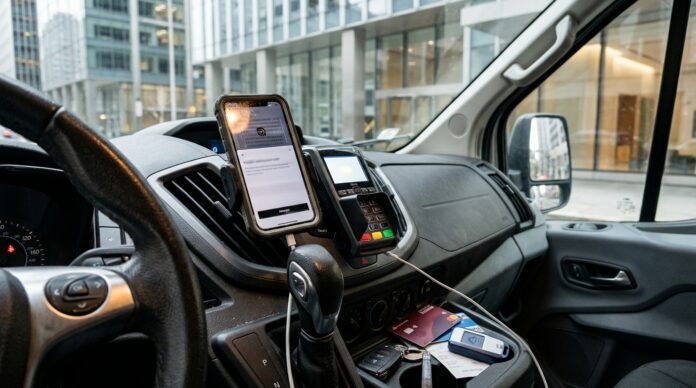
Uber has tested digital asset technology in collaboration with HSBC and Franklin Templeton. The pilot project is exploring how tokenization allows companies to keep their capital invested in money market funds while maintaining the operational capacity to process payments uninterrupted, even on weekends.
This initiative marks a decisive step in large-scale corporate treasury management, demonstrating that real-world assets represented in decentralized networks can resolve the liquidity frictions that traditional banking still struggles with.
Corporate treasury management using tokenized assets
Large multinationals move billions of euros daily to sustain their global operations, facing a structural inefficiency: idle money in current accounts does not generate a competitive return, while assets that offer better capital conditions often require liquidation periods that limit their immediate availability.
To address this challenge, Uber has demonstrated how tokenization allows idle liquidity to be put to work. through structured financial instruments in partnership with HSBC and Franklin Templeton. This pilot test demonstrates how distributed ledger infrastructure enables a treasury to maintain positions in money market products while simultaneously having liquid funds available to meet payments without delay.
The main objective is to optimize every euro or dollar available within the corporate structure. Instead of leaving balances tied up during bank closing hours, the digital representation of these funds allows them to maintain exposure to market rates without sacrificing the transactional agility required by a real-time business model.
Overcoming the limitations of the conventional banking calendar
One of the biggest bottlenecks in traditional financial management is the reliance on business hours and weekdays. Standard interbank transfer systems suspend some of their operations on weekends and holidays, forcing companies to accumulate unproductive cash reserves to ensure their continued operations.
Through the infrastructure developed with Franklin Templeton and the banking integration with HSBC, the transportation and delivery platform was able to run operations seven days a week. The ability to settle transactions over the weekend without needing to unwind positions in monetary assets in advance represents a significant shift for the technology and logistics industry.
This continuous operation allows companies to reduce the opportunity cost of tied-up capital. By enabling cash to continue generating returns until the exact moment it's needed to pay drivers, suppliers, or business partners, treasury significantly optimizes its overall efficiency.
The role of HSBC and Franklin Templeton in institutional integration
The collaboration between a technology giant and two leading traditional financial institutions underscores the maturation of institutional use cases. Franklin Templeton has been one of the pioneering asset managers in the crypto ecosystem by issuing money market funds represented directly on public, permissioned blockchain ledgers.
For its part, HSBC's custody and transaction banking division provides the essential regulatory and operational bridge to link decentralized environments with standard fiat clearing. This synchronization between the two layers ensures that issued assets meet stringent corporate risk controls, auditing, and regulatory compliance.
This institutional model demonstrates that blockchain technology is no longer conceived solely as a speculative vehicle, but as a high-speed transactional layer for regulated financial products. Those interested in understanding the technical foundations behind these instruments can explore the educational resources of Bit2Me Academy, where the architecture of digital assets is analyzed.
Tokenization of real-world assets (RWA) and the regulatory context
The Real World Assets (RWA) segment represents one of the fastest-growing areas within the digital financial ecosystem. Issuing bank notes, sovereign bonds, and liquidity fund shares through tokens allows for the fractionalization, transfer, and settlement of conventional instruments at significantly lower operating costs than traditional processes.
On the regulatory front, Europe is at the forefront thanks to the full implementation of the MiCA Regulation. This legislation provides a uniform and transparent framework that offers legal certainty to issuers, custodians, and transaction platforms throughout the European Union. Although Uber's pilot explores global products, the existence of regulations like MiCA paves the way for European corporations to adopt equivalent solutions without legal uncertainty.
Regulatory clarity is crucial for CFOs to make the leap to these tools. In the analyses on regulation and markets published in Bit2Me News It is frequently observed how the European regulatory framework acts as a catalyst for the entry of corporate capital into audited digital infrastructures, driving new trends in the adoption of cryptocurrencies and tokenized assets by institutional banking.
Long-term impact on the liquidity of large companies
Uber's pilot project is not an isolated experiment, but rather the prelude to a comprehensive transformation of corporate treasury. The ability to automate payment and exchange orders through smart contracts reduces intermediary costs, manual errors, and the time spent on accounting reconciliation.
As more asset managers and banks adopt interoperable tokenization rails, corporations will be able to build smart treasury portfolios. These structures automatically rebalance their balances to capture maximum short-term rate efficiency without jeopardizing day-to-day operating solvency.
The convergence of decentralized finance and institutional financial services opens the door to a financial market that operates 24/7/365. Companies that handle high volumes of instant transactions will find tokenization a key competitive advantage for maximizing their capital efficiency.
FAQ
What problem does liquidity tokenization solve for Uber?
It allows you to keep your capital invested in money market funds, generating continuous returns until the exact moment of payment, avoiding having idle funds in inactive bank accounts to cover commitments during weekends.
Why are traditional banks like HSBC participating in this pilot program?
Banking institutions are seeking to modernize their payment and custody infrastructures, offering their corporate clients continuous settlement solutions that compete with the native agility of digital asset networks.
How does MiCA regulation influence the advancement of corporate tokenization?
The MiCA Regulation establishes clear rules on the issuance of digital assets and the provision of crypto services in the European Union, providing the trusted environment and oversight that corporations need to operate with these technologies.
The initiative coordinated by Uber, HSBC, and Franklin Templeton confirms that the tokenization of real-world assets has moved beyond the conceptual laboratory phase to become a tangible solution to long-standing financial inefficiencies. The ability to manage liquidity continuously and productively redefines the operating rules of global treasury.
As regulatory frameworks evolve and technical interoperability becomes more established, the integration of distributed ledger-based infrastructures will solidify as the preferred standard for multinational corporations seeking to optimize every fraction of their available capital.
Investing in cryptoassets is not fully regulated, may not be suitable for retail investors due to high volatility and there is a risk of losing all invested amounts.
Generative artificial intelligence tools were used to create this article.