The Securities and Exchange Commission (SEC) is working to regulate the cryptocurrency sector and its main focus is Ethereum.
In recent months, the cryptocurrency industry has come under great pressure from lawmakers around the world. In Europe, the MiCA law is getting closer every day, while in the United States, the Securities and Exchange Commission (SEC) It has several open fronts, against Ripple and against some celebrities for promoting EthereumMax.
Furthermore, since the implementation of The Merge, Ethereum has fallen under the scrutiny of the SEC, which could sink its claws into the protocol.
The SEC and the possibility of regulating Ethereum
On the same day that the Ethereum Merger with the Beacon Chain took place, Gary Gensler, director of the SEC, declared in front of the United States Congress that digital assets Proof-of-Stake (PoS) could considered as values.
Gensler explained that the Holders can earn passive income by staking their ETH, meaning “there is an expectation of profits derived from the efforts of others”. This explanation is part of the Howey test, used by the SEC and other regulators to determine whether an asset is a security and therefore subject to federal securities law.
By changing your mining mechanism to a validation mechanism through ETH staking, the SEC could consider Ethereum a security and, therefore, would fall under the Securities Act of 1933, forcing Ethereum to register with the SEC and comply with certain investor protection standards.
ETH staking and securities regulation
Gensler's statements on PoS assets are especially delicate in the case of Ethereum.
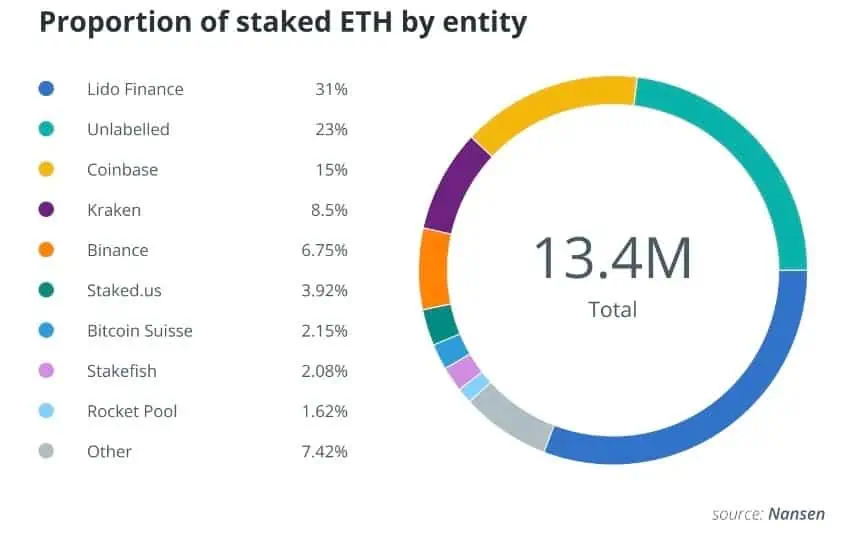
In order to validate transactions on the network, users must stake 32 ETH, a considerably high number, taking into account the price of the asset. Therefore, a common solution is to go to staking providers, such as Lido Finance, avoiding the capital requirement in exchange for receiving a portion of the fee.
If we take into account Gensler's statements, in which he explained that Ethereum transactions fall under the control of the SEC, since most of the ETH validation nodes are on US soil, in the future the SEC could exercise strong control over Ethereum transactions.
If the agency were to exercise this power in the future, could prohibit the validation of certain individual transactions, exerting censorship on the network and increasing transaction confirmation times.
In this way, US regulators could intend to force node validators under their jurisdiction to implement Know Your Customer (KYC) and Anti-Money Laundering (AML) procedures to validate transactions.
This would mean that users would have to verify their identities, their residences and provide personal financial and banking information to staking service providers in order to use it, something that will against the spirit of decentralized finance (DeFi), but that could attract the confidence of institutional investors.
The problem of current regulation and cryptocurrencies
As we have already explained, the SEC has strengthened its control over cryptocurrencies and companies that offer services, especially lending platforms. In fact, the SEC recently announced legal action against BlockFi for failing to register high-yield interest accounts as securities, according to the Investment Company Act of 1940, which led the platform to bankruptcy.
According to experts, the SEC is trying to regulate a modern and disruptive technology, with a legal framework from 1940, which completely makes no sense.
On the other hand, the SEC's statement that Ethereum transactions are under its jurisdiction is also not true, as Etherscan data shows that only 46% of ETH nodes are clustered in the US.
However, all this responds to the efforts of governments around the world to try to regulate and control the DeFi space, where billions of dollars move daily within a decentralized market that is beyond its control.
[hubspot type=cta portal=20298209 id=38fb28e1-1dc1-40e3-9098-5704ca7fcb07]