
The Securities and Exchange Commission (SEC) has made another landmark approval for the crypto world: Ethereum spot ETFs are authorized to be listed on U.S. stock exchanges. However, trading of these investment products will not happen until S-1 filings are approved.
The 10 Ethereum spot ETFs proposed by BlackRock, Grayscale Investments, Fidelity, Ark Invest and 21Shares, Invesco Galaxy, Franklin Templeton, VanEck, Hashdex and Bitwise have been approved by the SEC, after a quiet and discouraging process that had led several market experts to consider that these funds would not be approved this year.
However, the SEC made an unexpected U-turn earlier this week, changing the minds of several experts, when the agency asked US stock exchanges to update the funds' 180b-19 filings. The SEC's actions rekindled hopes for a possible approval, and it has finally happened.
On May 23, the U.S. Securities and Exchange Commission delivered its verdict on the 19b-4 filings of VanEck, BlackRock, Grayscale, Fidelity and the rest of the asset managers, giving the green light to Ethereum funds in the U.S. market.
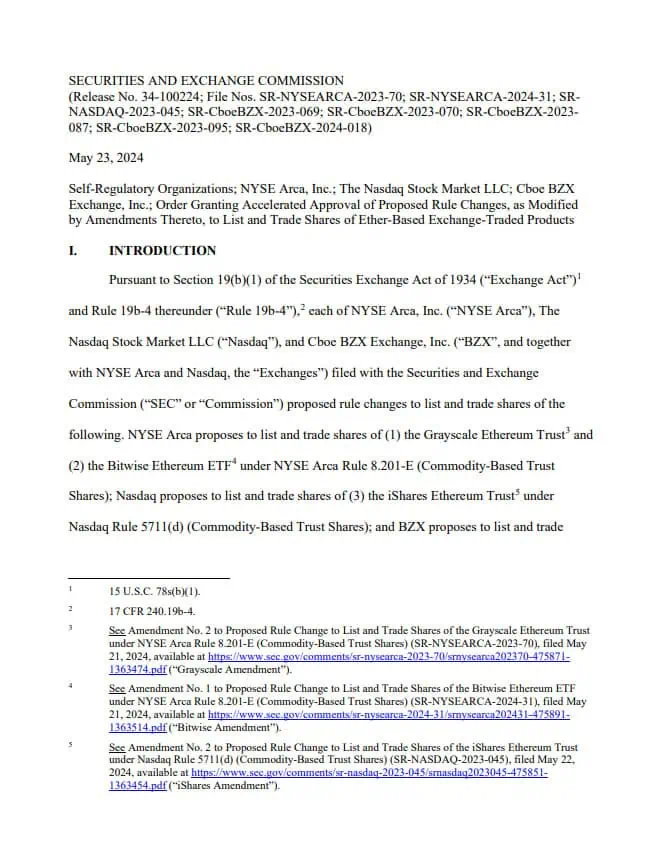
The landmark approval of the Ethereum ETF 19b-4 filings will enable the world’s largest asset managers, such as BlackRock, to offer their investors a regulated on-ramp to easily gain exposure to ether (ETH), which is currently the second-most capitalized cryptocurrency in the market, after Bitcoin.
19b-4 filings approved, but Ethereum ETFs still won't be listed on exchanges
The recent approval of Ethereum spot ETFs has its nuances. What the financial watchdog has done this Thursday is approve the 19b-4 filings, which authorize the funds to be listed on the country's main stock exchanges. However, this does not mean an immediate release, as explained by Bloomberg analyst James Seyffart, as the SEC still needs to approve fund managers’ S-1 filings before Ethereum ETFs can officially launch and begin trading on the market.
The door is open for the arrival of other cryptocurrency ETFs
In recent days, speculation has intensified that fund managers will file other applications to launch new spot ETFs based on other cryptocurrencies, especially now that the SEC has approved Ethereum ETFs and US lawmakers have asked the regulator to authorize ETFs based on digital assets.
On Wednesday, a bipartisan group of lawmakers sent a letter to the agency that regulates financial markets in the United States asking it to approve Ethereum and other digital asset ETFs, in order to ensure that Americans have regulated and safe access to the growing cryptocurrency market. Eric Balchunas, an ETF expert at Bloomberg, commented that the addition of “other digital assets,” which the lawmakers pointed out in the letter, was very interesting and opened the door for fund managers to pounce on the SEC’s vulnerability and submit new applications for funds based on other cryptocurrencies to test its limits.
As reported by this outlet, several experts are speculating that Solana could become the next major cryptocurrency on the market to have a spot ETF. Recently, Bernstein noted that the regulatory approval of Ethereum ETFs is setting a precedent for the arrival of other cryptocurrency ETFs on the market in the United States.
Cryptocurrencies are more accessible to institutional investors
Spot ETFs are an interesting development for cryptocurrencies, as they allow investors interested in these digital assets to gain direct exposure to the assets, without having to worry about their management and operation. In addition to this, they offer a regulated access route to the underlying assets, facilitating institutional entry into a nascent market such as cryptocurrencies.
Bitcoin exchange-traded funds, which were approved by the SEC on January 10, currently accumulate More than 850.000 BTC in reserves, whose value exceeds $58.000 billion dollars.
Institutional demand for Bitcoin has been such that Bitcoin ETFs have broken several all-time fund market records in a short period of time. For example, BlackRock’s iShares Bitcoin Trust (IBIT) reached $10.000 billion in total assets under management in its first two months, a milestone that took other successful ETFs years to achieve. At the time of writing, IBIT’s total assets are very close to $20.000 billion.
On the other hand, the success and demand that Ethereum spot ETFs will have in the market cannot be predicted. However, several experts argue that the unmet demand from cryptocurrency investors could lead Ethereum to new highs, while others consider that the absence of ether staking in the funds could minimize their attractiveness to investors.