
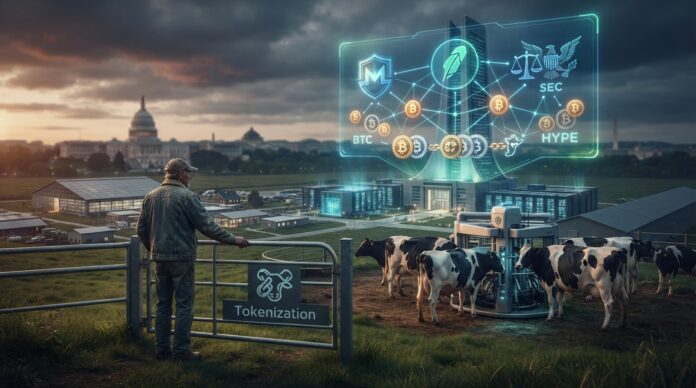
Real-world asset tokenization (RWA) continues to expand its reach, demonstrating that blockchain technology has practical applications that are transforming the traditional economy. In a groundbreaking move for the agricultural sector, Brazil's stock exchange (B3) has registered a loan backed entirely by tokenized dairy cows. This milestone marks a turning point at the intersection of decentralized finance, artificial intelligence, and rural finance.
The milestone of livestock tokenization
The registration of this livestock loan represents a significant step forward in the institutional adoption of blockchain technology. Recently, A loan of approximately €18.000 (100.000 Brazilian reais) has been structured using 10 dairy cows as collateral.These animals, belonging to the Fazenda Engenho Velho in the state of Paraná, have an estimated market value of around €21.500 (120.000 Brazilian reais).
The transaction was coordinated and structured by the Brazilian investment fund Target FIDC. This demonstrates that real-world assets (RWAs) can be effectively integrated into traditional financial markets, providing robust and verifiable guarantees. The participation of the B3 exchange, one of the largest market infrastructures in Latin America, underscores the growing institutional confidence in digital token-based financing models.
Digital identity and IoT technology in the field
For a physical, dynamic, and mobile asset like cattle to serve as collateral for a loan, absolute traceability is a fundamental requirement. Each cow involved in this transaction received a unique digital token, which is immutably linked to an encrypted digital identity on the network.
The key technological component of this process is the integration of the Internet of Things (IoT). The agricultural technology company Cowmed implemented AI-powered smart collars to monitor the health, nutrition, and behavior of each animal in real time. This constant, automated monitoring drastically reduces the need for costly physical inspections. The collected data is linked to the animal's token, guaranteeing lenders that the underlying asset maintains its value and optimal condition throughout the loan term.
RWA: Transforming access to agricultural credit
Historically, farmers and ranchers have faced significant barriers to accessing credit, relying almost exclusively on pledging land, heavy machinery, or fixed assets. Real-world asset tokenization (RWA) changes this paradigm by enabling the fractionalization and digitization of physical assets that were previously difficult to financially audit.
By using blockchain to record the ownership and status of biological assets, a much more agile and accessible financial ecosystem is created. Producers can now leverage the direct value of their live production for immediate liquidity. If you're interested in exploring how blockchain technology transforms value and democratizes access to finance, you can learn more about these concepts at [link to blockchain website]. Bit2Me Academy, where we break down how crypto ecosystems work.
Transparency, auditing and the regulatory framework
One of the biggest challenges in providing loans backed by mobile assets is the risk of fraud or the loss of value of the collateral. The immutability of blockchain solves this problem by providing a transparent and auditable record in real time. All participants in the loan agreement can verify the status of the collateral without relying on opaque intermediaries.
This pursuit of transparency and security aligns with the standards promoted by modern regulations. In Europe, for example, the MiCA Regulation It establishes a clear framework for the issuance and management of crypto assets, prioritizing user protection and market integrity. Although this operation took place in Brazil, it reflects a global trend toward standardization and legal certainty in the use of tokens linked to real assets.
The scalability of the model and its future impact
The scalability potential of this livestock credit model is vast. According to data revealed in the transaction, Cowmed's monitoring technology is already being applied to some 100.000 dairy cows distributed across more than 1.000 farms throughout Brazil.
If this token-backed credit system is standardized and expanded, it could radically transform how the primary sector obtains liquidity globally. It directly connects agricultural production to capital markets through blockchain infrastructure, eliminating friction and reducing operating costs. This use case demonstrates that tokenization is not just a technological narrative, but a financial tool with a tangible impact on the real economy.
FAQ
What is RWA asset tokenization?
Real-world asset tokenization (RWA) involves digitally representing a physical asset, such as real estate or livestock, on a blockchain network. This allows for immutable ownership registration, facilitates transfer, and enables its use as collateral in financial transactions with complete transparency.
How is the status of tokenized cows ensured?
The animals' condition is monitored using smart collars equipped with artificial intelligence and IoT technology. These devices track each cow's health and activity in real time, linking this vital information to its encrypted digital identity on the blockchain.
What advantages does this system offer to farmers?
This model allows livestock farmers to use their own live cattle as collateral to obtain loans, diversifying their financing options. By reducing bureaucracy and traditional physical inspections, access to liquidity becomes much faster, more efficient, and more accessible.
The integration of blockchain technology into traditional sectors like livestock farming demonstrates that the utility of crypto assets and tokenization extends far beyond the purely digital realm. As regulatory frameworks evolve and monitoring technology matures, we are highly likely to see even greater adoption of RWAs across various productive industries.
This type of initiative underscores the importance of building transparent, auditable, and efficient financial infrastructure. Connecting the tangible value of the physical world with the operational advantages of decentralized networks is the next major step toward consolidating a more inclusive and dynamic global economic ecosystem.
Investing in cryptoassets is not fully regulated, may not be suitable for retail investors due to high volatility and there is a risk of losing all invested amounts.