
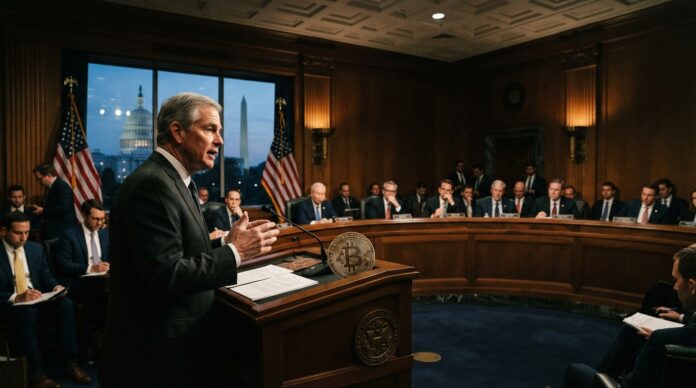
US Senator Ron Wyden has urged Senate leaders to maintain protections for crypto developers within the CLARITY Act. This measure aims to prevent creators of non-custodial software from being classified as money transmitters, a key issue in negotiations leading up to the midterm elections.
The final decision could set an important precedent on how decentralized technology is monitored globally, directly impacting innovation and the development of new tools in the sector.
The debate over the CLARITY Act and non-custodial software
Democratic Senator Ron Wyden has formally requested Senate leaders that preserve the section known as the Blockchain Regulatory Certainty Act (BRCA) within the framework of the CLARITY Act. This request, addressed to Minority Leader John Thune and Majority Leader Charles Schumer, underscores one of the most profound discussions in current technology regulation: the technical and legal difference between writing computer code and operating a financial service.
The core of the debate lies in how software creators are classified. According to the proposal championed by Wyden, developers who create and publish software that allows people to manage their own digital assets should not be treated as money transmitters. This is especially critical in cases where the developer has no control over users' funds, a fundamental characteristic of non-custodial technology.
To understand this point, it is helpful to explore educational resources such as Bit2Me AcademyThis explains how decentralization transfers custody directly to the user through private keys. If a developer simply publishes open-source code in a public repository, forcing them to comply with the regulations of a traditional financial intermediary would be technically and practically impossible, potentially stifling the development of new technological tools.
Ron Wyden's stance and global competitiveness
In his official statement, Wyden argued that treating crypto ecosystem developers as mere money transmitters stifles technological innovation. At a time when the race for digital leadership is global, imposing disproportionate regulatory burdens on software creators could drive talent to other jurisdictions with more favorable regulations better suited to the technical realities of Web3.
The senator emphasized that the BRCA reflects previous guidelines from the Financial Crimes Enforcement Network (FinCEN). Historically, FinCEN has differentiated between those who provide communication software or infrastructure and those who execute the transmission of value. These guidelines provide the necessary legal certainty for open-source project developers to continue building the decentralized finance ecosystem within U.S. borders. Legal certainty is essential so that creators can focus on improving the technology without the constant fear of regulatory delays or legal repercussions simply for releasing code.
Wyden summarized his position by stating that smart policy must empower law enforcement to do its job, but at the same time, it must facilitate innovation. This duality is the great challenge of any modern regulatory framework that attempts to regulate emerging technologies without stifling their early development.
Opposition and concerns about oversight
Despite strong arguments in favor of innovation, the inclusion of the BRCA in the CLARITY Act has met with resistance from certain sectors. Last month, a coalition of law enforcement organizations and Catholic groups expressed concern, arguing that exempting developers from certain obligations could create gaps in the oversight of illicit activities.
These groups fear that without strict controls on who develops and publishes software, malicious actors could exploit these tools to circumvent traditional financial controls. The tension between user privacy, freedom to develop software, and the prevention of financial crimes remains one of the most complex sticking points in the Senate negotiations.
On the other hand, several of the leading crypto industry associations have urged the Senate to keep this section intact. Their main argument is technical: if a non-custodial technology developer lacks the ability to access, move, or control user funds, it cannot comply with the reporting, KYC (Know Your Customer), and withholding obligations required of traditional financial intermediaries.
The legislative clock: Elections and recesses in the United States
Time is a critical factor in the passage of the CLARITY Act. Senate leaders are pushing for the bill to be passed this month. The goal is to bring a proposal to the floor with broad bipartisan support to avoid lengthy debates that could stall the legislative process.
The U.S. political calendar imposes strict deadlines. With a month-long recess scheduled for August and the midterm elections in November, the window of opportunity is closing rapidly. Lawmakers who support the bill want to pass it before the current legislative session ends, thus avoiding having to reintroduce it from scratch in a new Congress next year.
This time pressure has led industry analysts, such as Galaxy Digital, to reduce the likelihood of the CLARITY Act becoming law this year to 50%. Furthermore, the Senate must resolve other controversial provisions within the bill, including calls to establish stricter ethical standards regarding government officials' involvement in the crypto sector. This debate gained momentum after it was revealed that former President Donald Trump earned approximately €1.280 billion from his investments in this market over the past year.
The contrast with Europe and the MiCA Regulation
As the United States debates the foundations of its market structure, it is impossible not to look to Europe. The MiCA Regulation has positioned the European Union as a pioneer in creating a clear and unified regulatory framework for crypto assets. For users looking to build their portfolios on regulated platforms, a transparent and compliant environment is essential.
Unlike the current uncertainty in the US Senate, MiCA establishes clear rules for token issuers and service providers, although it has also left certain aspects of decentralized finance (DeFi) for future review. European regulatory clarity contrasts with the fragmented approach in the United States, where regulation is often decided through coercive measures rather than proactive legislation.
Staying informed about these global regulatory changes is essential. You can track the evolution of these regulations and their impact on the market through news.bit2me.com, where we analyze how legislative decisions affect the ecosystem globally.
FAQ
What is the CLARITY Act and what does it seek to regulate?
The CLARITY Act is a legislative project in the United States designed to establish a comprehensive market structure for digital assets. Its main objective is to define the responsibilities of the various actors in the ecosystem, providing a legal framework that balances technological innovation with consumer protection.
Why is it vital to protect software developers?
Protecting software developers ensures they are not misclassified as financial intermediaries. If a developer creates non-custodial code and lacks access to funds, imposing traditional financial regulations would stifle innovation and the development of new technological solutions.
How does the political calendar influence this regulation?
The US political calendar, with a recess in August and elections in November, limits the time available to pass the law. If it is not passed before the current Congress ends, the bill will have to be restarted next year, prolonging regulatory uncertainty in the digital asset sector.
The outcome of this debate in the U.S. Senate will determine the future of cryptographic innovation in the country. Protecting developers of non-custodial software is essential to maintaining technological competitiveness against established frameworks such as the MiCA Regulation in Europe.
Investing in cryptoassets is not fully regulated, may not be suitable for retail investors due to high volatility and there is a risk of losing all invested amounts.