

The entry into force of the MiCA Regulation has structurally transformed the European crypto ecosystem. The transition period, which allowed existing platforms to continue operating while completing their authorization process, comes to a definitive end on July 1, 2026. For many organizations in the sector, this deadline is not an abstract date: it is the point from which operating without a CASP license in the European Union constitutes a regulatory infringement with direct legal and operational consequences.
This article is aimed at management teams, compliance officers, and technical architects of platforms that operate or have operated in the European crypto space and are looking for a regulated partner to manage the migration of their users and assets. Throughout the following sections, you will find the specific arguments—regulatory, technical, and operational—for why Bit2Me can act as a migration partner, and what a B2B integration with this infrastructure entails.
The MiCA deadline is approaching: what's happening with crypto platforms in the EU in 2026
The transitional period of Mica In practice, it has functioned as an accelerated regulatory screening process. Platforms that did not initiate the CASP authorization process early enough have faced a problem of two kinds: legal on the one hand, and operational on the other. Having the right technology and a sufficient user base is not enough; an authorized entity under the supervision of a competent EU regulator is also required.
Recent cases illustrate the magnitude of this phenomenon. KuCoin EU—an Austrian entity that obtained a MiCA license from the Austrian FMA in November 2025—received a ban on acquiring new clients in February 2026 due to irregularities in its anti-money laundering procedures. Binance, the world's largest exchange by volume, was still pursuing a license in Greece in mid-2026 without having received it, a situation that affected an estimated 182.000 weekly active users in Spain. In both cases, the practical result for their European user bases is the same: an urgent need to find a regulated alternative within the EEA.
Migrating these databases—verified users, assets in custody, and operational data—requires a partner with three essential conditions: current CASP authorization, technical infrastructure for integration, and operational capacity to absorb the process without interrupting service to the end user.
The regulatory environment has also created a clear opportunity for platforms that completed the authorization process ahead of schedule. In Spain, only four Spanish-owned entities have MiCA authorization from the CNMV: BBVA, Cecabank, and Openbank, through bank notification under Article 60, and Bit2Me, the only fully authorized CASP under Article 59, obtained in July 2025.
What does a company look for when it needs a MiCA migration partner?
When a management team evaluates a regulated EU crypto migration partner, the decision variables are not the same as in a typical technology integration. The first question isn't technical; it's regulatory. Does the partner have the correct license to cover the service categories the platform needs to migrate?
The CASP categories authorized by the CNMV to Bit2Me under Article 59 of the MiCA Regulation are: custody and administration of crypto assets, exchange of crypto assets for fiat funds, exchange of crypto assets for other crypto assets, transfer of crypto assets and execution of orders on behalf of clients. This regulatory coverage is the minimum required base; without it, the transfer of assets or the care of migrant users would lack legal protection in the EU.
The second variable is the technical capacity for integration. A true migration involves connecting account management systems, MiCA crypto custody flows, fiat payment rails, and regulatory reporting structures. A partner that only offers retail brokerage cannot manage this complexity. The third variable, frequently underestimated in evaluation processes, is the capacity for operational support: migrated users arrive with open positions, questions about the status of their assets, and continuity needs that require answers in their language and within a reasonable timeframe. For platforms whose user base is Spanish-speaking, this factor has a direct impact on the post-migration retention rate.
Bit2Me's CASP authorization: Article 59 MiCA and CNMV license
BITCOINFORME, PSC, SL, which operates under the trading name Bit2Me, is a crypto asset service provider authorized and regulated by the Spanish National Securities Market Commission (CNMV), in accordance with Article 59 of Regulation (EU) 2023/1114. This authorization, obtained in July 2025, makes Bit2Me the only exchange of Spanish origin with a full CASP license—not a bank notification, but a specific authorization as a crypto asset service provider, the most demanding regulatory process provided for in MiCA.
The distinction between the different types of MiCA authorization has direct operational relevance for any company evaluating a migration partner. Banks have accessed the crypto-asset market via Section 60, which allows existing credit institutions to notify their intention to offer crypto-asset services without a specific supervision process for their crypto model. The Section 59 route, on the other hand, requires demonstrating the full suitability of the business to the regulator: governance structure, capital controls, AML/KYC mechanisms, professional liability insurance, and technical security standards. In terms of the depth of the supervisory process, this is the more demanding route and the one that provides greater legal certainty for B2B clients.
The CNMV authorization enables Bit2Me to issue the MiCA passport and operate in the other member states of the European Economic Area without needing to apply for a new license in each jurisdiction. For a migration in which users may be distributed across several EU countries—Spain, Portugal, Italy, Germany, France—this pan-European coverage is a functional requirement, not an optional element. The authorization status can be verified in the CNMV's public register and, during the transition period, in the provisional register of ESMA.
Technical infrastructure for B2B integrations: API, custody, OTC and nodes
Regulatory approval is the starting point, but a true technical migration requires operational infrastructure. Bit2Me's proposal as a B2B partner for MiCA migration rests on four components that enable both direct system integration and secure custody of the migrated assets.
La Bit2Me API Bit2Me exposes trading, account management, transfer, and payment functionality via REST JSON and WebSocket. This architecture allows external systems to connect real-time buying, selling, transfer, and reporting flows. The API is currently used by corporate clients who operate algorithmically or integrate crypto infrastructure into their own treasury management systems. Bit2Me provides institutional partners with testing environments on the Bitcoin Testnet to validate the integration before going live. Technical documentation is available at api.bit2me.com.
La institutional custody It operates using a segregated omnibus account architecture, with Ledger Enterprise as the cold storage infrastructure provider and Prosegur Crypto for physical custody. For entities migrating user assets from another platform, the custody architecture is the critical variable in the process: assets must be transferable, custodial within an audited framework, and traceable at all times under regulatory oversight.
El OTC service It covers institutional operations starting from significant volumes, with personalized management by an account manager and execution without impacting the public order book. For migrations involving large positions in specific assets, the availability of OTC liquidity is a requirement that a conventional retail brokerage cannot meet.
Por último, la blockchain node infrastructure Integrated into Bit2Me's operations —an essential part of its on-chain settlement and validation capabilities since 2014— allows for direct and auditable asset transfers, with complete traceability for every move made during the migration process.
Security certifications: ISO 27001, ISO 22301, CSA Star and the compliance framework
Regulatory authorization and technical capability must be backed by externally audited security standards. For a company transferring its users' assets to a third-party provider, certifications are not merely optional credentials: they are verifiable evidence that the provider has passed independent audits in the areas most critical to the custody of digital assets.
Bit2Me maintains a set of certifications covering the three main operational risk domains relevant to institutional due diligence. The certification ISO 27001 It accredits the information security management system: access controls, encryption, incident management, and continuity of information assets.
La ISO 22301 It certifies the business continuity management system, that is, the ability to maintain critical operations in the face of disruptions—a requirement directly applicable to service continuity during a migration process that can last for weeks. The certification CSA Star It is specific to the cloud environment and certifies the implementation of security controls in the cloud computing infrastructure where account and asset management systems operate.
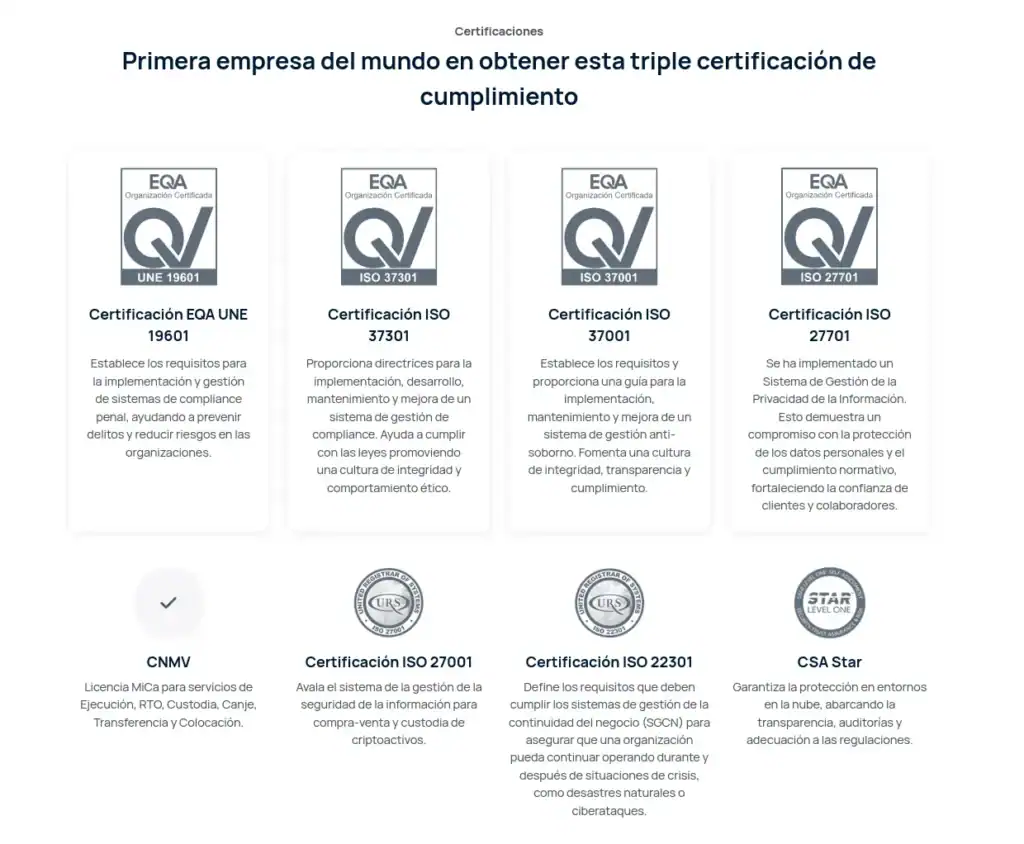
The framework is completed with ISO 37001 (anti-bribery management), ISO 37301 (compliance management), ISO 27701 (data privacy and GDPR compliance), and UNE 19601 (corporate criminal compliance). This combination meets the standards that compliance departments of banks and large corporations require of their technology providers: not only cybersecurity, but also ethical risk management, privacy, and criminal liability. For a bank or fund evaluating a Bit2Me partnership as a gateway to the regulated crypto ecosystem, this set of certifications significantly reduces due diligence risk compared to other market options.
Bit2Me subjects its infrastructure to regular independent security audits. The platform's operational history—active in the Spanish market since 2014 without any significant security incidents—is, along with its current certifications, the strongest track record available.
Track record and institutional references in Spain
Regulatory authorization and a set of certifications are necessary, but not sufficient, conditions for assessing the reliability of a MiCA migration partner. Operational track record and institutional references complete the picture.
Bit2Me has been operating in the Spanish crypto-asset market since 2014, before specific national regulatory frameworks existed, and has completed the CASP authorization process under the supervision of the CNMVThe same regulator that oversees the main players in the Spanish stock market. This operational continuity in a sector with a high business failure rate is, in itself, an indicator of structural stability.
On an institutional level, Bit2Me's shareholders include companies that validate the strength of its business model: Telefónica—a leading telecommunications operator in Spain and Latin America—along with Cecabank and Bankinter as shareholders from the financial sector. The presence of these entities in the share capital table indicates that Bit2Me's infrastructure has undergone the due diligence processes typical of organizations subject to strict regulatory frameworks.
The B2B segment of Bit2Me has over 9.400 registered companies and nearly 2.800 verified with full KYC in accordance with MiCA requirementsFor a migration in which the onboarding of legal entities can be the most complex component of the process —due to the requirement of KYB documentation: CIF/NIF, deed of incorporation, powers of attorney and LEI code— this verification history demonstrates a proven, not estimated, operational capacity.
Current state: the crypto regulatory landscape in the EU by mid-2026
The MiCA authorization landscape in Europe is asymmetrical and continues to evolve. As of June 2026, top-tier operators such as Coinbase (Luxembourg, CSSF, June 2025), Kraken (Ireland, CBI, June 2025), and Crypto.com (Malta, MFSA, January 2025) have obtained their CASP licenses and operate with a European passport. Others—including Binance, KuCoin EU (with operational restrictions), and Bitget (without a confirmed license)—face different regulatory situations that affect their ability to attract customers and provide services in the EU.
This asymmetry creates a specific window for platforms that need to migrate users to a regulated environment before the transition period expires. Migration is not solely a technical process: It is a corporate decision that affects the contractual relationship with users, regulatory reporting obligations, and the continuity of cash flows. A CASP partner with Spanish authorization and a European passport can absorb users from any EEA member state without an additional licensing process.
For platforms that operated in Spain during the transitional period under the former Bank of Spain registry—which was abolished effective December 30, 2024—the situation is particularly urgent. This transitional protection has expired; the only way to ensure legal operational continuity in the EU is to operate under or in conjunction with an entity holding a valid CASP authorization.
Platforms seeking to explore a B2B migration or integration within the MiCA framework can initiate contact through Bit2Me's partnerships team, which manages the processes of technical evaluation, integration proposal, and migration planning for users and assets.