

Morgan Stanley has transformed institutional Bitcoin investing with MSBT, competing directly with Strategy through a low-cost structure.
The entry of major Wall Street banks into the direct issuance of financial instruments linked to Bitcoin has marked a change in the global financial infrastructure.
Morgan Stanley, an institution that in 2017 questioned the intrinsic value of Bitcoin and digital assets, has completed its transition to the blockchain ecosystem with the launch of its spot Bitcoin exchange-traded fund (ETF), under the ticker MSBT.
The launch of this fund this month goes beyond simply adding a new product to the market. Rather, it represents a decision by traditional banks to move beyond being mere spectators or facilitators of transactions and become issuers with their own brand. By listing this instrument on NYSE Arca on April 8, Morgan Stanley seeks to directly capture management fees and capital flows from its high-net-worth clients, competing on the same playing field as native asset managers and treasury strategy firms.
Buy Bitcoin nowA new way to integrate Bitcoin into traditional wallets
The current financial market presents various ways to access Bitcoin's volatility, each with a markedly different risk profile.
Bitcoin Treasuries analysts emphasize that MSBT's main selling point is "pure exposure." Unlike other instruments that use financial engineering, this ETF offers a 1:1 relationship with the price of BTC, eliminating variables such as leverage or corporate debt. This characteristic positions it as a tool designed for the conservative, fiat-based investor seeking the benefits of "digital gold" without added layers of technical complexity.
While vehicles like Strategy (MSTR) operate through a capital structure that includes convertible debt and preferred stock —which typically amplifies market movements—, Morgan Stanley's exchange-traded fund remains on the spectrum of passive management.
According to analysts, the volatility of stocks linked to treasury strategies can be double that of Bitcoin itself. In contrast, MSBT seeks operational stability. Therefore, the significance of this launch lies in its cost structure; with a management fee of 0,14%, it positions itself as one of the most competitive options in the US market, attracting consistent capital inflows that have already resulted in 13 consecutive days of positive inflows toward the end of this month.
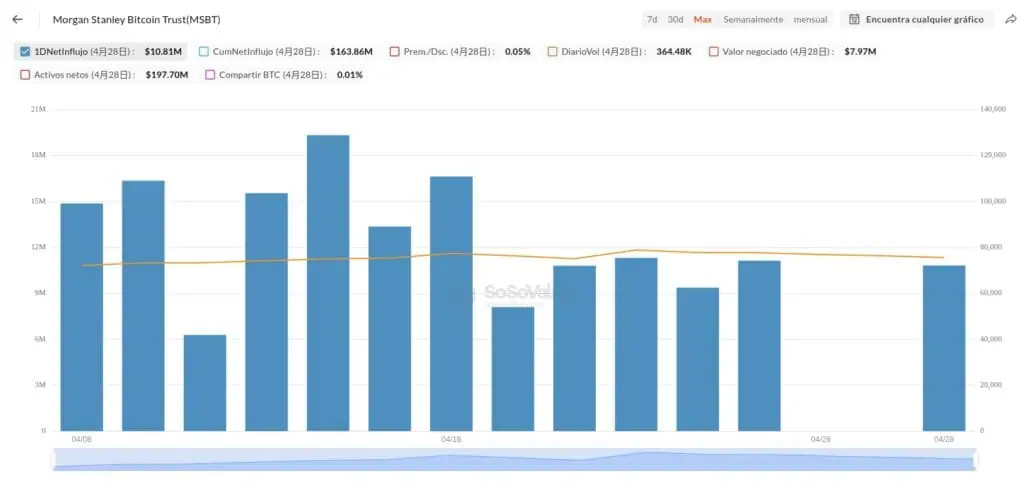
Source: SoSoValue
The muscle of the 16.000 financial advisors
Morgan Stanley's competitive strength extends far beyond the fees it charges for managing assets. Its true power lies in the scale of its distribution network, a structure that allows it to connect large volumes of capital with new investment opportunities. Its wealth management division manages approximately $9,3 trillion in customer assets, a figure that reflects the scale of capital that can now be channeled directly into the digital asset market under a regulated framework.
Before launching its own Bitcoin-linked vehicle, the bank's financial advisors seeking exposure to this type of asset had to use external products. This meant that some of the commission income ended up outside the institution. But with this new approach, the bank is able to integrate that demand into its own structure, strengthening both its offering and its profitability.
The mobilization of its advisor network introduces a significant shift in how internal demand is generated. The Global Investment Committee's guidelines suggest allocations of between 2% and 4% to digital assets within diversified portfolios. When these percentages are applied to the total volume of assets under management, the potential inflow into Bitcoin reaches figures ranging from approximately $55.000 billion to $111.000 billion.
This movement is not driven by casual investors, but by institutional capital and high-net-worth individuals operating with long-term horizons. This type of participation tends to provide greater stability, as it is less susceptible to daily volatility and is more structured within broader financial strategies.
Diversifying exposure to the crypto market in 2026
The arrival of traditional banking has further diversified the ecosystem without displacing existing solutions, but rather complementing the needs of different types of investors. According to experts, the current landscape is divided into three main categories of access to the Bitcoin economy:
- Direct spot exposure, through listed vehicles such as BlackRock's IBIT or Morgan Stanley's MSBT, among others, which are ideal for managed portfolios that require accurate price tracking without additional operational risks.
- Leveraged and treasury exposure, through shares of Digital Asset Treasury (DAT) companies, such as Strategy, which is preferred by investors seeking to maximize returns through aggressive accumulation strategies and the use of smart debt.
- Performance instruments, such as Strategy's STRC floating rate preferred shares, that seek to generate interest rates between 11% and 13%, using the balance of their native crypto-treasury funds as backing.
In short, this array of options suggests that banks are building a multi-channel distribution architecture. SEC filings this month confirm that Morgan Stanley will not stop at the Bitcoin spot ETF, as it is already preparing to launch other services related to the digital ecosystem.
The transition from viewing Bitcoin as a worthless asset to integrating it into the core of banking offerings in less than a decade confirms the sector's definitive maturation. The influx of patient, advisor-guided capital establishes a new standard of demand that, once consolidated as a regular item on investment balance sheets, is unlikely to recede.
Trade Bitcoin on Bit2Me