China’s Bitcoin mining ban in 2021 marked a significant turning point in the history of cryptocurrencies, especially in terms of sustainability and environmental, social and corporate governance (ESG).
Despite the lack of information regarding the post-ban on crypto mining in China, independent research, such as that conducted by Daniel Batten, ESG analyst and co-founder of CH4 Capital, has shed light on the adaptations and resilience of Bitcoin miners in this country.
In issue #009 of The Bitcoin ESG Forecast, Batten highlighted an important finding in Bitcoin miners' operations. He highlighted that miners located in China are currently heading towards greener practices, such as recycling waste heat from crypto mining for heating applications, in order to run their operations more efficiently. This, according to Batten, represents a significant advance in energy efficiency and reducing the carbon footprint of Bitcoin mining.
Bitcoin Hashrate Rises in China
Bitcoin hashrate migration has been a notable phenomenon following the ban on cryptocurrencies and their trading activity in China since mid-2021.
Initially, a significant portion of the network hashrate operating in the country moved to friendlier jurisdictions, such as Kazakhstan at the time and the United States. Miners who left China were looking to take advantage of the stability and resources available in other jurisdictions with more favorable legislation. However, while this geographic dispersion in Bitcoin's computing power has its advantages, such as global redistribution of hashrate and reinforcement of the network's decentralization and robustness, recent reports suggest that China remains a significant player in Bitcoin mining.
Thus, despite the existing ban, the sector has been experiencing a considerable increase, indicating a possible clandestine relocation of crypto miners within the country. According to Batten, data from the Cambridge Centre for Alternative Finance indicates that China operates 21,1% of the global Bitcoin hashrate, making it the second country with the largest share of blockchain computing power, after the United States.
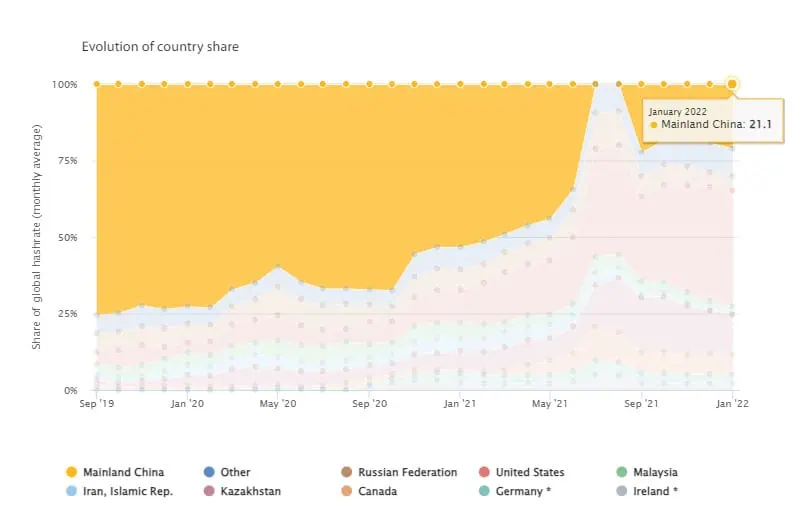
Source: CBCEI
China's miners operate with hydroelectric power
Although Bitcoin’s hashrate in China has declined compared to previous years, when it dominated as much as 70% of the total, reports also suggest that the portion of miners remaining in the country today could be employing a greener energy mix, indicating a positive shift towards sustainability of the sector in the country.
In 2021, the People's Bank of China cited among the reasons for banning Bitcoin and other cryptocurrency mining on its territory: energy consumption, carbon emissions, and the need to comply with the Paris agreement and achieve its climate goals by 2030.
However, according to Batten, today, “coal-based mining is no longer taking place” and cryptocurrency miners are operating primarily on hydroelectric power.
In the report, Batten noted that in Xi'an, Wuhan, Beijing and Xining provinces, hydropower becomes attractively cheap during the wet season.
A new practice is born in crypto mining
Bitcoin mining has been difficult to completely eradicate in China, due to the decentralized nature of the blockchain network and the ability for miners to circumvent restrictions by using more discreet methods or moving to less-strictly regulated regions within the country itself.
In this regard, Batten highlighted that a new practice has been gaining prominence in the context of cryptocurrency mining, particularly in regions where financial restrictions and currency regulation are strict. This new practice, called “retail mining,” refers to the operation of specialized mining equipment, known as ASICs, using electricity paid for with retail fees to mine BTC, which is then exchanged for dollars.
While this crypto mining practice can result in negative profitability due to electricity fees, for some miners the benefits of liquidity and access to foreign currency outweigh operational losses.
“Why would they mine at a loss? Simple: take money out of China, or from the yuan to dollars. They convert Chinese yuan for ASICS and electricity, which creates BTC, which is converted to USD. Many retail miners are happy to take the profitability hit simply to have a way to convert yuan to USD,” Batten explained.
This is a practice that underscores the complexity of the cryptocurrency market and how economic and regulatory factors can influence individual mining strategies.
China moves toward more environmentally friendly energy sources
On the other hand, it is vital to mention, due to the inescapable relationship that links Bitcoin mining with energy consumption, China's transition towards more sustainable energy sources. This energy transition is a testament to China's commitment to climate change mitigation and environmental sustainability.
Once coal-dependent, Shanxi province is emerging as a leader in solar power adoption, reflecting impressive growth in its solar and wind capacity.
Integrating technologies such as hydropower and hydrogen fuel, along with improvements in energy efficiency, are crucial steps toward reducing China's carbon footprint.
These efforts are not only in line with national goals, but also contribute to global efforts to combat climate change, in line with the Paris Agreement. Despite the challenges that remain, the shift towards a cleaner and more sustainable energy future is a positive and significant change for the country and the world, which could benefit the crypto industry, allowing for the return of Bitcoin and crypto assets.
Continue reading: BlackRock ETF Leads Bitcoin Investment, With Inflows of $73 Million
IMPORTANT: The content of this article is for informational purposes only and, in no case, what is written here should be taken as investment advice or recommendations. Bit2Me News reminds you that before making any investment you should educate yourself and know where you invest your money, as well as the pros and cons of the system. We separate ourselves from the actions and consequences that ignorance may entail. If you decide to invest in this or another asset class, you are solely responsible for the consequences that your decisions and actions may have.