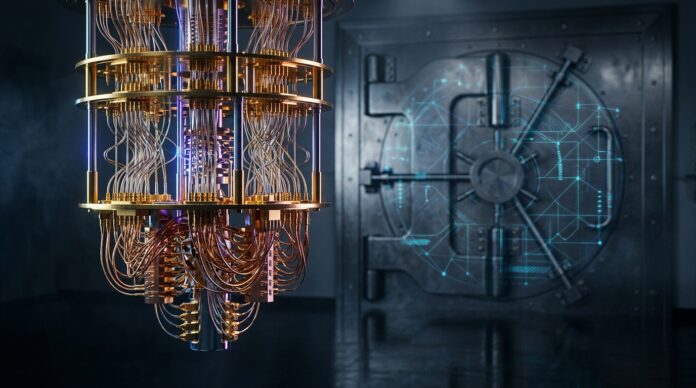
Google's Willow quantum processor has reduced errors in preparing specialized quantum states by nearly 40 times. This technical breakthrough alleviates one of the biggest hardware bottlenecks on the path to fault-tolerant quantum computing, reigniting the debate about the cryptography protecting older Bitcoin wallets.
Although a machine capable of compromising the network still requires years of engineering, the advance published in the journal Science It demonstrates tangible progress in bug fixes. The crypto community is calmly evaluating the implications of this technology for addresses originating from the Satoshi era.
The Willow processor and the reduction of quantum errors
The technical announcement presented by the researchers confirms that The Willow chip reduced errors by about 40 times when preparing magic statesThese are essential mathematical elements for performing complex calculations under quantum architectures. Until now, much of the public debate has focused on the raw number of physical qubits needed to break an algorithm, overlooking the fact that most of the hardware should be dedicated exclusively to filtering impurities from the data.
In the documented experiment, the fidelity rate reached approximately 99,99% for those quantum states that successfully passed the internal verification filters. However, the process is far from fully efficient: only about 8% of the initial preparation attempts were successful, reflecting that significant scalability challenges remain before a general-purpose machine can be built.
This advance doesn't mean that attacking a decentralized network is suddenly 40 times cheaper or faster. Its significance lies in the fact that it empirically validates a method for sustaining the approximately 500.000 reliable magic states per second that a sustained computational attack against complex cryptographic infrastructures would require.
How public-key cryptography works in Bitcoin
To understand the true scope of any quantum development, it's helpful to analyze how the Bitcoin (BTC) architecture operates. The protocol relies on the elliptic curve digital signature algorithm ECDSA (specifically secp256k1). Each wallet has a private key that authorizes transactions and a public key that allows other network participants to mathematically verify the signature's authenticity, as detailed in our training resources. Bit2Me Academy.
Reversing a public key to deduce the original private key would take trillions of years using the most advanced classical supercomputers on the planet. However, in theory, a sufficiently powerful quantum computer running the algorithm devised by mathematician Peter Shor in 1994 could solve this discrete logarithm calculation in a matter of hours or minutes. Whoever possesses the recovered private key could then sign valid transactions without the owner's prior authorization.
Contrary to this theoretical hypothesis, storing a recovery phrase on a physical medium does not provide protection if the associated public key is already visible on the blockchain. Information directly exposed on the decentralized infrastructure would then be the target for an attacker's algorithm.
The specific vulnerability of Satoshi-era wallets
Not all addresses on the network are in the same situation. In the first months of the protocol's operation, transactions used the original format called Pay-to-PubKey (P2PK), used in the mining rewards accumulated by Satoshi Nakamoto himself and his early collaborators. In this original format, the complete public key is permanently and visibly recorded on the blockchain from the moment it is received.
Later versions introduced significant improvements through the Pay-to-PubKey-Hash (P2PKH) scheme, as well as modern standards like Native SegWit and Taproot. In these transactions, the public key is protected behind a one-way hash function (such as SHA-256 combined with RIPEMD-160). For a quantum attacker, a hash-protected key remains completely hidden until the user decides to transfer the funds and signs a new transaction.
The dilemma lies with inactive addresses whose owners have lost access or passed away. If these coins are in an old P2PK format and are never migrated to post-quantum addresses, their public keys will remain visible indefinitely, becoming the first theoretical target if an operational quantum computer were to materialize within a decade or two.
The developers' response and the post-quantum transition
The open-source software development community has ample time to adopt technical solutions. Mitigating against quantum computing doesn't require rewriting the protocol from scratch, but rather implementing cryptographic algorithms based on networks or internationally standardized post-quantum signature schemes.
Among the steps analyzed by the specialists, the following stand out:
- Soft forks: Implementation of new types of quantum-resistant addresses, allowing users to migrate their funds gradually.
- Gradual deactivation of P2PK: Establish consensus timelines to restrict or freeze neglected old addresses whose public keys remain exposed, preventing incentives for automated attacks.
- Lattice-based cryptography: Adoption of next-generation digital signatures validated by global cybersecurity agencies, prepared to withstand Shor's algorithm.
Those who decide buy Bitcoin and manage their portfolio on platforms regulated under European standards such as MiCA, which typically operate under modern P2WPKH or Taproot addresses, thus maintaining an additional layer of protection against premature exposure of public keys on the network.
FAQ
Can Google's Willow chip steal bitcoins today?
No. The Willow chip represents an experimental advance in reducing physical failures at the level of laboratory microchips. Millions of stable physical qubits are needed to compromise cryptographic signatures, a technical scale that the scientific community estimates is still many years away.
Are current Bitcoin addresses at risk?
They are not in immediate danger. Current address formats do not directly expose the public key until an outgoing transaction is made. Only primitive P2PK-formatted addresses from 2009 and 2010 continuously reveal their public key.
How can the Bitcoin network be protected from quantum computing?
Through consensus-based software updates, developers can introduce post-quantum signature algorithms through enhancements that secure funding well in advance of the existence of fully operational quantum computers.
Advances from labs like Google's demonstrate the steady pace of research in advanced hardware, but defensive cryptography is also progressing in parallel. For the digital asset ecosystem, the key lies in the technical adaptability demonstrated over more than a decade.
With transparent standards and oversight from regulatory frameworks such as MiCA in the European Union, the industry continues to strengthen its security to ensure that the custody and operation of digital assets maintains its integrity in the face of future technological challenges.
Investing in cryptoassets is not fully regulated, may not be suitable for retail investors due to high volatility and there is a risk of losing all invested amounts.
Generative artificial intelligence tools were used to create this article.