
The changes Ethereum developers are making to the blockchain network to make it more scalable, secure, and faster are also transforming the narrative of ether, making the cryptocurrency a new form of money that transcends the definition of “fuel” with which it was born.
Ethereum continues its path towards the “perfection” promised by its developers with the migration to the participation protocol proof of stake (PoS) on Ethereum 2.0 or Serenity. The transition of the network to a new consensus model will allow it to be much more scalable, secure and fast, overcoming several of the problems it currently faces, such as high gas costs.
The arrival of this change is causing great optimism in the crypto community, and in the price of ether, which recently reached new historical highs. However, a blockchain Faster, safer and with transactions accessible to all, is not the only thing that its developers promise. The implementation of London, the next Ethereum update that will arrive as a hard fork next month, is one of the development team's most immediate solutions to the network's current problems. In addition, London will make ETH a cryptocurrency deflationary, which is beginning to pave its way to becoming a reserve of future value.
With the activation of London, which includes Improvement Proposal EIP-1559, Ethereum will start burning a large percentage of gas fees, which in turn will reduce the issuance of ethers on the network.
Ethereum Foundation researcher, Justin Drake, estimates that 120 million ether will be, in his opinion, the maximum supply of the cryptocurrency, which went from being a simple “fuel” for the network to a form of real money, comparable to Bitcoin.
It may interest you: The arrival of London is approaching, the hard fork that will reduce Ethereum fees
Deflationary money and reserve of value
Bitcoin, the world's first successful cryptocurrency and the most important one on the markets today, was born as a deflationary form of money, whose emission is limited to a maximum of 21 million coins. The protocol rules that govern the Bitcoin system, and that ensure that this condition is met, mean that every 4 years the emission of new bitcoins is reduced, and it is estimated that the last bitcoin will be issued on the network by approximately the year 2140.
These conditions make bitcoin a limited and increasingly scarce commodity, turning the cryptocurrency into a deflationary currency; that is, one whose value will grow or appreciate over time.
Ether, for its part, was not born as a deflationary currency. While its issuance is limited to 18 million coins per year, its total issuance, over time, was designed to be infinite. However, the rules are about to change.
As Drake explained on his Twitter account, the maximum emission of ethers could be around 120 million coins.
In a spreadsheet, the researcher explains that in a conservative scenario, after the activation of EIP-1559 and the merger of ETH with ETH 2.0 in 2022, the network will emit about 1.300 ETH/day, about 90% less than the network's current issuance of 13.600 ETH/day. In addition to the reduction in issuance, the network will burn about 3.000 ETH/day, which will further reduce the number of coins in circulation.
Drake's calculations, compared to the maximum emission of bitcoins, make the researcher consider ether as an "ultrasonic" form of money, whose supply will decrease with the burning of commissions. This leads the researcher to others It is estimated that the price of ETH in the markets will grow to unsuspected limits, becoming an alternative and reliable reserve of value.
Coin Metrics estimates a 75% drop in annual supply
The analysts of Coin Metrics performed their own calculations to estimate what percentage of gas fees would be burned on Ethereum with the imminent arrival of EIP-1559. According to the estimates According to analysts, the blockchain network could burn up to 75% of gas fees, seeing a significant drop in its annual coin issuance.
EIP-1559 will begin by addressing some of the most serious concerns about Ethereum’s economic policies and the currency’s relatively high inflation rate compared to Bitcoin, Coin Metrics notes.
The firm's researchers note that EIP-1559 will change Ethereum's gas fee mechanism to permanently remove a portion of the coin's supply and decrease its net issuance per day. The changes this update introduces to the network would lead to an estimated annual inflation rate (30-day average) of between 1 and 2%.
$3 million in daily earnings on ETH 2.0
On the other hand, the introduction of the staking Ethereum 2.0 will effectively turn ether into a yielding asset, analysts explain, noting that there are already more than 4,2 million ethers locked in the network contract, as shown Launchpad from Ethereum.
The firm's data indicates that Ethereum 2.0 validators are earning more than $3 million a day. An impressive figure considering that in December, when the first phase of this network was activated, earnings did not exceed $200.000 a day.
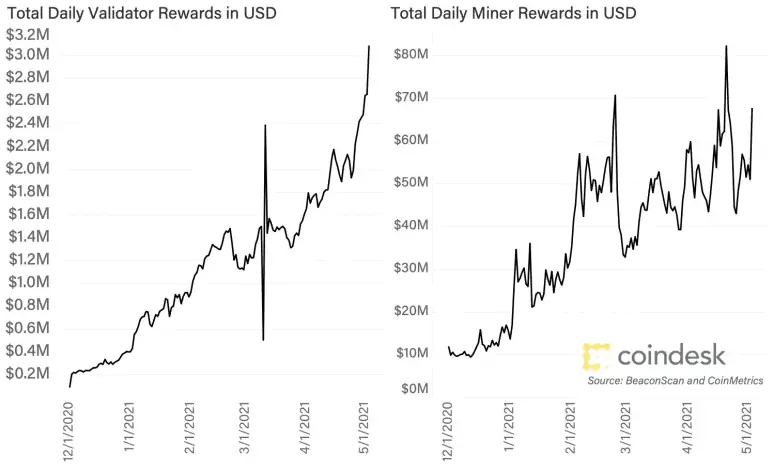
Source: Coin Metrics
ETH has seen a huge surge in recent weeks, driven primarily by interest and demand from retail and institutional investors. Ethereum futures launched by the Chicago Mercantile Exchange (CME) and new Ethereum ETFs in Canada are attracting a significant number of investors who are investing large amounts of capital into the cryptocurrency. This has significantly increased Ethereum’s market cap, causing Bitcoin to lose dominance in the industry.
Continue reading: Bitcoin and Ethereum to make history at Sotheby's with physical Banksy artwork