

The latest crypto adoption report published by Chainalysis shows that cryptocurrencies have become the main driving force of emerging economies and markets in Latin America and other regions of the world, such as Africa.
Venezuela, Argentina, Colombia, and Brazil are the Latin American countries that appear on Chainalysis' list of the locations with the highest adoption of cryptocurrencies in the last year. According to the report of crypto adoption from the analytics company, titled “Global Cryptocurrency Adoption Index 2021”, which analyses the adoption patterns of these new technologies in more than 150 countries around the world, cryptocurrencies, They are becoming the main driving force of development and financial innovation in countries with emerging economies, such as in Latin America, Africa and Central Asia, where the use and demand for cryptoassets by citizens has grown exponentially in the last year.
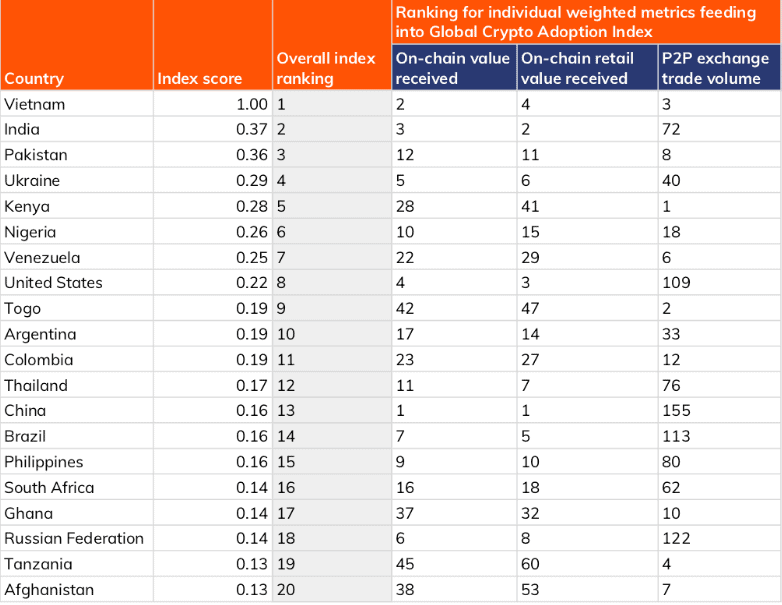
Chainalysis, a company dedicated to research and forensic analysis in blockchain, explains that in preparing this report, it focused on knowing the volumes of transactions and value that private users make through peer-to-peer (P2P) platforms and not only on transaction volumes by country, since this would favor nations with large numbers of professional and institutional investors. Likewise, the firm explained that the new classification allowed it to discover new interesting trends in the crypto industry at a global level.
Firstly, emerging economies and markets are relying on cryptocurrencies to cope with the devaluation of their local currencies, which in turn is driving up the percentage of global crypto adoption and reflecting greater and growing confidence in this industry.
It may interest you: Crypto adoption: The United States, Cyprus and Singapore lead the way in countries best prepared for cryptocurrencies
Emerging economies and cryptocurrencies
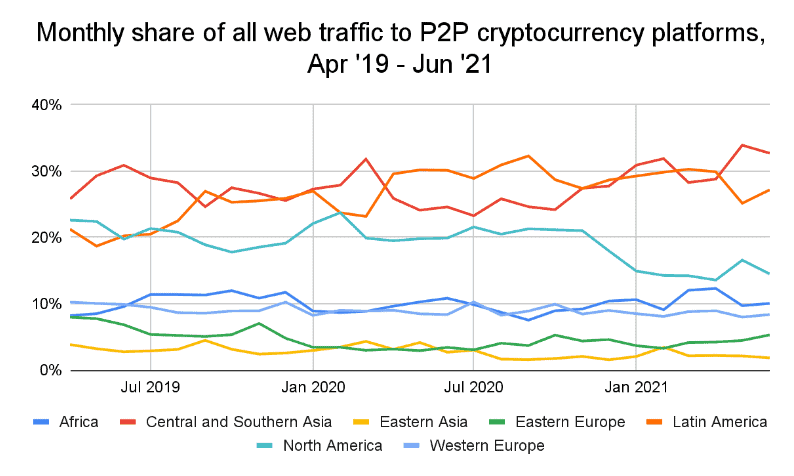
Cryptocurrencies and digital assets have gained a significant foothold in emerging economies, where more and more citizens are turning to crypto assets to escape currency devaluation and preserve their value. According to Chainalysis, cryptocurrency adoption in regions such as Central and South Asia, Latin America, and Africa, which are rich in emerging markets, is far higher than that seen in larger economies such as Western Europe and East Asia.
Regions with emerging economies send more web traffic to cryptocurrency P2P platforms than regions with large economies, the firm said.
Chainalysis also points out that, in addition to tackling inflation and devaluation, cryptocurrencies also help citizens to avoid financial and value limits imposed by their countries' banking entities, as well as to carry out cross-border transactions, whether for sending remittances or importing goods, in a very short time and with quite affordable commission rates.
Global adoption of cryptocurrencies is growing
“Global adoption of cryptocurrencies is skyrocketing”, the firm said based on its analysis of data. Chainalysis notes that citizens in several countries in Latin America, Africa, Central and South Asia are increasingly immersing themselves in cryptocurrencies, adopting them as a means of exchanging value, in sending remittances and for commercial activities, while in regions such as North America, Western Europe and East Asia, cryptocurrencies are mostly viewed as medium- and long-term investment assets.
According to the firm's data, for the second quarter of 2020, global cryptocurrency adoption scored an average of 2,5 points, based on the scores of each country analyzed. However, in the second quarter of this year, global cryptocurrency adoption reached a score of 24 points, showing a growth of 960% compared to 2020 figures.
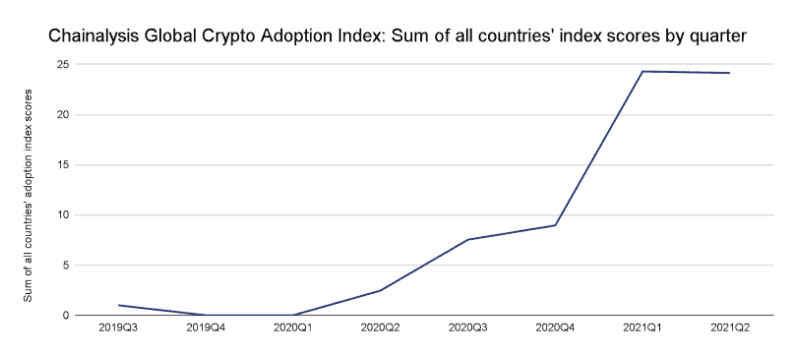
Current growth in global cryptocurrency adoption levels is 2.300% larger than in 2019 and 881% larger than in all of 2020, Chainalysis said.
The firm also highlighted that the volume of cryptocurrency transactions taking place in the United States and China has fallen sharply since March of this year. In the case of the United States, the drop in volume may be motivated by an increasing professionalization and institutionalization of cryptocurrency trading in the country, while in China it may be a product of the continued crackdown the government has taken on cryptocurrency trading and mining.
Cryptocurrencies after a decade
12 years after the arrival of Bitcoin and Blockchain, the analysis firm notes that cryptocurrencies have become a “truly global phenomenon” that is attracting the attention of both individuals and large institutional investors and corporations.
The next Chainalysis report will be released in the second quarter of 2022. The firm expresses that the future of cryptocurrencies is promising and that there is still much to see in the crypto industry with the new business models that are being developed. Chainalysis also promised to present a report on the adoption levels of decentralized finance, also known as DeFi, which are causing great frenzy in millions of users around the world.
Continue reading: Brazil leads cryptocurrency investment with new carbon-neutral Bitcoin ETF