
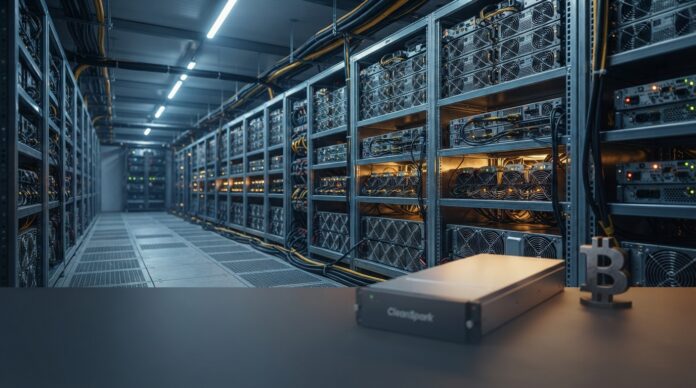
CleanSpark, a well-known Bitcoin mining company listed on the Nasdaq, has taken a decisive step in diversifying its business model. The company will dedicate a significant portion of its energy capacity to high-performance computing, adapting its facilities to meet the growing global demand for artificial intelligence.
The convergence of crypto infrastructure and traditional data centers continues to redefine the technological landscape. With this move, the company seeks to maximize the use of its energy resources, demonstrating how facilities designed to secure decentralized networks can evolve toward new technological horizons.
A strategic agreement in Georgia
On July 14, CleanSpark announced that has signed a 20-year infrastructure lease agreement with a global technology company with a high credit rating, whose name has not been disclosed. This agreement will be developed at the company's campus in Sandersville, Georgia, and marks the firm's biggest leap from exclusively Bitcoin mining to high-performance computing (HPC) for hyperscale clients.
The contract covers the data center infrastructure that will support 175 megawatts of critical IT load. CleanSpark projects that this initial term will generate contracted revenues of $6.600 billion (approximately €6.050 billion). This figure could climb to $11.600 billion (approximately €10.630 billion) if the tenant chooses to exercise either of the extension options stipulated in the agreement.
The adaptation of these facilities underscores a growing trend in the sector: the repurposing of electrical capacity and advanced cooling infrastructure to power artificial intelligence data centers. This approach allows companies to diversify their operations beyond traditional cryptocurrency mining.
The transition to high-performance computing
The economic model behind this agreement significantly transforms the company's revenue structure. CleanSpark's average annual net operating income from this contract is expected to reach $330 million (approximately €302 million). The first deliveries of this processing capacity are scheduled for the fourth quarter of 2027.
High-performance computing requires facilities with very rigorous technical specifications, especially regarding uninterrupted power supply and heat dissipation systems. Companies that have built large centers for the bitcoin mining They have a natural competitive advantage, as they have the physical infrastructure and energy agreements necessary to host large-scale artificial intelligence servers.
As you can see from the evolution of the sector, the ability to pivot towards AI offers a predictable long-term cash flow, mitigating the volatility inherent in crypto market cycles and network difficulty adjustments.
Infrastructure expansion in Texas
In a further indication of the market's appetite for these types of facilities, both parties have executed a letter of intent and an exclusivity agreement covering CleanSpark's entire portfolio in the state of Texas. This portfolio represents up to 885 megawatts of secured and planned power capacity.
If this letter of intent translates into firm contracts, CleanSpark's transition to becoming an infrastructure provider for AI and cloud workloads would accelerate exponentially. Managing nearly one gigawatt of power would position the company as one of the most significant players in hosting next-generation hardware in the United States.
The state of Texas has established itself as a hub for energy and technology, attracting numerous companies thanks to its independent power grid and policies favorable to industrial development. Expansion in this region is a logical step toward scaling up hyperscale operations.
Strength in Bitcoin mining and reserves
Despite this shift towards computing, CleanSpark's core business continues to post record numbers. In early July, the company mined 614 BTC and raised its operational hash rate to 50 exahashes per second (EH/s), an all-time high for the company. This level of processing demonstrates a continued commitment to the security of the Bitcoin network.
Furthermore, the company's treasury holdings increased to 13.924 BTC, solidifying its position as one of the largest corporate reserves among public miners. Management has chosen to retain a significant portion of the mined Bitcoin rather than sell it on the market, a strategy that reflects its long-term view of the asset.
For those interested in the ecosystem, understanding the scale of these operations helps to gauge the network's strength. If you wish to participate in this environment, you can buy Bitcoin through regulated and transparent platforms, building your portfolio with a known and managed risk.
Market and analyst reaction
Wall Street has reacted positively to this shift towards computing. Citizens initiated coverage of the stock with a "Outperform" rating and a price target of $27 (approximately €24), citing the strategic move towards hyperscale computing capabilities. Chardan, for its part, raised its target from $16 to $19 (from €14 to €17) and maintained its buy rating.
Both analyses agreed that the Sandersville contract is tangible proof that CleanSpark can monetize its energy and land assets beyond mining, a sector where margins constantly fluctuate due to the price of Bitcoin and network difficulty.
Investor reaction has been mixed but mostly positive. CleanSpark shares surged by more than 20% in pre-market trading following the news, later stabilizing with gains of around 9% during the day. Stay up to date on these corporate developments through [link/social media platform]. Bit2Me News.
FAQ
What does the new CleanSpark agreement entail?
The agreement involves allocating 175 megawatts of its energy capacity in Georgia to house high-performance computing servers. This 20-year contract is projected to generate $6.600 billion in revenue, diversifying the company's business model into artificial intelligence.
Will CleanSpark stop mining Bitcoin?
No, the company maintains a very robust mining operation. It recently achieved a record hash rate of 50 exahashes per second and holds a treasury of 13.924 BTC, demonstrating that mining remains a fundamental pillar of its corporate strategy.
Why are mining companies turning to AI?
The high-capacity electrical infrastructure and advanced cooling systems required for cryptocurrency mining are highly compatible with the requirements of artificial intelligence data centers. This allows companies to optimize their facilities and ensure stable, long-term revenue streams.
The evolution of CleanSpark perfectly illustrates how infrastructure initially built for the crypto ecosystem holds enormous intrinsic value for other emerging technology industries. The ability to process data at massive scale is the new oil of the digital age, and facilities with access to abundant and cheap energy are at the heart of this revolution.
As artificial intelligence demands ever-increasing computing resources, we are likely to see more synergies between Bitcoin miners and tech giants. This balance between securing decentralized networks and empowering AI will shape the development of digital infrastructure over the next decade, always within a framework of compliance and transparency aligned with global regulations such as the MiCA Regulation in Europe.
Investing in cryptoassets is not fully regulated, may not be suitable for retail investors due to high volatility and there is a risk of losing all invested amounts.