

Cardano has once again increased the size of its block on the network, to seek greater scalability and performance.
Input Output HK, the company that develops the Cardano blockchain, reported this Monday that block size on the network increased by 10%, as planned in a Cardano improvement proposal presented last week.
The upgrade corresponds with the network’s current development era, Basho, which is focused on increasing scalability and performance on the blockchain.
So far this year, Cardano has seen its block size increase twice. The first time occurred at the beginning of February, when the block size went from 72 KB to 80 KB, growing 11,1% at that time. Now, 10% increase brings block size on Cardano network to a total of 88 KB.
The increase in block capacity allows the network to process a greater number of transactions simultaneously, increasing its scalability and improving its performance. This update will have a positive impact for users, who will be able to enjoy better speeds and lower commission costs when confirming your transactions on the blockchain.
It may interest you: Vasil, the new Cardano update to improve its scalability
Greater scalability and performance on Cardano
In a series of tweets, Input Output HK detailed that the increase in Cardano's block size went into effect yesterday, Monday, at epoch 335. The company noted that this increase is part of a series of future improvements that will be implemented throughout throughout this year on the network, to continue promoting its optimization and development.
Scalability and performance are vital to the future of the network. Cardano was born to offer a blockchain ecosystem where developers can create and implement countless projects and protocols that provide value and utility to society.
Cardano is a third generation blockchain designed for smart contracts, which is being built on a scientific basis to overcome all the current problems and limitations faced by the most popular blockchains such as Bitcoin and Ethereum.
For the month of June, this blockchain will activate a new update, called Vasil, which is focused on boosting Cardano's performance to make the network more scalable.
DeFi on Cardano grows exponentially this year
The decentralized finance ecosystem, also called DeFi, on Cardano has grown by 25.700% so far in 2022.
By early January, four months after implementing smart contracts on the mainnet and giving rise to the development of a new generation of projects on the network, Cardano's DeFi protocols had an approximate liquidity of $822.000. As of the current date, The total liquidity deposited in the network exceeds 213 million dollars, as data from the DeFi platform Llama shows.
The dominant protocols on the Cardano network are Minswap, WingRiders, and SundaeSwap, which dominate 99% of all liquidity deposited on this network, currently.
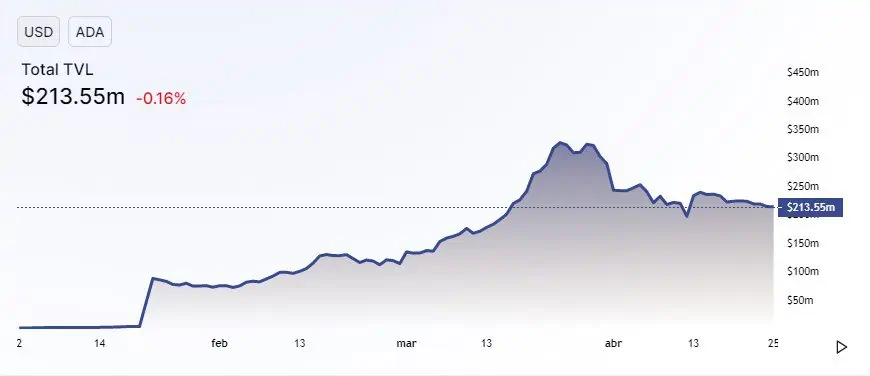
Source: DeFi Llama
Blockchain developers point out that, as the DeFi ecosystem continues to grow, they will focus even more on improving the speed and capacity of the network, to increase its scalability, while ensuring its security and decentralization.
Thanks to its potential, Cardano, which is currently ranked as the ninth most important cryptocurrency in the crypto market by capitalization, is one of the large projects that is competing with Ethereum, to take ground from the king of DeFi.
At press time, its native cryptocurrency, ADA, is trading on the market with a value of $0,89 per unit.
Continue reading: Why has Cardano price risen in the last week?
Buy ADA on Bit2Me