

A $3.900 billion Bitcoin transfer cost just $1,60, a fee that demonstrates the enormous efficiency of blockchain technology compared to traditional banking and cross-border transaction systems.
The immutable record of the blockchain has just witnessed one of those operations that defy the logic of the traditional financial system and expose, with the coldness of numbers, the existing technological gap between fiat money and digital assets.
A user, whose identity initially remained anonymous, executed the sending of 43.033 bitcoins between digital wallets. At the exchange rate at the time, the value of the transfer amounted to the astronomical sum of $3.932.155.272However, the data that has shaken analysts and market observers is not the volume of capital, but the cost of processing it.
The Bitcoin network only charged one commission fee of $1,64 for validating and securing this nearly four billion dollar movement.
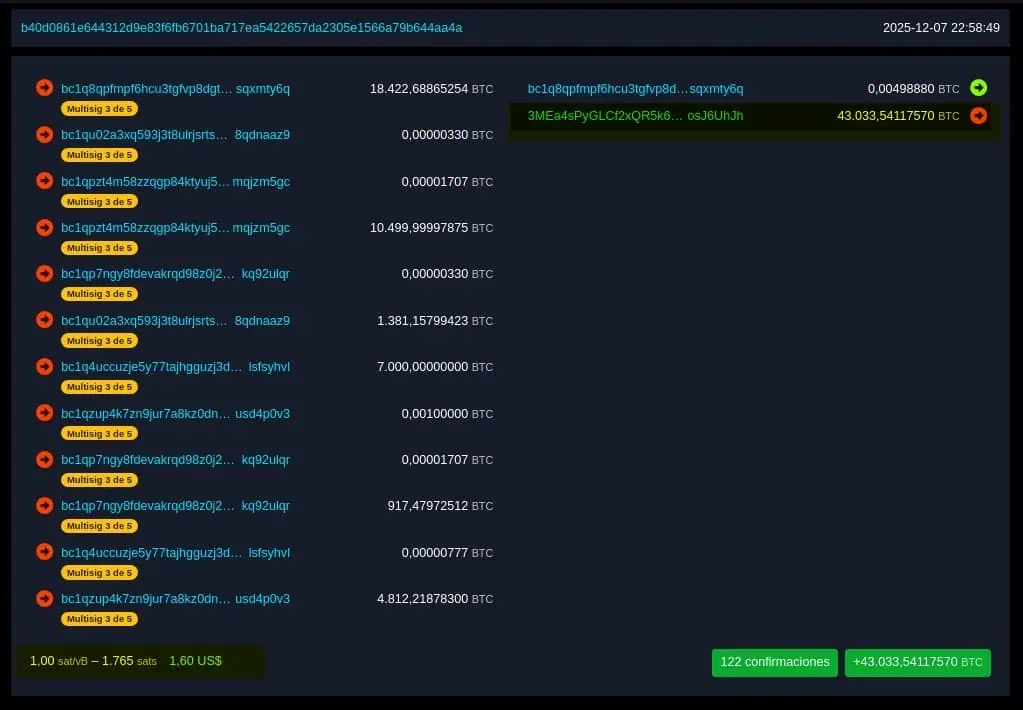
Twenty One moves its bitcoins ahead of their listing on the NYSE
La operación It soon ceased to be a mystery and became a demonstration of corporate strength. Jack Mallers, a recognized figure in the ecosystem, confirmed that The funds belong to the firm Twenty One. This strategic capital move is directly linked to a milestone for the company, which began trading this week on the New York Stock Exchange.
Far from being a simple reallocation of funds by an unknown "whale", it was a high-level institutional operation which leveraged the decentralized infrastructure of the Bitcoin blockchain to achieve a final settlement that, under other standards, would have required complex and costly logistics.
The financial community was quick to react to the disparity in costs and time. If Twenty One had tried to move that same amount of money through the conventional banking system using the SWIFT network, the scenario would have been radically different. Experts they point out that a transfer of that magnitude would have required multiple compliance checks, the intervention of correspondent banks and a wait of up to three business days for confirmation of the funds.
Furthermore, the fees associated with cross-border or interbank transactions of this magnitude would have amounted to hundreds, or even thousands, of dollars, diluting value along the way simply due to the cost of administrative friction.
Move value without waiting: trade Bitcoin hereBitcoin and cryptocurrencies challenge the limits of the financial system
The recent Bitcoin transfer offers a clear window into how cryptocurrency technology can completely transform money management.
Unlike the traditional financial system, where the movement of funds depends on intermediaries and processes that are usually slow and costly, Bitcoin works in a decentralized mannerThus, when Twenty One carried out that operation, it did not need to approve the transaction with a central bank or adhere to banking hours; it was enough to send a cryptographic order that the network processed in a few minutes.
The relevance of Bitcoin's efficiency and blockchain technology has resonated even in spheres close to politics and traditional business. Public figures such as Eric Trump They have used these types of examples to highlight the operational advantages of digital assets.
President Donald Trump's son has emphasized how Bitcoin is superior to the banking system, highlighting that the network allows billions of dollars to be moved, even on a Sunday night, a holiday, or during a banking crisis, without the network suffering interruptions or delays.
For Eric and many other experts, this feature of 24/7 operation Bitcoin's experience contrasts sharply with the experience of the average banking user, who is often tied to business hours and weekdays to conduct financial transactions.
Traditional banks close their doors, their settlement servers go offline over the weekend, and international transfers are left in limbo until the markets open on Monday morning. However, Bitcoin, lacking a central authority and physical offices, never sleepsThe network continues to process blocks every ten minutes, ensuring that liquidity is available whenever the owner of the private keys decide to use it.
Buy and trade BTC today on Bit2MeThe irreversible revolution of financial infrastructure with crypto
What happened with this massive bitcoin transfer is a reminder that the financial infrastructure is undergoing a silent but irreversible transformation.
As more companies go public and hold cryptocurrencies in their treasuries, we will increasingly see capital movements that highlight the limitations of last century's banking systems. This isn't about replacing the dollar tomorrow, but rather about recognizing that settlement technology has advanced to a higher standard of speed and low cost.
Being able to move billions of dollars in minutes, for a price that doesn't exceed that of a cup of coffee in any city in the world, is the practical demonstration of the efficiency that Bitcoin has established as a benchmark for modern financial transfers.
 Certificate
Bitcoin 101 Course
Medium levelIn Bit101Me Academy's Bitcoin 2 Course you can continue your crypto education and learn what Bitcoin is, where it comes from and how to obtain it.