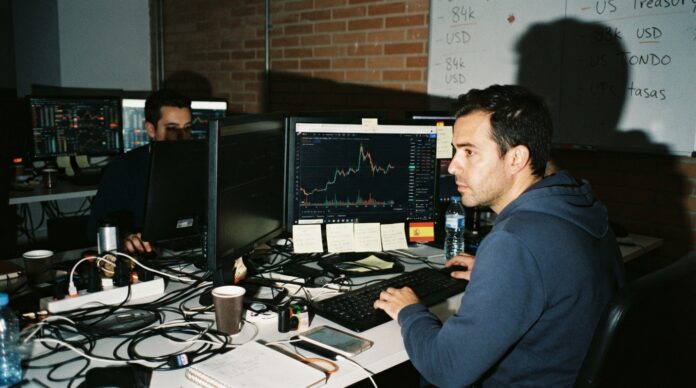
Bitcoin remains stable near $84.000 despite The yield on 10-year US Treasury bonds has reached 5,18%., its highest level since 2007. In parallel, the ONDO token has recovered the $0,50 mark, driven by advances in tokenization.
The impact of Treasury rates on the crypto ecosystem
The global macroeconomic landscape is undergoing a profound transformation. In recent days, the yield on 10-year US Treasury bonds has risen by more than 4 basis points, reaching 5,18%. This level has not been seen since July 2007, reflecting the current pressure on traditional financial markets. Meanwhile, 30-year bonds have also reached significant milestones, climbing to 5,46% and recovering levels not seen since 2004.
This surge in government debt rates typically creates a challenging environment for risk assets. When traditional financial instruments offer higher interest rates, institutional capital tends to shift toward these safe havens. However, the behavior of the crypto market has defied conventional expectations. In this context, the U.S. Treasury Department scheduled the repurchase of up to $6.000 billion in 20- and 30-year bonds, a measure designed to inject liquidity into long-term debt markets and stabilize extreme fluctuations.
Bitcoin demonstrates resilience in the face of macroeconomic pressure
Despite tightening financial conditions, Bitcoin (BTC) has shown remarkable resilience. After a brief dip below $83.000, the leading cryptocurrency managed to stabilize and fight its way back to the $84.500 level. This strength in the face of such an aggressive bond market suggests a maturing institutional perception of Bitcoin, solidifying its role as an alternative store of value in diversified portfolios.
During these highly volatile sessions, transaction logs have shown institutional movements including lots of up to 1M QTY (01M) across various digital assets, underscoring the deep liquidity that the crypto ecosystem maintains even in scenarios of macroeconomic stress. If you are evaluating acquire BitcoinIt is essential to understand how these global dynamics influence price action in the medium and long term.
ONDO and the evolution of real-world assets (RWA)
While Bitcoin absorbs the macroeconomic impact, the altcoin sector has seen notable movements, especially in the real-world asset (RWA) arena. The ONDO token, belonging to Ondo Finance, positioned itself among the best-performing assets, managing to recover the psychological level of $0,50 for the first time since December 2025.
This push coincides with the recent activation of Ondo Intelligent Portfolios. Unlike other RWA products that focus on tokenizing individual stocks or commodities, this new infrastructure allows non-US users to access tokenized shares in diversified portfolios. These tokens, which track strategies from models developed by BlackRock (such as BLKHIon for high income and BLKGRWon for high growth), already operate on the Ethereum and BNB Chain networks, using the CoW Protocol for settlement.
The international context: the Japanese yen and global liquidity
The interconnectedness of global markets means that events in Asia have direct repercussions on Wall Street and, by extension, on the crypto market. Alongside the rise in US interest rates, the Japanese yen (JPY) has experienced renewed downward pressure, weakening to 159 yen per US dollar. This depreciation brings the currency closer to the intervention zone established by the Bank of Japan.
As macroeconomic experts point out, a currency intervention by Japan typically involves selling US securities to buy yen. This action could add further upward pressure to Treasury bond yields, creating a domino effect that crypto market participants should closely monitor. To learn more about how macroeconomics affects your assets, you can explore the educational resources available at [website address]. Bit2Me Academy.
Regulation and transparency: the role of the MiCA Regulation
Amid this global financial complexity, the European Union stands out for offering a framework of certainty through the MiCA Regulation. While other jurisdictions are still debating the classification of RWA tokens and stablecoins, Europe has established clear rules requiring rigorous audits, transparency in reserves, and consumer protection. Operating in a European regulatory environment ensures that users interact with platforms that adhere to the highest compliance standards.
Bit2Me, as your secure exchange and authorized crypto suite, operates under these strict parameters, ensuring that your wallet is built within a transparent and regulated ecosystem. Stay informed through reliable sources such as news.bit2me.com It is the first step towards making informed decisions in a constantly evolving market.
FAQ
Why do Treasury bond rates affect Bitcoin?
Bond rates represent the interest paid on government debt. When these rates rise, bonds become more attractive to institutional capital, often reducing the liquidity available for riskier or alternative assets like Bitcoin, thus putting downward pressure on their prices.
What are real-world assets (RWAs) in the crypto ecosystem?
Real-world assets (RWAs) are digital representations or tokens on a blockchain that are backed by traditional financial assets, such as bonds, stocks, real estate, or commodities. Projects like ONDO facilitate the integration of these traditional markets with decentralized finance (DeFi).
How does the MiCA Regulation affect the purchase of crypto assets?
The MiCA Regulation provides a unified legal framework in the European Union that requires crypto platforms to maintain high levels of transparency, auditing, and user protection. This reduces uncertainty and allows users to build their portfolios in an environment with known and managed risk.
Bitcoin's ability to maintain its value in the face of historical pressures from the bond market underscores the growing maturity of the crypto ecosystem. At the same time, the expansion of tokenization of real-world assets demonstrates that blockchain technology continues to integrate deeply with traditional financial infrastructure.
Understanding these macroeconomic indicators and operating within regulated and transparent frameworks is essential for navigating today's financial landscape. The convergence between traditional finance and digital assets continues to open new avenues for technological diversification.
Investing in cryptoassets is not fully regulated, may not be suitable for retail investors due to high volatility and there is a risk of losing all invested amounts.
Generative artificial intelligence tools were used to create this article.