
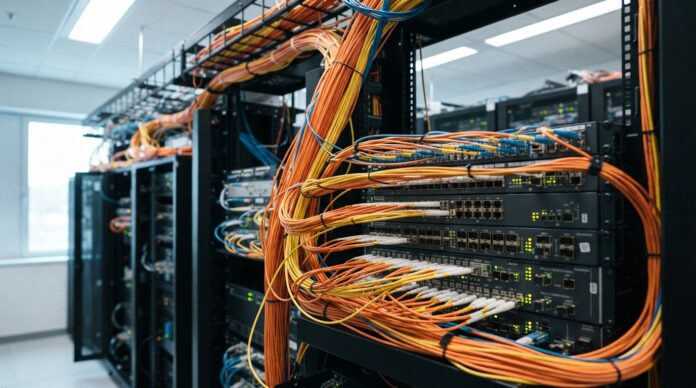
DoubleZero enables a dedicated fiber optic market data feed to HyperLiquid. This advancement allows professional trading firms to access the decentralized exchange's full order book more quickly, marking a key step in the evolution of on-chain infrastructure toward institutional standards.
The integration of fiber optics into the Hyperliquid ecosystem
The crypto ecosystem is constantly transforming, and the underlying infrastructure must evolve to support growing institutional demand. In this context, DoubleZero Enables a dedicated fiber optic market data feed for HyperliquidThis technological solution is specifically designed to provide professional trading firms with uninterrupted, high-speed access to the complete order book of this decentralized exchange. Until now, market participants relied primarily on public application programming interfaces (APIs), which, while functional for retail users, have significant limitations when it comes to high-frequency trading.
The development of this dedicated feed was not an isolated effort. It was carried out in close collaboration with validator operators and key ecosystem partners, including Hyperion DeFi, MAVAN, and Kinetiq. The participation of these players underscores the need for a robust infrastructure capable of handling the massive flow of information generated by a real-time market. For market makers and quantitative trading firms managing positions of 1 million QTY or even institutional blocks reaching 8 million QTY, relying on standard connections is no longer sufficient. Pinpoint accuracy in data reception is vital for maintaining liquidity and executing complex strategies with known and managed risk.
Overcoming the limitations of public APIs
Historically, companies seeking a comprehensive and up-to-date view of the Hyperliquid order book faced two main options: assemble the data themselves using responses from public APIs or bear the technical and operational costs of running their own Hyperliquid nodes. Both alternatives present challenges. DoubleZero has noted that recent changes to Hyperliquid's public APIs have reduced both the frequency and depth of updates available through these channels, making split-second decision-making difficult.
To address this bottleneck, DoubleZero operates a global fiber optic network specifically designed to move data extremely quickly between participants in blockchain networks and other distributed systems. This service delivers a continuous and streamlined flow of market data, essential for proprietary trading firms that require consistent updates. It's worth noting that Hyperliquid is the third platform available through DoubleZero's Edge market data service, joining previous integrations with the Solana network and the Kalshi prediction market.
The convergence between traditional finance and the on-chain environment
Hyperliquid's market data infrastructure is beginning to closely resemble that used by traditional electronic exchanges as professional trading moves to the on-chain environment. Hyunsu Jung, CEO of Hyperion DeFi, points out that established financial institutions like CME, Nasdaq, and other major exchanges distribute their professional market data through dedicated networks. This model allows automated trading firms to receive a constant stream of ordered data at ultra-high speeds.
According to Jung, Hyperliquid data can now be consumed using this same basic model: publish once and distribute simultaneously via dedicated fiber. This convergence doesn't mean the crypto ecosystem is losing its decentralized essence, but rather that on-chain markets are adopting the data infrastructure that professional trading firms already use and require to operate efficiently. If you want to delve deeper into how these market dynamics work, you can explore the educational resources available at [link to resources]. Bit2Me Academy.
Real-world assets and perpetual futures on the blockchain
The new data feed isn't limited to native assets. It includes Hyperliquid's own perpetual futures, as well as markets operated by trade[XYZ]. Trade[XYZ] uses Hyperliquid's underlying infrastructure to offer perpetual contracts linked to commodities and real-world assets, including oil, gold, and silver. The ability to access high-speed market data for these types of assets significantly expands the possibilities for those looking to build a diversified portfolio, combining the agility of the crypto environment with the stability of traditional commodities.
Integrating these assets into decentralized platforms requires a seamless flow of information. Fluctuations in global gold or oil prices must be instantly reflected in the on-chain order book to avoid discrepancies that could affect traders. DoubleZero's fiber optic network provides precisely that critical synchronization, ensuring that market participants have access to the most accurate and up-to-date information possible.
The unavoidable impact of geographical latency on trading
Despite the technological advancements represented by dedicated fiber optics, fundamental differences exist between traditional and decentralized markets that technology alone cannot eliminate. In traditional exchanges, trading firms can place their servers physically close to the infrastructure that processes trades (a practice known as colocation), reducing latency to microseconds. In contrast, Hyperliquid executes trades on-chain, distributed across its network of nodes.
It's important to clarify that DoubleZero's service is limited exclusively to delivering market data; it does not place or execute trades on behalf of firms. Therefore, as Jung points out, convergence does not imply that Hyperliquid will become a clone of CME. Furthermore, the laws of physics still apply: geographical latency does not disappear. A firm located in Tokyo will still have a physical disadvantage in terms of data transmission speed compared to a firm located in New York, regardless of the quality of the fiber optic cable used.
Transparency, security and the framework of the MiCA Regulation
Adopting institutional-grade infrastructure in the crypto ecosystem not only improves trading efficiency but also fosters a more transparent and auditable environment. In Europe, the implementation of the MiCA Regulation establishes a clear framework that demands high standards of protection and transparency for market participants. Having accurate and reliable data flows is a fundamental step for decentralized platforms and service providers to align with regulatory expectations and offer a secure trading environment on your exchange.
The maturity of the crypto market largely depends on its ability to integrate proven technologies into traditional finance without sacrificing the advantages of decentralization. To stay up-to-date on how regulation and technology continue to shape this sector, you can follow the updates at news.bit2me.com.
FAQ
What does fiber optics bring to on-chain trading?
Dedicated fiber optics provide a direct, fast, and stable connection to an exchange's order book. This allows professional firms to receive continuous and orderly market data, overcoming the speed and frequency limitations typically found in standard public APIs.
Does DoubleZero replace the execution of operations in Hyperliquid?
No. DoubleZero's service focuses exclusively on high-speed market data transmission. Trade execution and contract settlement continue to be performed in a decentralized on-chain manner via Hyperliquid's native infrastructure.
What types of assets benefit from this technology?
In addition to traditional cryptocurrencies, this technology benefits perpetual futures and tokenized real-world asset markets. For example, it enables accurate, real-time tracking of contracts linked to commodities such as gold, silver, and oil.
The integration of dedicated fiber optic networks into decentralized platforms marks a turning point in the maturity of the crypto ecosystem. By adopting the data infrastructures that have powered traditional financial markets for decades, the on-chain environment is poised to accommodate unprecedented institutional volume while maintaining its distributed nature.
As technology advances and regulatory frameworks solidify, the line separating traditional finance from decentralized finance is becoming increasingly blurred. The ability to process and distribute information at lightning speed will undoubtedly be one of the cornerstones upon which the future of global trading will be built.
Investing in cryptoassets is not fully regulated, may not be suitable for retail investors due to high volatility and there is a risk of losing all invested amounts.
Generative artificial intelligence tools were used to create this article.