
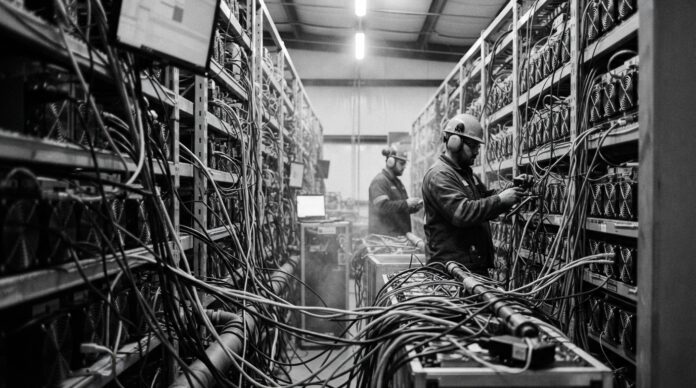
Bitcoin mining company Riot Platforms has completed the repayment of a $200 million credit facility. This strategic financial move has allowed the company to release its locked collateral, which included reserves in Bitcoin, USDC, and cash.
In an environment where efficient capital management is key to expansion, this milestone reinforces the company's position to diversify its operations into new, high-demand technology sectors.
Details of the corporate loan settlement
The digital infrastructure company Riot Platforms has fully repaid a $200 million line of creditThis move has allowed the company to regain full control over the collateral backing the debt. According to official documents filed with the U.S. Securities and Exchange Commission (SEC), the company completed the repayment of the principal and accrued interest without incurring any prepayment penalties.
The released collateral consisted of a diversified basket of financial assets, including Bitcoin, the USDC stablecoin, and cash. These funds were held in safekeeping by a regulated institutional custodian, a common practice in crypto corporate finance to ensure the transparency and security of the pledged funds for the duration of the loan.
The role of collateral and institutional custody
Using cryptocurrencies as collateral to obtain fiat currency liquidity is a common strategy among large companies in the sector. Instead of selling their holdings and losing exposure to potential market appreciation, companies choose to lock up their assets to access immediate working capital.
In this case, the inclusion of USDC alongside Bitcoin demonstrates the growing integration of stablecoins into high-volume institutional trading. In the European context, the use of these types of assets is increasingly regulated thanks to the MiCA Regulation, which establishes a strict regulatory framework for the issuance and management of fiat-backed tokens. This ensures that the assets maintain audited and transparent reserves, protecting the stability of the ecosystem.
For users looking to explore this environment, platforms like Bit2Me offer tools within a regulated framework. If you decide buy Bitcoin Or to explore other options to build your portfolio, it is essential to do so through your secure and authorized exchange, thus ensuring that your operations meet the highest standards of regulatory compliance.
Expansion into data centers and artificial intelligence
Beyond managing its debt, Riot Platforms is undergoing a profound transformation of its business model. The company has begun diversifying its operations, expanding its data center division to serve the growing global demand for artificial intelligence (AI).
In August, the company closed a 20-year deal to supply 191 megawatts of capacity from its Rockdale, Texas, facility to Anthropic, a leading AI development firm. This contract, valued at approximately $9 billion, marks a milestone in the convergence of cryptocurrency mining infrastructure and high-performance computing.
Mining data centers are designed to be highly flexible in their energy consumption. This responsiveness to demand allows facilities to stabilize the local power supply. By integrating artificial intelligence operations, which require constant uptime, companies adapt their energy architecture by leveraging an existing large-scale energy access infrastructure, giving them an undeniable competitive advantage.
Diversification of income and financial results
The results of this diversification strategy are already tangibly reflected in the company's financial statements. During the first quarter of 2026, Riot Platforms reported total revenues of $167,2 million. Of this figure, its newly launched data center division contributed $33,2 million, demonstrating the viability and growth potential of this new cash flow.
For mining companies, relying solely on Bitcoin block rewards can be a model with known and managed risks, especially after halving events that reduce the issuance of new coins by half. By leasing their energy and infrastructure capacity to AI giants, these companies stabilize their revenue and reduce their exposure to the inherent volatility of the crypto market.
Meanwhile, the ecosystem as a whole continues to see significant capital movement. Side projects in the institutional payments sector have recently raised $37 million in funding rounds, and the analysis of large historical reserves, such as the alleged 1 million Bitcoin attributed to the network's earliest wallets, continues to capture the attention of analysts studying long-term value retention.
Market outlook and continuing education
Understanding these complex corporate moves is essential for anyone interested in the evolution of blockchain technology. The strategic decisions of publicly traded companies like Riot Platforms not only affect their internal balance sheets but also set clear trends for how digital energy and infrastructure will be used in the next decade.
If you want to learn more about how these mechanisms work, from large-scale mining to institutional stewardship, you can access free educational resources at Bit2Me AcademyEducation is the best tool to navigate a constantly evolving sector, where financial technology and artificial intelligence are creating new paradigms of value.
FAQ
What does releasing collateral mean in a corporate loan?
Releasing collateral means that, once the principal loan and interest are repaid, the company regains full control over the assets it had pledged as security. In this case, Riot Platforms regained access to its reserves of Bitcoin, USDC, and cash after paying off its $200 million debt.
Why are mining companies partnering with artificial intelligence firms?
Mining companies own large data centers with access to massive power and advanced cooling systems. This infrastructure is exactly what artificial intelligence companies need to train and run their models, creating a natural synergy and a new, stable revenue stream for miners.
How does the MiCA regulation affect the use of stablecoins like USDC?
The MiCA Regulation in the European Union requires stablecoin issuers to maintain transparent, audited, and liquid reserves to back the value of their tokens. This provides a robust legal framework for both retail users and institutions that use these assets in their daily operations.
Riot Platforms' liquidation of this significant credit line underscores the adaptability and financial strength being demonstrated by major players in the digital infrastructure sector. By freeing up collateral and redirecting some of its resources toward the artificial intelligence sector, the company is not only optimizing its balance sheet but also strategically positioning itself in two of the fastest-growing technology industries globally.
As the market matures and regulations like the MiCA Regulation bring clarity in key jurisdictions, the convergence of digital assets, traditional corporate finance, and high-performance computing will continue to shape the digital economy. Observing these institutional moves offers valuable insights into the future of technology and efficient capital management.
Investing in cryptoassets is not fully regulated, may not be suitable for retail investors due to high volatility and there is a risk of losing all invested amounts.
Generative artificial intelligence tools were used to create this article.