
On Wednesday, Venezuelan police authorities reported the arrest of those responsible for the robbery of Bancar, a Bitcoin and other cryptocurrency exchange platform based in the country.
Banking, one of the exchanges de cryptocurrencies, approved by the National Superintendence of Cryptoassets and Related Activities (Sunacrip) of Venezuela to operate legally in the country, was the victim of a robbery in which he lost more than 1,9 million dollars in Bitcoin, after two subjects who had administrator access to the platform decided to transfer 101 BTC to addresses of individuals and legal entities.
According to the report issued by the Scientific, Criminal and Criminal Investigation Corps of Venezuela (CICPC), the two subjects, identified as Jose Manuel Osorio Mendoza, of 33 years, and Kelvin Jonathan Diaz, 34 years old, had direct access to the inner workings of the exchange; they also served as programmers of the platform, so accessing Bancar's servers was not a complicated task.
Authorities indicate that at the time of the theft 1 BTC had a value of $17.000 USD within the exchange, but at the time of this edition Bitcoin is around $19.200 USD per unit.
It may interest you: Venezuela announces Decentralized Stock Exchange for the trading of tokenized assets
When trust hangs by a thread
Hacks to cryptocurrency platforms is a trend that has unfortunately gained greater strength in the last year. This 2020 several exchanges, and especially decentralized finance projects (DeFi), have been victims of hackers, who manage to break the security of these services and protocols and get hold of part of the funds stored there. But, this does not seem to be the case in Venezuela. According to the CICPC report, theWhat happened was a robbery carried out by the only two people who had administrator access to Bancar, who performed maintenance on the platform and implemented improvements to the exchange.
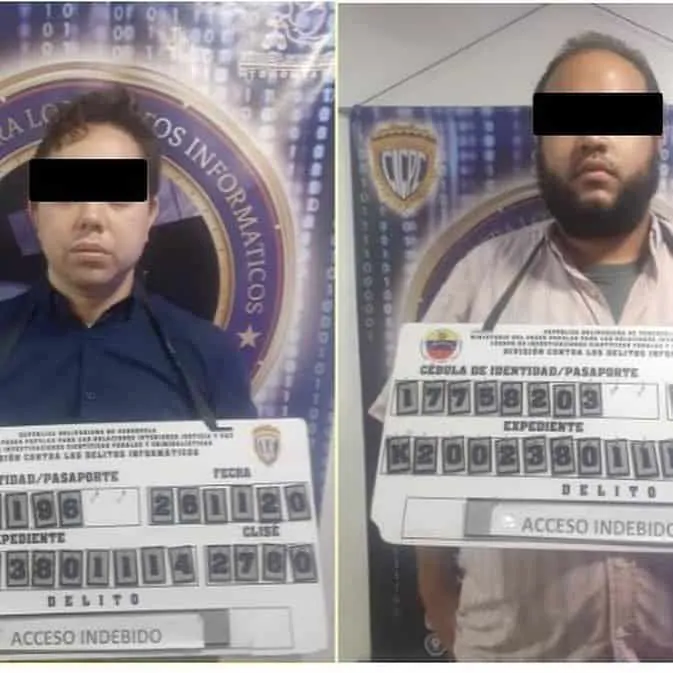
Source: Photos from Cicpc
“This way, they were fully identified, since they were the only ones who could access the system to carry out improvements, maintenance and modifications.”
Before the statements From the CICPC, the Venezuelan community was quick to make itself felt to congratulate the officials for the arrest of the criminals, in addition to lamenting that two professionals in the area of technology and information technology, instead of exploiting their potential to do good, dedicated themselves to the opposite, stealing from the same platform for which they worked.
More details about the case
CICPC officials carried out a police procedure on November 26, although they did not report on this operation until now. According to the report, the CICPC realized that the subjects carried out the robbery from the company Proinsa CA, whose main address is located in Miranda State and where the subjects are presumed to work. The investigations by the officials also determined that José Manuel Osorio Mendoza and Kelvin Jonathan Díaz used connections through CANTV, the state's telecommunications and internet services provider.
The CICPC tracked the remote connections used by the subjects and identified that several BTC transactions were made from there, which were not authorized by the exchange, to Venezuelan individuals and legal entities.
Security protocols
Likewise, in the CICPC statements, the authority argues that the two people responsible for the theft bypassed all of the exchange's security, although Bancar has not yet issued an official report to provide more details about the incident. One media outlet reports that the exchange's security measures are unknown, or whether it uses multi-signature to authorize transactions.
Cryptocurrencies: an alternative for Venezuelans
The economic and social crisis that the Latin American country has been facing for years is not an unknown issue for much of the world. In the difficult context in which millions of Venezuelan citizens live every day, cryptocurrencies have become one of the most viable alternatives to face the country's economic problems, and not see their fiduciary money devalued in a few days, and in many cases, in a few hours.
The theft from Bancar is therefore a huge blow to the citizens who kept their bitcoins within this exchange, although at the moment there is no official confirmation as to whether the 101 BTC, equivalent to around 1,9 million dollars, stolen from the platform belong to the users, the exchange, or partly to both.
In the past, authorities had already carried out several police procedures to stop several malicious actors who were carrying out phishing attacks to scam Venezuelans and steal their cryptocurrencies, including the state digital currency, the Petro.
Cryptocurrency initiatives in Venezuela
The Venezuelan state is also adopting several initiatives related to cryptocurrencies and digital assets, although from its point of view. In October, the creation of a Decentralized Stock Exchange for trading tokenized assets, although it does not seem to be as decentralized as its name indicates, since those who wish to use this exchange must provide their personal or legal data through a KYC and the exchange will be controlled by several power structures that centralize its management.
Also at the beginning of October he announced the creation of a national cryptocurrency mining pool, to which all miners in the country must register and connect to operate legally in Venezuela.
Most recently, the state celebrated the inauguration of a mining pool of Bitcoin and other cryptocurrencies that will support the needs of the country's military. Known as the Bolivarian Army Digital Asset Production Center, this mining pool is equipped with ASIC equipment that will allow it to generate "unlockable" income for the nation's military personnel.
In July, these military forces announced the confiscation of more than 300 units of ASIC equipment from a Venezuelan citizen who was transporting them without the required authorization, according to reports at the time, an action that was strongly criticized by the Venezuelan population.
Continue reading: Cryptocurrency defender in Venezuela proposes that the National Mining Pool coexist with the private sector