

The White House Council of Economic Advisers (CEA) has shared a report analyzing the impact of stablecoins on banking, highlighting benefits for consumers and minimal risks to the traditional credit system.
The report, titled Effects of Stablecoin Yield Prohibition on Bank LendingIt is a comprehensive technical analysis that redefines the government's perspective on stablecoins and their integration into the financial system.
Saying Valid identity documentThe report, shared on the official White House website, departs from previous prohibitive stances to focus on operational efficiency and protecting user welfare. According to the data presented, the coexistence of stable digital assets and traditional banking is viable. It does not represent a systemic threat. for the creditworthiness of financial institutions, as some believed. The report specifically assesses the provisions of the GENIUS Act of 2025 and the implications of allowing these assets to generate returns for their holders.
Overall, the results indicate that severe restrictions on stablecoin interest rates do not offer significant protection to bank loans and, instead, deprive citizens of competitive and innovative savings tools.
Trade stablecoins on Bit2MeStablecoins and traditional banking: what the new CEA analysis reveals
The CEA analysis addresses one of regulators' central concerns: the potential shift of bank deposits towards stablecoins if they offer attractive returns.
Based on a mathematical model designed to measure this scenario, the Council determined that, in an initial simulation, eliminating profitability incentives on these assets would only boost bank lending by $2.100 billion. That move represents just a 0,02% of the total credit of the systemThis variation is considered minimal. However, applying such a restriction would generate a social cost of approximately $800 million, making it clear that its overall economic effect would be negative and that the benefit would not compensate for the loss.
The study also analyzes how these additional credit flows would be distributed. Projections indicate that large banks would concentrate around 76% of the new loans, while smaller institutions, with assets below $10.000 billion, would capture the remaining 24%. For the latter, the increase amounts to about $500 million, which barely represents a growth of 0,026 % in their loan portfolios. These figures are very different from previous estimates, such as those presented by Nigrinis in 2025, which spoke of an impact of several trillion on the banking system.
According to the CEA, current data shows that The expansion of stablecoins does not put liquidity at risk. necessary to sustain loans to households and businesses.
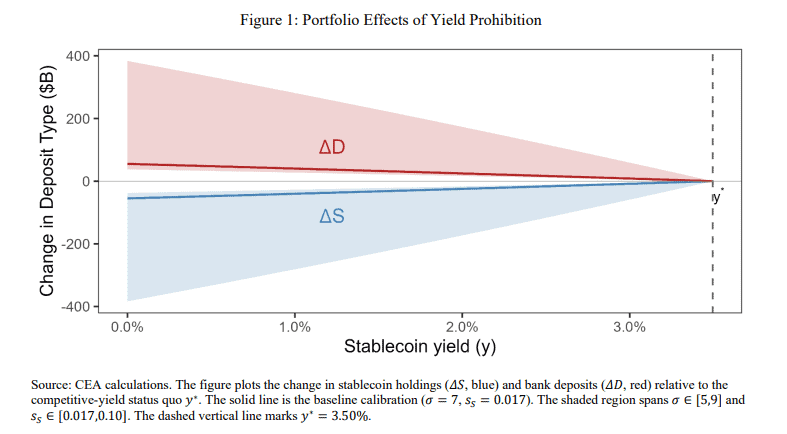
Source: CEA
The report also assessed scenarios of increased pressure on the financial market. One scenario posits that the stablecoin market could grow to six times its current size, reaching $2 trillion compared to the volume of deposits. However, even under these extreme conditions, which include the assumption of frozen reserves and a radical shift in the Federal Reserve's monetary policy, the overall increase in credit would be only a fraction of the total increase. 4,4 %, equivalent to about $531.000 billion more from the end of 2025.
In this landscape of digital expansion, community banks would increase their lending by a 6,7 %This demonstrates that traditional financial infrastructure has sufficient capacity to adapt to digital market innovation without compromising its stability.
Access regulated stablecoins hereTransparency and solvency: Stablecoins can redefine financial trust
The stability of the stablecoin ecosystem in the United States relies on the rigorous application of the GENIUS ActApproved in July 2025, this legislation, according to the Council of Economic Advisers, requires issuers to back each token with assets of equivalent value, guaranteeing a constant one-to-one ratio. Reserves can only consist of safe and highly liquid instruments, such as cash dollars, funds in federally insured financial institutions, short-term Treasury bonds, and reverse repurchase agreements backed by the Treasury itself. With this framework, the law aims to prevent immediate financial collapses and maintain the stability of digital currency values, reinforcing user confidence in a verifiable and transparent system.
Although the GENIUS Act technically prohibits direct issuers from offering interest to holders, the report notes that there is no explicit restriction on third parties or affiliates developing yield-generating products.
The analysis warns that the draft proposal of CLARITY Act It also attempts to close these secondary channels to prevent the flight of bank deposits. However, it also argues that such measures would have minimal effects on bank protection and, on the contrary, would eliminate competitive benefits for the consumer.
By keeping reserves fully backed rather than being partially loaned, the stablecoin model offers transparency that, according to government analysts, promotes market stability without sacrificing utility for the end user.
Based on the results of its research, the CEA emphasizes that Regulation should prioritize the well-being of the citizen above the protection of bank margins. If returns associated with the use of stablecoins are prohibited, families would be forced to keep their money in lower-yielding accounts, thus reducing their ability to manage their resources in more flexible environments.
The administration, supported by the Council's data, proposes moving towards precise rules that drive financial innovation and promote public confidence. The report concludes that Stablecoins represent a natural evolution of digital money and that, under appropriate legal frameworks, they can coexist safely with the banking system without altering its structural balance.
Join Bit2Me and trade stablecoins“In summary, a ban on yields would do very little to protect bank loans, while foregoing the benefits for consumers of competitive yields on stablecoin holdings.”the White House emphasized.
Digital equilibrium: stablecoins, regulation and the financial future
The report also considers the evolution of decentralized financial services (DeFi) within this new regulatory environment. The clarity provided by the CEA's analysis allows digital infrastructure projects to operate with greater legal certainty.
By validating that the growth of stablecoins does not stifle traditional credit, the report may be opening a door to the legitimate development of platforms that offer returns within the digital realm.
Although market experts point out that it is unclear to what extent this report may influence the current debate The CLARITY Act, which has suffered several delays due to the banking sector's dispute with the crypto market over the prohibition of stablecoin yields, may allow the current administration to completely abandon punitive measures and move toward a more predictable regulatory system capable of maintaining the dollar's influence in the global financial environment through technological instruments. This vision recognizes that competition to offer better returns is an essential part of the market and that limiting it would only generate unnecessary economic and social costs.
The Council's conclusions reinforce this position, indicating that the positive effects of restricting yield-based transactions are practically nil. Instead, they point out that true consumer protection lies not in shielding banks from technological competition, but in ensuring a balanced environment where innovation and stability can coexist.
The integration of stablecoins, under the parameters of the GENIUS Act, positions these assets as safe and transparent components that complement the existing financial offering, promoting an environment where innovation and stability are not mutually exclusive objectives.
Trade stablecoins now on Bit2Me