Buying and saving in cryptocurrencies has become very popular in Venezuela, a country affected by the biggest economic crisis in Latin America.
Although cryptocurrencies are characterized by being highly volatile, these digital assets have gained great popularity among Venezuelan citizens, who continue to face a deep economic crisis, described as the largest seen in all of Latin America.
Since 2007, the bolivar, the country's fiduciary currency, has lost 14 zeros due to various monetary reconversions accompanied by the highest hyperinflation in the world, a situation that has driven its citizens and residents to take refuge in cryptocurrencies as an alternative to preserve their savings.
In the Latin country, which has become a multi-currency economy where the US dollar, the euro and the Colombian peso are popular, cryptocurrencies such as Bitcoin (BTC) and Tether (USDT) have also found a place and are widely used today for carrying out commercial transactions, sending and receiving remittances and as alternatives for investment.
Venezuela, is it an emerging market in the cryptocurrency industry?
In recent years, the terms “Bitcoin","cryptocurrencies, "And"blockchain"have become part of the Venezuelan lexicon.
P2P investing and payments with cryptoassets are now more common among those looking for a solution to withstand the devaluation of the bolivar, and Bitcoin mining has come to life among those looking for an additional source of income to supplement their salaries and sustain their livelihoods.
At the end of 2021, blockchain analysis firm Chainalysis ranked Venezuela as the seventh country in the world and the first in Latin America with the highest level of adoption of Bitcoin and cryptocurrencies in terms of on-chain transaction volume.
Chainalysis data further highlighted that the country’s citizens and residents are putting a greater portion of their wealth into peer-to-peer (P2P) cryptocurrency transactions, ranking it sixth in the region in terms of peer-to-peer trading volume.
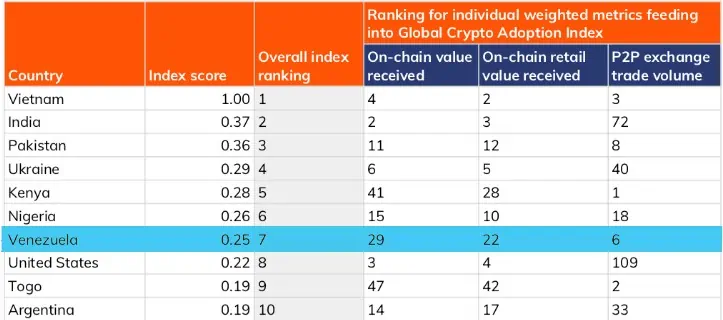
According to the firm, Venezuela received a total volume of $2021 billion in cryptocurrency transactions in 28.300. Compared to 2020 data, the adoption of Bitcoin and cryptocurrencies in the country grew by 52% by the end of last year.
Cryptocurrency payments and taxes
In Venezuela, there are already thousands of businesses that accept payments with cryptocurrencies and stablecoins. Among the most important ones we can mention: Plaza supermarkets, Excelsior Range, McDonald's, Farmatodo, location, KFC, La Milanesa, sellers on MercadoLibre and even real estate Archipelago Real Estate. Another big player is the chain of stores Frame sawing machine which also accepts cryptocurrency payments in the country.
Likewise, the mobility services company Yummy Rides rolled out cryptocurrency payments in mid-April, announcing that its users could now use stablecoins like Tether (USDT) to pay for its services.
The list of companies and businesses that accept crypto assets in Venezuela is estimated at several thousand. In Caracas alone, the Venezuelan capital, The Journal noted in 2021 that some 3.000 businesses were already accepting cryptocurrency payments in the city.
However, since the beginning of this year, cryptocurrency transactions are subject to taxes of up to 20% as established in the country's Large Financial Transactions Tax Law. At the end of January, the National Assembly approved a reform to adjust its tax regulations to the different currencies used in the nation, including the dollar and crypto assets.
The Axie Infinity, AXS and SLP frenzy
On the other hand, the popular blockchain game Axie Infinity is among those responsible for promoting the use and adoption of cryptocurrencies in the Latin country.
Axie Infinity, developed by the Vietnamese company Sky Mavis, gives its players the chance to earn money while having fun, which is why it has been one of the most popular games in Venezuela in the last year.
Such has been the adoption of Axie Infinity in the country, that Venezuela ranked as the second country in the world with the highest number of active players after the Philippines. Likewise, token holders Axie Infinity Shards (AXS) y Smooth Love Potion (SLP) They have also begun using their gaming tokens to finance the acquisition of real estate, as they do with Bitcoin or Tether.
Francisco López, president of the Venezuelan Chamber of Real Estate, said in an interview that the government must adapt its legislation to emerging technologies, to include cryptocurrency transactions legally and meet the needs of citizens in the face of the rise of these digital assets.
Scams Proliferate Alongside Crypto Adoption
On the other hand, the popularity that cryptoassets have gained in Venezuela has also given rise to scams. Cybercriminals have found new ways in the crypto industry to scam and steal from their victims using different means, such as fraud and phishing.
Last month, the Computer Crimes Division of the Scientific, Criminal and Criminal Investigation Corps of Venezuela (CICPC) warned users about a New cryptocurrency scam called a “mirror page.” As explained through Instagram, cybercriminals send a text message via WhatsApp where the victim is informed about a fake user account and password that contains an exorbitant amount of the stablecoin USDT.
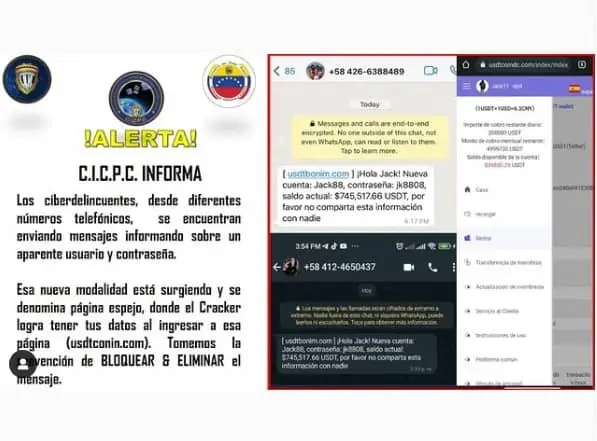
By clicking on the link, users download malware that allows the hacker to capture and obtain their victims' private data, such as login details for exchange accounts, bank accounts, and more.
Faced with the threat, Venezuelan authorities stressed that users should not click on the malicious link, to mitigate the possibility of falling for the scam. They also recommended deleting the message and blocking its sender.
Situation of Bitcoin miners in the country
Bitcoin mining is one of the activities in the crypto industry that is most interesting for Venezuelans, due to the profitability it offers in the country despite the deteriorated national electrical system.
Crypto miners are enjoying the low cost of Venezuelan electricity. In addition, companies that mine bitcoins on an industrial scale are almost guaranteed energy service. So it is a 100% profitable activity. Alejandro Quiles, from the crypto mining company Grupo Tools CA, stated in an interview that the cost of energy in the country is what favors bitcoin mining.
However, due to its popularity, the government has created two regulatory bodies, the Superintendency of Cryptoassets (Sunacrip) and the Treasury of Cryptoassets of Venezuela, in charge of supervising and regulating this activity and everything related to cryptocurrencies.
Therefore, to mine in the country, companies must register with the authorities in order to obtain the respective license and authorization to carry out this crypto activity.
Continue reading: El Salvador reveals the designs of what the “Bitcoin City” will be like