
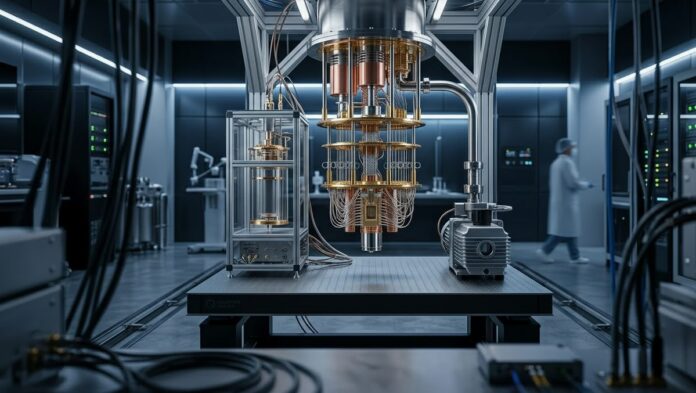
The development of quantum computing represents one of the most significant technical challenges to the integrity of distributed ledgers and public-key cryptography.
In the mid-1990s, mathematician Peter Shor formulated an algorithm capable of solving complex numerical problems that form the basis of modern computer security. Although no computer exists today with the necessary scale to run this algorithm, a recent report published by Google Quantum AIand the subsequent analysis of Grayscale InvestmentsThey emphasize the need to strengthen blockchain networks in the medium term.
The timelines for reaching between 1200 and 1450 logical qubits, which is the minimum capacity estimated by Google researchers to compromise current systems, may not be linear. In this context, XRP Ledger It is identified as one of the blockchain infrastructures with native features that facilitate the transition to post-quantum security standards.
The XRP Ledger infrastructure in the face of Shor's algorithm
According to Grayscale analysts, the security of conventional blockchain networks depends on the difficulty of reversing mathematical functions that link public and private keys. Shor's algorithm theoretically allows this process to be performed more quickly, which would compromise digital signatures. Based on Google's white paper, the analysts emphasize that the uncertainty surrounding when quantum supremacy will be achieved is forcing development communities to integrate post-quantum cryptography (PQC) before the technology becomes operational at scale.
Company highlights Networks like XRP Ledger (XRPL), developed by Ripple, have begun this process through active experimentation on their test network, AlphaNet. In this environment, hybrid cryptography tools and signature algorithms that comply with National Institute of Standards and Technology (NIST) standards, such as the ML-DSA scheme, are validated.
99% of the XRP supply is secure
On the other hand, analysts emphasize that XRPL's resilience is not limited solely to the adoption of new algorithms, but rather resides in its account management architecture. One of the most relevant natural defenses of this network is that 99,97% of the total asset supply is held in accounts whose public keys have not been exposed on the blockchain.
The public key becomes visible the moment the first outgoing transaction is made from a given address. However, without this information being exposed, a quantum computer lacks the necessary objective to attempt to derive the private key.
However, according to the technical data provided, Only 0,03% of the current XRP supply is exposed to this theoretical riskAnd most of them correspond to accounts with small balances, which, according to experts, limits the attack vector for malicious entities.

A network ready for the era of quantum computing
In addition to protection against lack of exposure, the network incorporates a technical feature called key rotation o Key RotationThis tool allows users to modify the signing keys of their accounts without needing to change the wallet's public address or move the funds to a new location.
From an engineering and governance perspective, this feature dramatically simplifies mass migration to quantum-resistant standards. Instead of facing complex consensus processes to update static balances or legacy wallets, network participants can dynamically update their security credentials, maintaining operational continuity and the integrity of stored assets.
Based on this data, analysts conclude that the combination of technical governance focused on constant updates and native protections against public key exposure puts this blockchain infrastructure in a position of technical advantage to face the evolution of quantum computing.
XRPL, one of the leaders in the era of tokenized assets
According to Google Quantum analysts, the technical robustness of the XRP Ledger against the quantum threat takes on critical relevance when analyzing its growing role in the digitization of the traditional economy. Currently, this network offers comprehensive support for the Real World Asset (RWA) tokenizationnatively integrating compliance controls, advanced issuer permissions, and detailed asset metadata systems.
These capabilities have encouraged global financial institutions to use Ripple's infrastructure to manage regulated debt and securities instruments. Currently, the XRPL ecosystem hosts approximately two-thirds of all TBILL tokenswhich are backed 1:1 by short-term US Treasury bills, consolidating its position as one of the leading platforms for this type of financial asset.