
In the last 24 hours, the price of Ether has fallen by more than 15%, what is the reason for this free fall?
Ethereum has had one of the worst starts to a week in recent memory with losses of 15,24%. At the time of writing, The price of Ether is at $1.214,69. This represents the lowest price in the last two years, specifically, the price of Ether is at the levels of March 2020, during the COVID-19 pandemic.
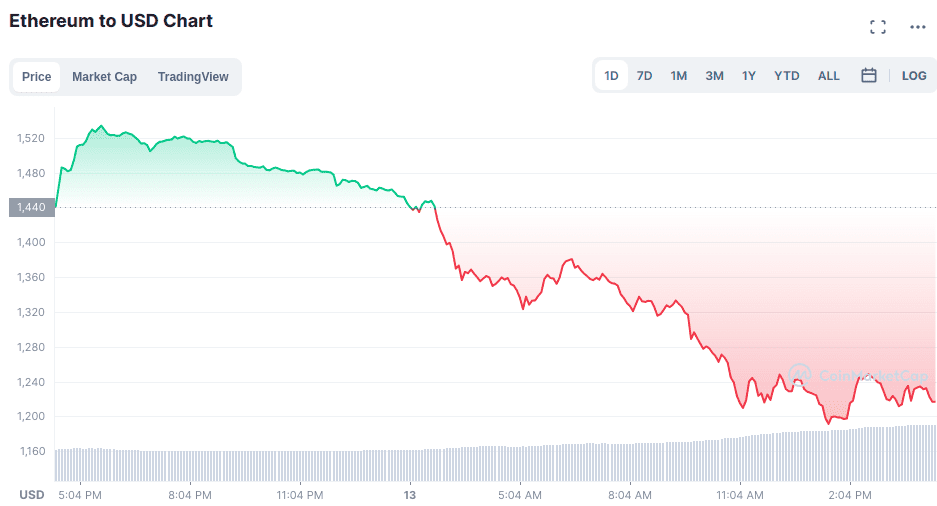
Moreover, all indicators point to the fact that the price of Ether could continue to fall. In this regard, the Relative Strength Index (RSI) is already in the oversold zone, which is usually a sign of a trend change.
On the other hand, stETH, which is offered as a reward for staking Ether on Lido, has lost its peg with ETH, This has led to the liquidation of positions that had borrowed Ether using stETH. The uncoupling began last Thursday, when Alameda Capital, one of the largest stETH holders, sold all of its holdings: $1.500 billion worth of tokens.
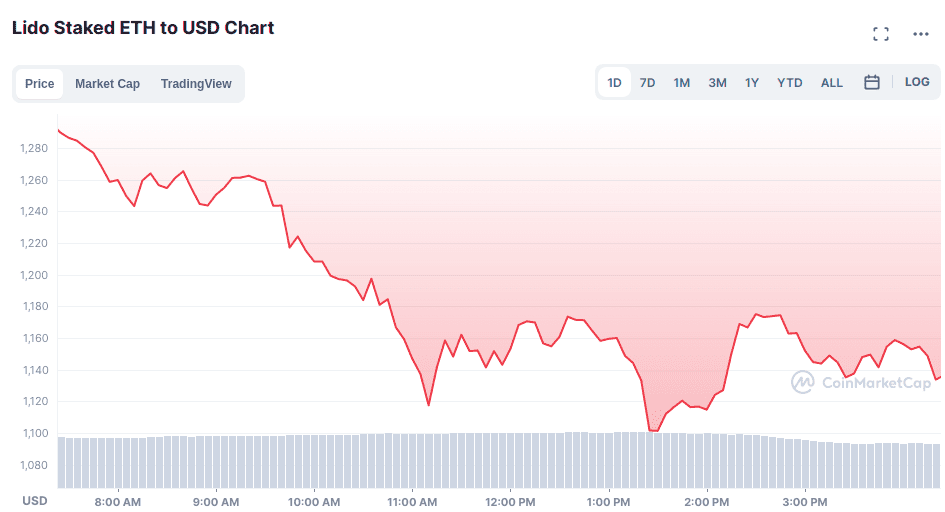
These liquidations, coupled with market selling pressure, are causing panic in the markets, especially in Ethereum, which has suffered serious losses over the weekend and on Monday.
What is stETH?
stETH is a token that is awarded to users who stake ETH on the Ethereum 2.0 Beacon Chain via Lido. That is, When a user stakes ETH on Lido, they receive stETH at a 1:1 ratio.
stETH combines the value of your initial staking deposit plus staking rewards that accumulate daily.
The amount of stETH tokens is updated when the oracle reports are updated based on the amount of ETH deposited for staking and the amount of rewards and penalties accumulated throughout an entire day.
Lido's stETH can be used in the same way as Ether, so users can Get rewards on Ethereum staking 2, as well as rewards through integrated platforms such as Curve and Sushiswap.
The oracle of Lido
The oracle is a fundamental piece of the entire staking process in Ethereum, since determines the amount of ETH in staking and the variations resulting from the activityIn short, the oracle is responsible for managing and recording the activity of the validators.
The oracle(s) are assigned by the DAO and the information collected is updated daily, at which point stETH is issued or burned.
What is Lido?
To become an Ethereum 2.0 validator, you must stake a minimum of 32 ETH on the Beacon Chain. Additionally, the deposit will have to be locked until certain development phases of Ethereum 2.0 are completed, specifically until phases 1.5 and 2.0.
The 32 ETH limit and long lock-up period prevent a large portion of users from participating in ETH 2.0 staking.
This is where Lido comes in. It is a protocol that offers staking services through non-custodial liquid poolsIn this way, users can stake any amount of ETH tokens in the Lido pool to participate in staking on the Beacon Chain.
In exchange for staking on Lido, the protocol offers users stETH, a 1:1 derivative with Ethereum, which represents the amount of Ethereum staked, as well as the rewards accumulated by users.
How does Lido work?
When a user makes a deposit into Lido, their tokens are sent to the protocol's staking smart contracts, which They pool the funds and distribute them between one of the nine operators selected by the DAO. Distributions are made by grouping deposits into batches of 32 ETH.
Pooling funds minimizes the risk of mismanagement, and at the same time, since traders do not have access to the funds (they only have a public key with which to stake on behalf of the user), they cannot withdraw them either.
On the other hand, Lido's smart contracts are also responsible for managing the burning and issuance of stETH; tokens are minted in the escrow and burned when traded.
What are the risks of Lido?
Lido is a protocol that manages staking through smart contracts, which means there are risks of vulnerabilities and code errors. As usual, Lido contracts are open source, so they are audited and backed by a reward program for those who identify bugs.
On the other hand, Lido is built on a technology, that of Beacon Chain and Ethereum 2.0, which is still experimental, so There is no guarantee that ETH 2.0 will develop smoothlyIn this sense, a possible error in ETH 2.0 would cause a fluctuation in stETH.
At the same time, as the value of stETH is based on the staking rewards associated with Ethereum, If ETH 2.0 does not reach the required adoption levels, the value of stETH could also fluctuate.
These two risks could explain Why the price of stETH has become slightly decoupled from that of Ethereum, as the Ethereum 2.0 development team has recently announced a new delay in the merging process of the Beacon Chain and the Ethereum network. Coupled with a red market, this could have sparked fear among investors who have started liquidating their positions en masse.
Furthermore, users risk a stETH exchange price lower than its inherent value due to withdrawal restrictions on Lido, making arbitrage and risk-free trading impossible.
[hubspot type=cta portal=20298209 id=38fb28e1-1dc1-40e3-9098-5704ca7fcb07]