

A study by the Cornell Bitcoin Club reveals that Nigeria and Venezuela lead the world in Bitcoin knowledge. Discover why these nations see the cryptocurrency as a tool for freedom, not just speculation.
If a survey were conducted on where the greatest experts in decentralized financial technology are located, popular intuition would likely point to the skyscrapers of New York, the innovation hubs of London, or the tech districts of Tokyo. There is a deeply ingrained belief that the adoption of cutting-edge technologies is the exclusive privilege of nations with the highest Gross Domestic Product (GDP). However, the reality of the digital economy is completely rewriting this map.
A revealing study conducted by the Cornell Bitcoin Club, a prestigious student organization dedicated to blockchain education and outreach, has dismantled prejudices about crypto adoption. The data is conclusive: global leadership in Bitcoin knowledge and trust lies not with the G7 powers, but with [unclear - possibly " ... Nigeria y Venezuela.
Bitcoin is freedom: Buy BTC on Bit2MeNigeria and Venezuela trust Bitcoin more than other economies
This discovery marks a turning point in the cryptocurrency narrative. It's no longer just about assets for diversifying investment portfolios on Wall Street; it's about real utility. In these countries, Bitcoin has gone from being a digital curiosity to a pragmatic tool.
Research suggests that a true understanding of Bitcoin—understood as a peer-to-peer electronic cash system— flourishes most vigorously where the need for financial alternatives is most palpable.
Thus, while the developed world debates regulations, in Nigeria and Venezuela, citizens are already experiencing the future of money, integrating it into their daily lives as a mechanism of empowerment and autonomy.
Source: Cornell Bitcoin Club and partners
Deep knowledge: When technology responds to human need
What distinguishes users from Nigeria and Venezuela, according to the full test The Cornell Bitcoin Club members haven't just "heard of" Bitcoin; their technical and practical knowledge is profound. In many Western markets, interaction with cryptocurrencies is limited to buying and selling through custodial applications, where a third party holds the funds. In contrast, these leading countries have a deeply rooted culture of self-custody and management of private keys.
This phenomenon demonstrates one of Bitcoin's most valuable qualities: its ability to act as a universal financial educator. Blockchain technology, being open and permissionless, allows anyone with internet access to "be their own bank." In dynamic and challenging economic contexts, such as those experienced in Nigeria and Venezuela, the population has found in Bitcoin's intrinsic characteristics—its censorship resistance, its global portability and predictable emission— a store of value and an efficient transactional channel.
Learning in these regions is organic and community-based. It is not formal education delivered in classrooms, but rather a transmission of knowledge driven by practical application.
People learn about the immutability of the blockchain or the importance of the recovery phrases (seed phrases) Because these tools grant them immediate financial sovereignty that traditional systems, for various logistical or structural reasons, cannot always offer. Therefore, Bitcoin is perceived here not as an instrument of speculation or gambling, but as a liberating technology that allows individuals to protect the fruits of their labor and conduct transactions without borders or bureaucratic intermediaries.
Access Bitcoin now: create your free accountTrust in code: The gap between emerging and traditional economies
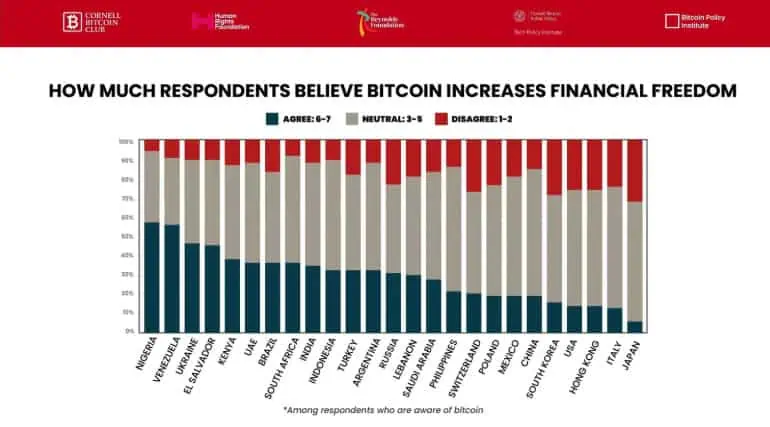
The most striking metric in the Cornell Bitcoin Club study is undoubtedly the trust index. The research explored the extent to which citizens believe Bitcoin fosters financial freedom. The results place Nigeria leads the way with 57,10%, followed very closely by Venezuela with 56,02%These figures far exceed the optimism observed in fully developed economies.
To put it in perspective, the study highlights a fascinating contrast with nations such as Japan, United States y SwitzerlandIn these countries, where traditional banking systems are robust and fiat currency enjoys historical stability, skepticism toward Bitcoin is notably higher. In Japan, for example, 32,95% of respondents reject the idea that Bitcoin brings financial freedom. This suggests an interesting inverse correlation: the more comfortable people are with the legacy financial system, the lower their perceived need for a decentralized alternative.
Conversely, in emerging economies, “trust in the mathematical code” of Bitcoin is higher than trust in conventional financial institutions. Besides Nigeria and Venezuela, countries such as Ukraine with 46,52%They also show high levels of conviction regarding the digital currency. This confidence translates into a real intention to use it. The report notes that, in places like the United Arab Emirates, Nigeria, India e IndonesiaA vast majority of those surveyed have concrete plans to use Bitcoin in the next 12 months.
“Belief in Bitcoin’s liberating potential is strongest where local currencies are volatile or banking access is limited, and weakest in countries with stable economies and established financial systems.”says the report.
The data published in the report validates the thesis that Bitcoin is, above all, a neutral and apolitical network. It doesn't judge the user's origin or the situation in their country; it simply works. Block after block, every 10 minutes, the network offers the same security and certainty to a merchant in Lagos or Caracas as to an investor in New York. However, it is the former who, driven by their local realities, have most enthusiastically embraced the advantages of a currency that doesn't depend on central authorities.
The new paradigm of digital wealth
The findings of the Cornell Bitcoin Club are changing how the success of cryptocurrencies is measured around the world. Nigeria and Venezuela stand out not for having the best digital infrastructure, but because their people feel a real need to use BitcoinThis shows that the main reason Bitcoin is growing is because people are looking for more freedom to manage their money.
The leading cryptocurrency has proven to be a resilient and positive technology, capable of offering financial inclusion where traditional models encounter barriers. By leading the global ranking of cryptocurrency awareness, Venezuelans and Nigerians are not only adopting a new form of money, but also validating its value. the original purpose of Bitcoin: return financial power to the individual.
As the world moves toward inevitable digitalization, the lessons from these nations will be vital. They teach us that true wealth in the digital age lies not only in the accumulation of capital, but also in knowledge, autonomy, and the ability to operate freely within an interconnected global economy. Bitcoin, in this sense, has fulfilled its promise of being a beacon of innovation and freedom for those who truly appreciate it.
Trade BTC with confidence: protect your portfolio