

A recent CoinShares report revealed a major shift in the cryptocurrency fund market: inflows exceeded $220 million and XRP overtook Bitcoin.
The market for investment products in digital assets recorded a net inflow of 224 million during the last week, marking a recovery in the sentiment of large funds after periods of volatility.
According to the latest weekly report from analytics firm CoinShares, this positive flow raises the total assets under management (AuM) globally to 131.800 millionThis figure reflects the sector's maturity compared to the close of the previous year. However, the upward momentum moderated towards the end of the week, according to the report, due to better-than-expected macroeconomic data in the United States and a more restrictive stance from investors.
James Butterfill, head of research at CoinShares, points out that this behavior reflects a clear dichotomy between assets. While XRP has managed to capture massive institutional interestOther leading assets like Ethereum face selling pressure stemming from evolving legislation. According to the researcher, this scenario underscores how the source of capital and the legal framework of each protocol are beginning to segment the performance of cryptocurrency exchange-traded funds (ETPs).
XRP records its biggest weekly inflow since late 2025
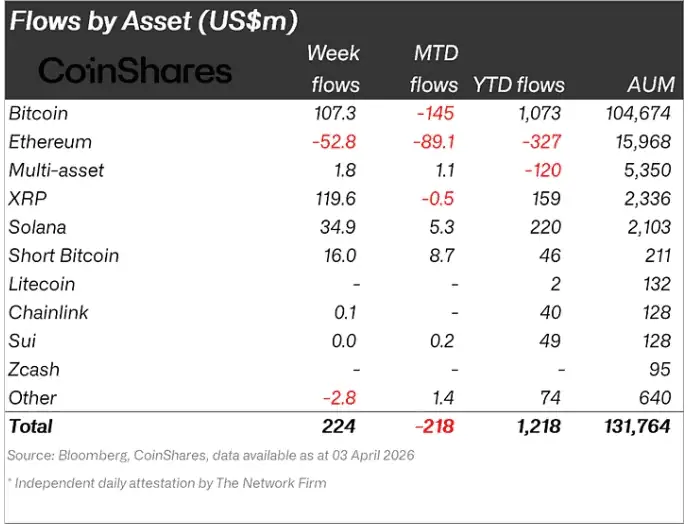
XRP It positioned itself as the most outstanding asset of the analyzed period by attracting 119,6 million in net inflows. This figure represents the largest weekly flow for the token since mid-December 2025 and raises its cumulative inflows so far in 2026 to 159 millionThis volume is equivalent to approximately 7% of their assets under management, suggesting a portfolio rotation towards protocols that, in the eyes of institutions, present greater resilience or clarity in their current use cases.
For its part, the report reveals that Bitcoin It showed mixed behavior. Although it registered entries by 107,3 million, investment products positioned short (short-bitcoinThey also saw an increase in 16 million, the highest level since November 2025. This polarization indicates that, while there is a solid base of institutional buyers, a significant part of the market is hedging against the possibility of further corrections.
Solana It also maintained a positive trend with contributions from 34,9 millionconsolidating a steady growth that already represents 10% of its managed capital.
Source: coinshares
Europe: Hub for institutional crypto investment
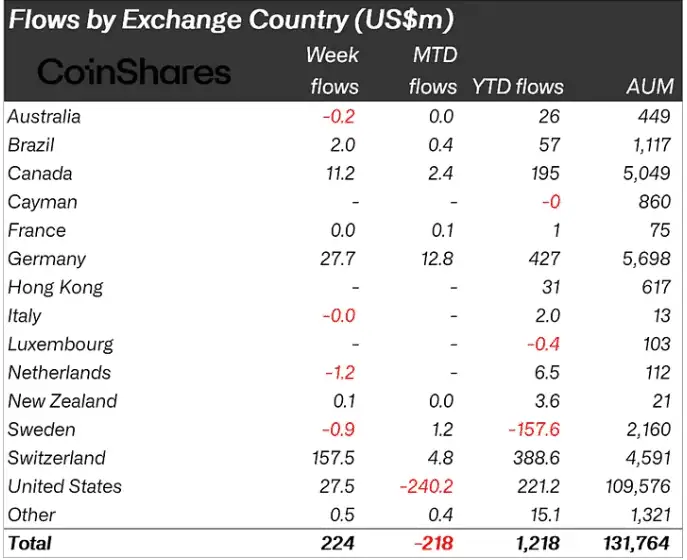
The geography of investment, also analyzed in the report in question, shows that Switzerland It consolidated itself as the most dynamic center of institutional flow during the last few days, accumulating 157 million in inflows. With that figure, the Alpine country far surpasses traditional markets such as Germany and the United States, which each registered close to 28 million dollars.
Based on this data, a shift in trend is evident, with large investors prioritizing jurisdictions with clear rules and stable regulatory environments. In this scenario, the evolution of Marco MiCA (Markets in Crypto-Assets) In the European Union, it is gaining prominence, as its establishment has offered signs of greater maturity and regulatory coherence for the crypto ecosystem at a regional level.
Source: coinshares
The crypto market adjusts to global tensions
The consolidation of capital flows into cryptocurrency ETPs demonstrates the continued maturation of the digital finance ecosystem, highlighting a stage where real-world utility and regulatory compliance are beginning to shape the decisions of large funds. While macroeconomic data still reflects uncertainty, the inflows accumulated by these investment funds indicate that the sector's growth remains strong.
Analysts are now closely watching economic policy decisions in the United States, as their impact could redefine competition between traditional assets and digital instruments. In this context, improved market transparency and the expansion of issuers of listed products, with the recent entry of Morgan Stanley to the market, they are emerging as key factors for attracting new institutional capital.